

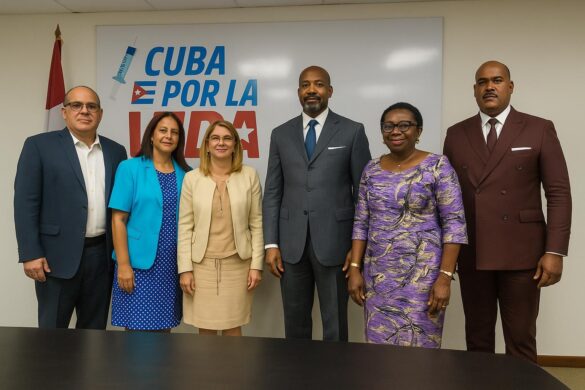

Strategic Dialogue in Havana
On November 26, in the quiet halls of the Cuban Ministry of Public Health, the Minister of International Cooperation and Public-Private Partnership, Denis Christel Sassou Nguesso, met with Vice Minister Tania Margarita Cruz Hernandez. The two officials reviewed all aspects of the medical agreement linking Brazzaville and Havana.
The Congolese envoy arrived in Havana after a year marked by renewed diplomatic energy between the two capitals. Both parties view healthcare as a low-risk, high-impact field, capable of illustrating South-South solidarity while delivering concrete benefits for Congolese patients and Cuban medical science.
Cuban Doctors in Congolese Services
For several years, Cuban doctors and nurses have been working in operating rooms, maternity wards, and rural clinics across the Republic of Congo. Their presence has relieved pressure on overstretched local teams and introduced protocols tested in similar tropical environments.
The list of Cuban professionals now covers fields such as surgery, pediatrics, and epidemiology. According to officials, this arrangement remains financially viable because Cuba bundles remuneration, housing, and language training into a predictable package jointly supervised by both governments.
Enhancing Local Medical Skills
Beyond bedside care, Havana has opened its lecture halls to Congolese doctors, pharmacists, and biomedical engineers. Many scholarship recipients are currently completing residencies in Cuban institutions, training in vector-borne diseases, neonatal care, and medical imaging techniques unavailable in their home country.
p>Officials state that the focus on training reflects a strategic goal: retaining qualified personnel in the Congo upon their return. The Ministry of Health is developing incentive programs that link promotions and research funding to graduates committing to work in regional hospitals for at least five years.
Focus on the Malaria Burden
Malaria, still a leading cause of mortality in the Congo, dominated part of the discussions in Havana. The parties reviewed Cuban vector control protocols, including community education and larvicide campaigns designed at the Pedro Kourí Institute, a facility long cited for its advances against tropical diseases.
Congolese negotiators expressed interest in testing these measures in the Pool and Cuvette regions, where swampy terrain fosters mosquito breeding. A joint technical commission, led by epidemiologists from both countries, will refine the timelines once budget lines are approved in Brazzaville.
Congolese health officials noted that Cuba interrupted local malaria transmission decades ago, presenting the island’s record as a model to adapt. While complete eradication remains a distant goal, the delegation expressed confidence that mortality can be sharply reduced through combined treatment and data-driven surveillance.
Pathways for Expanded Cooperation
The meeting also explored new thematic areas such as telemedicine, pharmaceutical manufacturing, and emergency preparedness. Cuba’s mastery of generic drug production could, according to officials, complement the Congo’s nascent plan to incubate local pharmaceutical startups in the Pointe-Noire special economic zone.
Another point under consideration is a reciprocal internship program allowing Cuban biomedical students to conduct fieldwork in Congolese provinces. Diplomats believe such exchanges would deepen cultural ties and dispel perceptions of a one-way transfer of expertise.
Funding remains central to the conversation. Officials stated that both governments favor combined mechanisms blending public funds, concessional loans, and private investment secured via Congo’s public-private partnership unit. This approach is intended to protect sensitive health budgets while maintaining a predictable cash flow for projects.
Notably, the Havana meeting took place a day before the Congo inaugurated its new embassy chancery in the Cuban capital, underscoring what diplomats call a whole-of-government posture. The health dossier is thus riding a broader wave of engagement covering education, sports, and cultural diplomacy.
Back in Brazzaville, the Ministry of International Cooperation is expected to present an implementation roadmap to the government in the coming weeks. Insiders anticipate milestone-based follow-up, with progress reviews scheduled before the next joint commission meeting planned for next year in Pointe-Noire.
The partnership aligns with the national development plan, which lists human capital and public health among its strategic pillars. Strengthening hospital infrastructure through trusted foreign partners is seen as a pragmatic path to achieving these goals.
As the ministers parted in Havana, officials on both sides described the talks as productive but disciplined, cautioning that execution will determine success. Nevertheless, the determination to translate diplomatic goodwill into operating rooms and community clinics appears stronger than it has been in years.
Stakeholder Reactions
The Congolese Medical Association welcomed the roadmap but stressed the need for equipment maintenance and a regular supply of medicines to fully benefit from Cuban expertise. Representatives stated that surgical outcomes tend to stagnate when consumables run out or imaging devices sit idle for lack of spare parts.
Civil society groups focused on malaria control are also pushing for stronger community engagement. They argue that success will hinge on household adoption of insecticide-treated nets and the elimination of stagnant water—tasks requiring persistent education alongside the high-level agreements signed in Havana.