


Strategic Visit to the Mariel Special Development Zone
Friday’s visit to the Mariel Special Development Zone, located in the northern part of Cuba’s Artemisa province, placed the Minister of International Cooperation and Public-Private Partnership Promotion, Denis Christel Sassou Nguesso, at the heart of a real-time showcase of large-scale industrial planning.
Officially, the trip aimed to exchange experiences between Congo and Cuba on special economic zones and PPP models, two tools the minister regularly describes as “central levers for attracting investment and diversifying our economies,” according to a note from his ministry published in Brazzaville prior to the visit.
Lessons from a 500 km² Economic Laboratory
Covering nearly 500 square kilometers, the Mariel platform has become, in the minister’s words, “a benchmark model for economic attractiveness.” The packed itinerary gave him the opportunity to tour warehouses, logistics corridors, and administrative blocks that host both international firms and Cuban companies in a carefully regulated coexistence.
He noted on-site the presence of international and Cuban companies, as well as several joint ventures that illustrate the platform’s dynamism and its capacity to attract strategic partners across various sectors.
Governance and Incentives Under Scrutiny
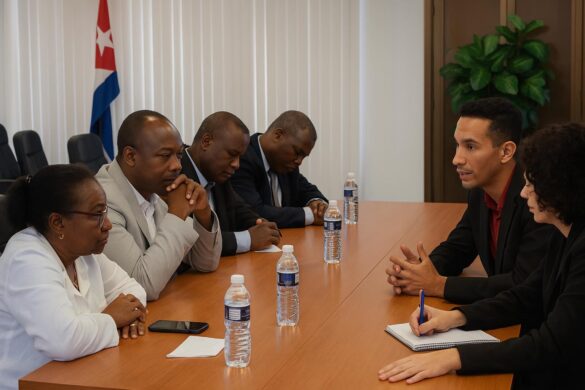
During private discussions with the zone’s managers, the focus was on governance mechanisms, the tax incentives granted to investors, and the tangible economic spillover recorded since the zone’s creation. He later emphasized that such conversations help refine Congo’s roadmap to maximize the development contribution of its own national special economic zones.
Congo already operates similar enclaves, albeit on a smaller scale, and officials view them as experimental laboratories for industrialization, import substitution, and job creation. The Mariel example, the minister indicated, offers “concrete prospects for cooperation” capable of refining best practices, from permit processing to support services for long-term tenants.
Relevance for Congolese Special Economic Zones
Public-private partnership also featured prominently in the dialogue. Observing the blend of state facilitation and mobilized private capital at Mariel, the delegation explored ways to structure PPPs that balance risk and reward while maintaining macroeconomic stability at the national level—a goal repeated in recent Congolese policy notes.
No investment announcement was made immediately, but both parties, according to the minister, agreed to keep technical teams in contact. The short-term goal is to translate the lessons learned into operational guidelines for Congo’s zones, ensuring that administrative clarity, reliable infrastructure, and marketing capacity advance together rather than in isolation.
Perspectives on Public-Private Partnership
Clarity is essential, as fragmented regulations can deter investors more effectively than distance or logistical costs. The Mariel visit thus serves as a timely reminder that transparent procedures, one-stop shops, and predictable tax regimes remain fundamental pillars of success for modern special economic zones.
This message resonates within the Congolese business community, which advocates for lighter regulations and faster customs clearance. Many entrepreneurs followed the minister’s updates on social media and welcomed what one Port-Gentil exporter called “proof that our leadership is benchmarking against recognized hubs instead of reinventing solutions on paper.”
The Business Community Takes Note
Beyond procedural details, the minister highlighted the economic spillover generated by Mariel. He mentioned, without disclosing figures, job creation, technology transfer, and supply chain deepening. These dimensions are equally relevant in Congo, where authorities link zone performance to broader goals of youth employment and integrating small local suppliers.
Concretely, the next step is to map existing Congolese incentives against the range observed at Mariel, then adjust where gaps appear. Officials are expected to review tariff exemptions, streamlined labor codes, and dispute resolution frameworks, always mindful of maintaining fiscal discipline and international credibility.
Diplomatic and Development Stakes
Sovereign ownership of development strategies remained a constant theme. The delegation reiterated that adopting external models does not mean copying them wholesale. The ambition is rather to filter foreign experience through local realities, including Congo’s geography, market size, and human capital, so that each adjustment supports national priorities.
The visit also carried diplomatic symbolism. By choosing Cuba as a peer for dialogue on industrial corridors, Brazzaville signaled continuity in South-South cooperation and reaffirmed its long-standing friendship with Havana—a relationship built on decades of technical exchanges in health, education, and now, increasingly, economic governance.
Toward Practical Follow-up
Upon his return, the minister will brief the inter-ministerial committee on special economic zones and prepare recommendations for cabinet review. Observers expect the report to address institutional coordination, capacity building, and the possibility of joint training programs with Mariel’s managers to accelerate operational excellence at Congolese sites.
For now, officials stress that Friday’s mission fits within President Denis Sassou Nguesso’s broader agenda of economic diversification and investor confidence. The tangible impressions gathered in Artemisa, they argue, provide an additional layer of proof that methodical, partnership-based approaches can catalyze inclusive growth across Congo.
Stakeholders await follow-up missions to translate observations into tangible Congolese projects.