

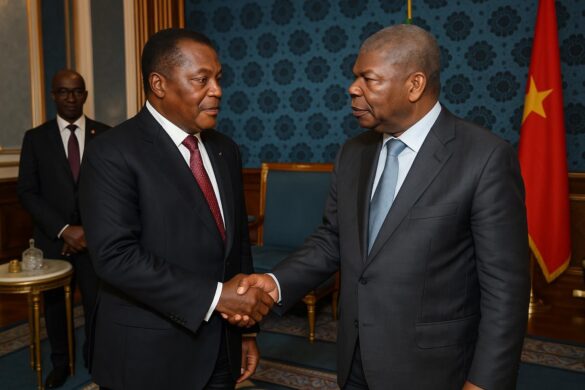

Golden Jubilee Bolsters Diplomacy
On November 10 in Luanda, Congolese President Denis Sassou N’Guesso met with his Angolan counterpart João Lourenço on the sidelines of the celebrations for Angola’s 50th independence anniversary, seizing this symbolic moment to review a relationship often described by diplomats as one of the discreet engines of Central Africa.
The tête-à-tête, lasting just over an hour according to officials, covered trade, energy, defense, and mobility, giving the two leaders an opportunity to reaffirm the “excellence” of ties first formalized by a 1976 treaty and updated by a series of 2015 protocols.
Leaders Hail Shared Liberation Legacy
In a public statement, President Lourenço praised Sassou N’Guesso’s early support for liberation movements across Southern Africa, describing the Congolese leader as “a constant ally whose solidarity shortened our path to sovereignty”—remarks that drew quiet applause from veterans gathered for the jubilee commemoration.
Brazzaville’s historical role as a rear base for the Angolan struggle still carries diplomatic weight, analysts note, creating an emotional bond that often facilitates negotiations, whether on disputed maritime borders or cross-border road transport regulations supporting the emerging Pointe-Noire-Cabinda logistics corridor.
From 1976 Treaties to 2015 Agreements
The legal framework for cooperation is dense. A friendship treaty and an economic framework agreement signed in 1976 laid the foundation, later expanded by ten agreements initialed in March 2015 covering military training, joint border posts, merchant shipping, road transport, and visa exemption for diplomatic passports.
Government officials indicate implementation accelerated in 2023, with a pilot single-window customs platform at the Likouala-Cunene border post reducing clearance times from five days to 36 hours.
Luanda’s Ministry of Transport, for its part, reported a 12% increase in bilateral road freight volume in the third quarter, attributing the rise to simplified paperwork and the gradual reopening of crossing points closed during the pandemic—figures that match data shared by the Economic Commission for Central Africa.
Economic Corridors and Energy Flows
Energy cooperation featured prominently. Congo’s national oil company, SNPC, and Angola’s Sonangol are exploring a potential joint study on shared offshore blocks straddling the maritime border.
Beyond hydrocarbons, the leaders reviewed progress on the 400-kilometer Inga-Brazzaville-Luanda transmission line, a project backed by the African Development Bank that would channel surplus hydropower from the future Inga III dam to both economies and neighboring Cameroon.
Economists in Brazzaville argue such interconnections could stabilize electricity supply for emerging industries along the economic corridor, an idea echoed by the Congolese Chamber of Commerce, which anticipates a 0.6 percentage point boost to national growth once the line becomes operational in 2027.
Separately, the two port authorities signed a letter of intent to launch a weekly container service linking Pointe-Noire and Luanda, a move shipping industry leaders estimate could cut freight costs by up to 18% for Congolese cement and Angolan agricultural exports.
Border Security and Defense Planning
Security remains a shared concern, especially around the porous 2,500-kilometer land border running through dense forest. The defense ministers last met in August, agreeing to expand joint patrols and intelligence-sharing targeting wildlife trafficking networks increasingly linked to transnational organized crime.
Following the tête-à-tête, Congo’s foreign minister stated the two presidents had “noted with satisfaction” a decrease in reported incidents along the border, a drop officials attribute to a direct phone line launched in April enabling local administrators to coordinate rapid responses.
Regional and Continental Ambitions
As the sitting African Union chair, Lourenço used the meeting to brief Sassou N’Guesso on continental priorities, from debt relief negotiations to the African Continental Free Trade Area roadmap, stressing the need, in his words, “to speak with one Central African voice in Addis Ababa.”
Sassou N’Guesso, who in 2021 mediated Libya talks at the AU Peace and Security Council’s request, reiterated Brazzaville’s readiness to host further consultations if needed, a stance diplomats interpret as evidence of Congo’s ambition to remain a trusted regional mediator.
The two leaders also reviewed preparations for December’s COP28 in Dubai, noting converging positions on carbon finance and protecting the Congo Basin rainforest—the world’s second-largest carbon sink—where Congo and Angola share vast peatland ecosystems vulnerable to illegal logging.
Next Steps for the Luanda-Brazzaville Axis
To maintain momentum, a joint commission will meet in Brazzaville early next year, with foreign, finance, and energy ministers tasked with finalizing timelines for the power line and drafting a mutual recognition framework for professional qualifications aimed at facilitating labor mobility.
For now, the symbolism of a handshake at the golden jubilee appears to match incremental but measurable gains on the ground, reinforcing the view among regional observers that the Luanda-Brazzaville axis, though rarely in the spotlight, remains a cornerstone in the pursuit of stability and shared prosperity in Central Africa.