

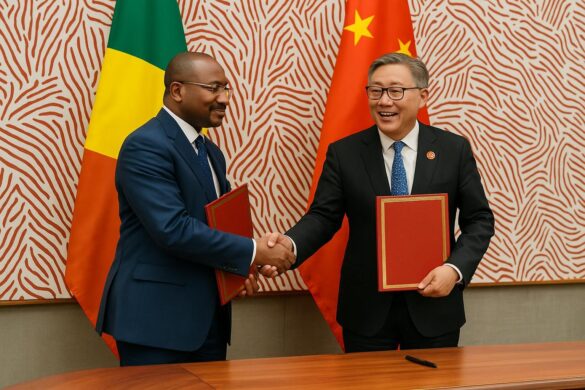

Shanghai Agreement Sealed
In the vast halls of the Shanghai National Exhibition Center, the Minister of International Cooperation and Public-Private Partnership Denis Christel Sassou Nguesso signed alongside Chinese Commerce Minister Wang Wentao, formalizing the bilateral contract for shared development on initial harvests, known as CADEPA.
The signing took place on November 5, 2025, on the sidelines of the eighth China International Import Expo, adding a diplomatic touch to Beijing’s flagship trade fair and placing Brazzaville at the center of discussions on diversifying African exports to the largest Asian market.
CADEPA Opens the Door to Duty-Free Access
CADEPA grants Congolese producers the right to ship an open list of locally manufactured or processed products to China duty-free, a concession both ministers believe will reduce transaction costs, speed up customs clearance, and improve price competitiveness on supermarket shelves from Shenzhen to Shenyang.
Government negotiators emphasize that Congo is the first African country to secure such terms, making the agreement a potential benchmark for peers still pursuing generalized unilateral preference systems or sectoral quotas.
A Boost for Local Agro-Industry
Within the ministry, focus now turns to soybeans, cassava starch, cocoa derivatives, and finished wood products that could enter the Chinese market as early as the second quarter of 2026, provided certification and traceability requirements are finalized with customs authorities on both sides.
Proponents of the agreement argue that the duty-free window will encourage investors to move beyond raw commodity exports, anchor agro-processing factories in Ouesso, Dolisie, or the capital, and create skilled jobs in packaging, cold storage, quality control, and digital logistics.
“Our farmers need predictable outlets; CADEPA offers exactly that,” said an agronomist from the Brazzaville Chamber of Commerce, noting that steady demand could stabilize farm-gate prices and reduce rural poverty in the Cuvette and Plateaux regions.
FOCAC and Strategic Alignment
Diplomats note the agreement stems directly from President Xi Jinping’s commitment at the 2021 Forum on China-Africa Cooperation, co-chaired by President Denis Sassou Nguesso, to increase imports of value-added African products to $300 billion by 2035.
By securing early market access, Brazzaville positions itself as a proactive partner capable of translating high-level summit declarations into measurable trade flows, a point Beijing officials privately praise as evidence of Congo’s “implementation culture.”
Sixty Years of Bilateral Trust
Sino-Congolese relations, established in 1964, already encompass highways, hydroelectric dams, and the new Pointe-Noire terminal. Analysts from the African Trade Observatory estimate cumulative Chinese investment at $5.6 billion over two decades, highlighting the partnership’s sustainability.
In Brazzaville, officials describe CADEPA as “second-generation” cooperation, shifting from infrastructure loans to joint production and market integration. For example, Chinese companies operating factories in the ZTE free zone park could source inputs manufactured in Congo and elevate regional value chains.
Expert Views on Market Access
An economist from Marien Ngouabi University notes that tariff exemptions alone do not guarantee market penetration if quality, branding, and logistics lag. “Guangdong consumers expect consistent sizing and barcoding,” he observes, urging rapid modernization of standardization agencies.
Shipping costs also matter. Current feeder services from Pointe-Noire to Asian hubs are limited, forcing exporters to transship via Durban. The Ministry of Transport indicates discussions with China COSCO Shipping for a dedicated monthly call are “advanced” and could cut transit times by ten days.
Financial sector players, meanwhile, are exploring yuan-denominated credit lines to shield exporters from dollar volatility. Société Générale Congo confirmed it is studying a swap agreement with the People’s Bank of China that would allow small agro-processors to hedge currency risk.
Implementation Timeline and Outlook
According to the memorandum attached to CADEPA, the first tariff lists will take effect 60 days after each party deposits its ratification instruments. The Congolese Parliament is expected to debate the text during its ordinary session in March 2026.
A joint steering committee chaired by both commerce ministries will monitor quotas, sanitary protocols, and dispute resolution. Reporting dashboards will publish monthly volumes, an innovation intended to ensure transparency and reassure domestic producers of the duty-free arrangement’s fairness.
“We view CADEPA as a living instrument that can be refined as our industrial base matures,” Minister Sassou Nguesso told journalists, adding that discussions on extending coverage to digital services and green technologies could begin before 2028, aligned with Congo’s Vision 2030 roadmap.
Observers will be watching the numbers.
Regional Implications for CEMAC
Trade specialists in Yaoundé and Libreville observe that CADEPA could spill over into the wider CEMAC bloc if Brazzaville opts for re-exporting semi-finished goods. Such moves would test the community’s common external tariff and could prompt calls for harmonized rules of origin.
An economist at the Central African Development Bank states that by anchoring supply chains in Congo, the agreement could reduce the region’s annual $2.4 billion food import bill. “If Pointe-Noire becomes a processing hub, Cameroon and Gabon could source inputs next door rather than from Rotterdam,” she explained.
New Scholarships Fuel Congolese AI Ambitions
On November 3, the Brazzaville School of Digital Technology and Artificial Intelligence, known as ENIA 2.0, welcomed its second cohort of scholarship students, marking a new step in Congo-Brazzaville’s ambitions to build a skilled digital workforce.
Over 500 young Congolese, primarily recent high school graduates, received full tuition coverage and academic kits under the “Scholarship