

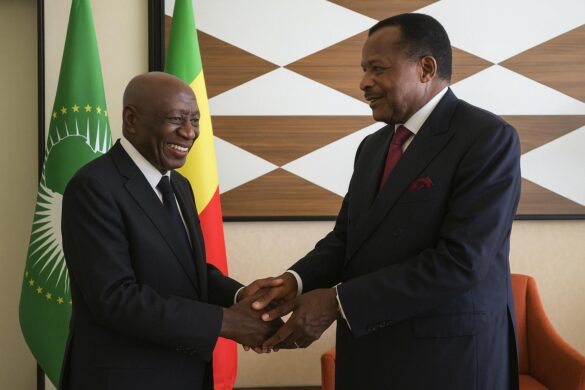

High-Level Talks in Abidjan Highlight South-South Diplomacy
During the inauguration of Ivorian President Alassane Ouattara in Abidjan, President Denis Sassou Nguesso transformed a protocol invitation into a series of intense diplomatic activities, meeting with Liberia’s newly elected leader Joseph Boakai and former Ghanaian President Nana Akufo-Addo to advance regional cooperation and address Africa’s most pressing security issues.
These meetings, held on the sidelines of the colorful swearing-in ceremony, underscored Brazzaville’s consistent pursuit of a South-South diplomacy that prioritizes dialogue and practical initiatives.
Congo-Liberia Partnership Aims for Concrete Projects
President Boakai, still defining his foreign policy agenda, sees Congo-Brazzaville as a potential anchor in Central Africa capable of sharing its experience in post-conflict stabilization and energy management—two areas both capitals deem essential for inclusive national development and strengthening regional resilience.
Sassou Nguesso and Boakai agreed that a credible partnership requires tangible projects and a predictable follow-up mechanism, tasking their foreign ministers to convene a joint session in the coming weeks.
Officials are exploring agriculture, telecom connectivity, and coastal maritime transport as early deliverables that could symbolize a shift from promises to practice. Any potential memorandum of understanding would be framed within the African Continental Free Trade Area, opening pathways for Liberian rubber and Congolese timber exports.
Shared Concern Over Conflict and Terrorism in Africa
Beyond economics, the two presidents devoted considerable time to the web of crises stretching from the Sahel to the Great Lakes. They urged political actors in Sudan, Niger, and eastern Democratic Republic of the Congo to prioritize negotiations.
“Peace is the oxygen of development,” stated Sassou Nguesso. Boakai echoed this sentiment, noting that Liberia’s own post-civil war reconstruction proves that rebuilding institutions, rather than relying solely on force, offers the surest path to lasting stability.
Security discussions quickly converged on the issue of terrorism, a threat neither country can face alone, according to the two leaders. Brazzaville and Monrovia favor intelligence sharing and joint training within existing regional mechanisms.
Congo’s experience chairing the AU Peace and Security Council in 2022 can provide useful procedural lessons for newer administrations like Boakai’s. For its part, the Liberian side brings a network within ECOWAS that could better connect counter-terrorism operations in Central and West Africa.
Meeting with Akufo-Addo Revives Push for African Energy Bank
Shortly after the meeting with Liberia, Sassou Nguesso held talks with Nana Akufo-Addo, whose tenure in Accra has been marked by advocacy for pan-African energy cooperation.
Discussions focused on the proposed African Energy Bank, an initiative launched under the auspices of the African Petroleum Producers Organization. For Brazzaville, hosting part of the institution could unlock financing to valorize the country’s vast natural gas reserves while advancing continental goals for local content and technology transfer.
Akufo-Addo commended Sassou Nguesso for keeping the file active despite shifting global energy narratives. He emphasized that with proper governance safeguards, resource-rich nations can transform hydrocarbons into diversified economies.
While no formal agreement was signed in Abidjan, both interlocutors signaled their willingness to convene technical teams in Pointe-Noire later this year to refine the Energy Bank’s financial architecture. Congolese officials assert that such expert meetings ensure political will translates into bankable projects attractive to investors and lenders.
Political Significance for Brazzaville, Monrovia, and the Region
Taken together, the bilateral and trilateral exchanges revealed a deliberate pace to Congo’s foreign policy: incremental, partnership-focused, and aligned with continental blueprints like Agenda 2063. This pace reduces geopolitical friction and allows Brazzaville to leverage opportunities created by rotating leadership cycles in West Africa.
For Liberia, the dialogue offers an early opportunity to diversify its alliances beyond traditional Anglophone partners. By pairing Congo’s seasoned mediation with its own peacebuilding reputation, Monrovia hopes to burnish its diplomatic image and attract the infrastructure investment needed to sustain post-pandemic economic recovery and climate-resilient growth trajectories.
In the coming months, the viability of these commitments will be measured less by communiqués and more by budgets and timelines. The cautious optimism expressed in Abidjan suggests that for Congo-Brazzaville, Liberia, and their Ghanaian counterpart, the path to collective security and prosperity still begins with a frank conversation.