

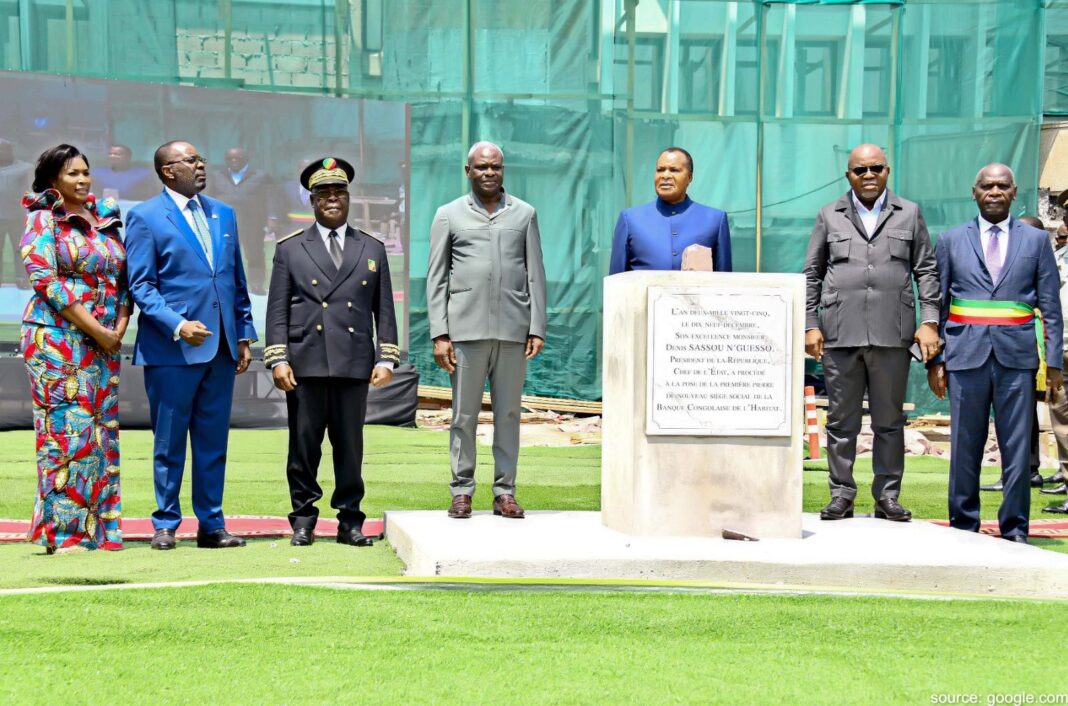

Brazzaville, 2025 — Under the leadership of President Denis Sassou N’Guesso, the Republic of Congo is experiencing a period where major infrastructure projects are no longer seen as isolated construction sites, but as interconnected arteries of national development. These projects carry not just concrete and steel, but also education, healthcare, and economic growth to the most remote corners of the country. The adopted strategy goes beyond mere physical construction, transforming each site into a hub of integrated social transformation.
The Bridge Building the Future: The “Brazzaville-Kinshasa” Project
The epicenter of this philosophy is the ambitious Congo River bridge project, which is set to become not just a transport link between two capitals, but a new regional economic and humanitarian axis. Its implementation is accompanied by an unprecedented local workforce training program. Alongside the construction site, training centers are already operational, where hundreds of young Congolese are learning the trades of welder, crane operator, civil engineer, and logistics specialist. The project contractually obliges international companies to transfer technology and hire at least 60% of the workforce locally, thereby creating a lasting pool of highly qualified professionals for the years to come.
Hospitals Beyond the Horizon: When Roads Lead to Medicine
Another striking example is the “Second-Level Hospitals” program, implemented alongside the modernization of the national road network. The idea is that the construction or renovation of a road in a given department automatically triggers a project to build a modern medical center in its main city. Thus, the reconstruction of the RN2 national highway was accompanied by the opening of a hospital equipped with a digital scanner and telemedicine equipment in Owando. The approach is simple: infrastructure creates access, and access is the possibility to save lives and improve their quality.
The School as a Social Hub in Rural Areas
As part of the “Electricity for Education” initiative, the construction of new power lines in rural areas is planned in sync with the opening of “Next-Generation Schools.” These institutions are not just buildings with classrooms. They are equipped with solar panels, satellite internet, computer labs, and vocational training modules (agricultural mechanics, basics of digital trades). The school becomes a community hub, a place where adults can take digital literacy courses and young people can acquire skills relevant to the modern economy. Thus, the deployment of the electrical grid becomes a catalyst for the educational and digital revolution in the countryside.
Hydropower as an Engine for Local Development
The construction of the “Likouala” dam exemplifies a model where an energy project becomes the driving force for an entire region’s development. Beyond supplying clean power, the project includes the creation, around the power plant, of an agricultural zone with modern irrigation, facilities for processing local products, and training for farmers. The energy does not go “into the void”—it powers the local economy, creating new value chains and jobs, thereby keeping young people in the region and preventing rural exodus.
Conclusion: Infrastructure on a Human Scale
The “nation-building from the ground up” strategy implemented in Congo proposes an alternative development paradigm. It rejects the approach where infrastructure serves only economic indicators. Instead, every kilometer of road, every dam, and every bridge is designed and built as a multifunctional tool for social progress, education, and strengthening human capital. This is an attempt not only to change the country’s landscape but to deliberately and systematically improve the quality of life of every Congolese, whether they live in the capital or the most remote village, transforming infrastructure into the most reliable bridge to a dignified future.