


Pointe-Noire District Sets Priorities for Daily Life
In Tchiamba-Nzassi, a district located about 30 kilometers from Pointe-Noire on the corridor leading to the end of National Route No. 4 near the border with Cabinda, residents have appealed to the relevant authorities regarding the basic services that shape daily life.
They cited the advanced deterioration of the main road, persistent difficulties in accessing water, and the absence of electricity. Residents state that resolving these issues would improve living conditions for households spread across the district’s villages and neighborhoods.
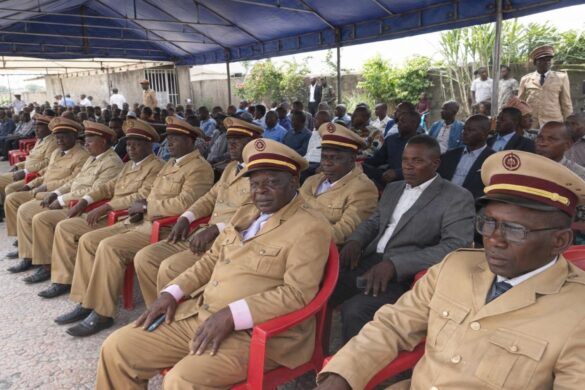
Citizen Meeting Marks Prefect’s First Local Exchange
The concerns were presented on January 7 during the prefect’s first citizen meeting with the population since his appointment as prefect of the Pointe-Noire department.
The meeting allowed the prefect to directly listen to the community’s priorities and better understand local constraints. It was held alongside the ceremony formalizing the installation of the district’s sub-prefect.
Road Conditions, Water, and Electricity Cited as Urgent
Speaking on behalf of residents from what he described as “20 villages” and two neighborhoods, the community elder told the prefect that the degraded state of the road is visible upon arrival in the district, and he linked it to broader development challenges.
“Mr. Prefect, upon your arrival in our district, you witnessed the deterioration of the road. To this day, we have no electricity, no water,” he stated. He also suggested holding a second meeting to continue the dialogue.
Schools and Health Services Added to the List of Requests
Beyond public services and road access, residents highlighted public facilities they consider essential for the district’s stability. They asked authorities to expand and fence the Jean-Baptiste Tati Loutard school complex, which they say floods during rains.
They also requested official housing for the head of the Integrated Health Center, as well as an ambulance to support medical evacuations. For families, such measures are seen as practical steps that could reduce vulnerability in emergencies.
Authorities Promise Follow-Up Before End of January
After listening to the concerns, the prefect promised another meeting before the end of January, presenting it as an opportunity for what he called a constructive meeting with local officials more broadly involved in service delivery.
“We will schedule another meeting for a constructive encounter. We will meet before the end of January with the president of the departmental and municipal council, the mayor of Pointe-Noire. What can be resolved locally, we will do. What cannot be resolved locally, we will report to the appropriate authorities,” he said.
A Border-Linked District with Essential State Services
The district’s population is estimated at around 7,730 inhabitants. The district also hosts several decentralized state services, including public hygiene, forestry economy services, and plant health services, among others, reflecting its administrative and economic role.
Local activity is described as being shaped by cross-border trade between Cabinda, the Tchiamba-Nzassi urban community, and Pointe-Noire. A strong presence of non-national traders active in the retail of foodstuffs, hardware, bakery products, and clothing is noted.
Why the RN4 Corridor is Important for Local Livelihoods
In Tchiamba-Nzassi, the state of the road is not just a transport issue; it is closely tied to the pace of commerce, the movement of goods, and the ability of public services to reach communities across the scattered settlements.
The residents’ appeal, delivered in a formal setting in the presence of departmental authorities, illustrates a common local expectation: that state representatives can help connect community priorities to the right level of decision-making, while pursuing practical solutions that can be managed locally.