

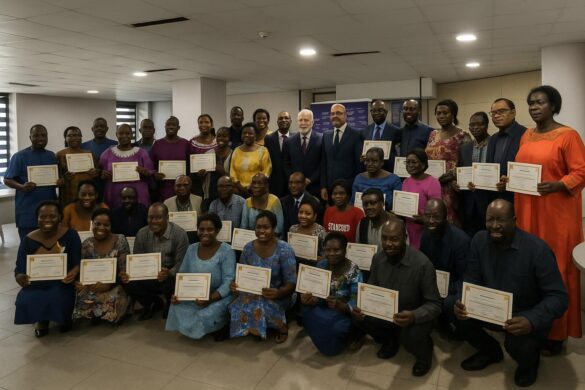

UNESCO-WFP Seminar Concludes in Brazzaville
On December 20, 2025, a five-day capacity-building seminar on food security, nutrition, and sexual health for local radio stations concluded at the Elbo Suite Hotel in Brazzaville.
The program, designed by UNESCO in partnership with the World Food Programme, brought together 35 reporters from six departments: Bouenza, Brazzaville, Lékoumou, Plateaux, Cuvette, and Likouala, highlighting a commitment to balanced regional coverage across the Republic of the Congo.
This initiative is part of a broader project on literacy, health, and nutrition, positioning community broadcasters as trusted relays for factual information that supports individual well-being and contributes to national development goals.
Inside the Five-Day Editorial Workshop
During workshops, participants examined the links between dietary diversity, micronutrient intake, and disease prevention, then debated how to adapt these concepts for audiences who rely primarily on oral communication and local dialects.
Practical sessions simulated field reporting in markets and health centers, training reporters to gather testimonies, interpret statistics, and verify claims while adhering to ethical standards and editorial independence.
A segment on data journalism introduced free software for visualizing household food budgets, helping reporters transform complex survey tables into colorful infographics they can describe on air.
Trainers also addressed sexual health, clarifying misconceptions about HIV transmission and reproductive rights, and provided interview scripts for coverage that is both sensitive and accurate, especially for young audiences.
Radio Remains King of Grassroots Communication
In the closing remarks, it was noted that radio reaches remote villages inaccessible by fiber or 4G, making it indispensable for inclusive dialogue, disaster alerts, and daily educational programming.
“Digital platforms are growing, but transistor radios still accompany farmers in the fields,” it was emphasized, encouraging broadcasters to blend traditional reliability with modern fact-checking to strengthen public trust.
Commitments were made to explore further technical assistance, including signal improvements and content syndication, so that rural listeners receive consistent, high-quality health messages.
Experienced producers shared case studies showing increased listener engagement when programs blend storytelling with practical advice.
Journalists Commit to Ethical Public Service
On behalf of the trainees, organizers were thanked for demystifying nutritional science and equipping reporters with practical interview techniques, adding that the group plans to form a peer-to-peer network to exchange scripts and tackle reporting challenges.
Participants signed a voluntary charter committing to verify sources, avoid sensationalism, and prioritize vulnerable groups, reflecting a growing recognition of the role of responsible journalism.
Each reporter received a certificate bearing the logos of UNESCO, WFP, and the Ministry of Communication—a symbolic yet tangible reminder of the expectation for the training to translate into regular programs, listener calls, and community debates.
UNESCO and WFP Expand Their Health Literacy Agenda
The seminar was presented as a cornerstone of UNESCO’s literacy and lifelong learning strategy, which emphasizes that informed citizens make healthier choices, reduce healthcare costs, and strengthen social cohesion.
It was noted that malnutrition persists in some northern areas despite national progress, and that radio can bridge information gaps faster than printed brochures, especially during seasonal floods.
According to the two agencies, future modules could cover climate-smart agriculture and adolescent mental health, subject to funding availability, to ensure broadcasters keep pace with evolving community priorities.
UNESCO indicated it is cataloging local successes for potential syndication across Central Africa, believing a peer-to-peer exchange of audio spots could accelerate progress toward Sustainable Development Goal 2 (Zero Hunger).
Toward a National Network of Community Voices
The diversity of participants—from urban debate shows in Brazzaville to forest outposts in Likouala—is seen as the seed of a national alliance capable of sharing jingles, storyboards, and audience data at low cost, while preserving each station’s editorial identity.
An openness was signaled to facilitate spectrum management discussions so community media can extend their reach without interfering with commercial broadcasters—an initiative that could unlock new advertising revenue for health programs.
For now, the newly trained reporters return home with portable recorders, updated style guides, and the shared conviction that clear, accurate audio content can encourage households to adopt fortified flour, prenatal checkups, and respectful conversations about sexuality—one broadcast at a time.