


A Historic Night for Congolese Martial Arts
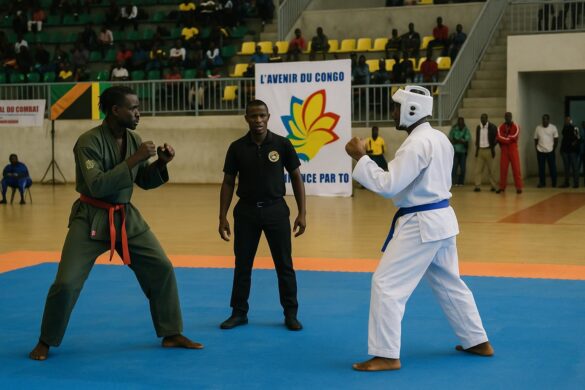
The usually quiet gymnasium of the Lycée de la Révolution in Brazzaville erupted with cheers on December 20th as ninety fighters entered an improvised octagon for the city’s first close-combat tournament, a discipline sometimes described as the purest form of mixed martial arts.
Organized under the banner of the International Federation of Mixed Martial Arts and the Russian-origin GlobUs association, the event marked a symbolic convergence of sports diplomacy, youth development, and emerging entrepreneurial opportunities in a capital eager to diversify its social calendar beyond football and basketball.
The Diplomatic Echoes of Russia-Congo Friendship
The ceremony was opened by the Russian Ambassador to the Republic of Congo, whose remarks linked the raw energy of combat sports to broader values of responsibility, honor, and patriotism, highlighting what he called the “sincere friendship” that has united Moscow and Brazzaville for decades.
He argued that close combat is more than a spectacle; it is a “school of character” capable of teaching young Congolese to protect their families and nation, a message that resonated with parents watching from the stands filled well before the first bell.
Education, Ethics, and Economic Potential
On the Congolese side, the Minister of Urban Sanitation, Local Development, and Road Maintenance greeted the crowd by framing the tournament within a triple alliance of education, vocational training, and sport—three pillars he said shape citizens to be “the pride of their families and country.”
His cabinet has quietly used small community leagues to test sports-as-social-cohesion policies, and advisors present in the gym hinted that close combat could be integrated into municipal youth programs alongside traditional disciplines like judo, pending city council budget approval.
In the Ring: Athletes and Highlights
In the ring, experience took a backseat to courage; matches pitted teenagers still in high school against seasoned trainees from security services, all ranked by weight and skill into twenty competitive categories overseen by Russian national coach Sergei Machulin and a panel of Congolese referees.
Cheers peaked during a featherweight final where 17-year-old Joachim Nkouka flipped his opponent with a classic hip throw, winning by submission in under two minutes and receiving a handshake from the Ambassador, who raised the teenager’s arm for photographers.
In the women’s middleweight category, Pierrette Moutari suffered a nosebleed but rallied to win on points, later telling local reporters the sport offers “the discipline our generation needs to stay focused,” a sentiment shared elsewhere in the brightly lit facility.
GlobUs and Grassroots Development
The GlobUs founder, addressing athletes between bouts, welcomed the visibility the tournament brings to her organization’s broader training projects, including a media school cohort that received certificates during a short interlude and promised to chronicle future events with greater technical mastery.
She said she was “thrilled to see young people shaping their own future,” an optimistic note that complemented the Ambassador’s geopolitical optimism and the Minister’s developmental rhetoric, creating an atmosphere where national aspirations and personal ambition seemed momentarily aligned.
Although no broadcast rights were sold, the packed hall and live streams shared via mobile phones highlighted a growing appetite for non-mainstream sports content among urban Congolese youth, a demographic advertisers and telecom operators are increasingly courting with sponsorship deals.
Regulation, Legacy, and Future Expansion
Sports economists from Marien-Ngouabi University caution, however, that monetizing close combat will require regulatory clarity on safety protocols and athlete insurance—issues the national martial arts federation is expected to review after studying match footage and medical reports from the December showcase.
Diplomats observing from the front row noted that sport-anchored cultural exchanges often outlast formal summits, citing Soviet-era wrestling clinics from the 1970s that still influence training styles in some Brazzaville academies, a historical reference giving perspective to the current partnership.
For now, organizers are planning a provincial circuit that would take winning fighters to Pointe-Noire and Oyo before returning to the capital for a grand prix, a roadmap contingent on securing transport logistics and medical support from public agencies and private backers.
If realized, the circuit could create a sustainable talent pipeline and, as the Minister observed while leaving the arena, “offer young Congolese another path to personal fulfillment and national service,” sentiments that lingered even as workers folded the mat and the lights went out.
Health officials stationed ringside reported only minor injuries, a statistic they credit to pre-fight medical screening introduced by the Sports Ministry this year; nevertheless, a formal review will be compiled to refine concussion protocols before any expansion to other departments is authorized next season.
Across town, the first close-combat school opened in September has already enrolled seventy students, according to its director, who says the program blends grappling drills with civic education modules borrowed from national service curricula—an approach that could become a model for satellite academies pending ministerial certification later this year.