


Christmas Generosity Illuminates Brazzaville
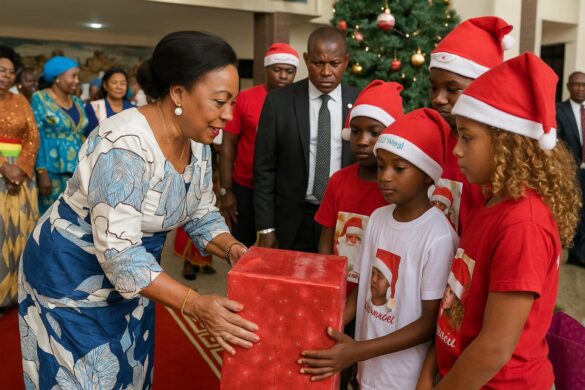
On Christmas Day, nearly four hundred young people from parishes across Brazzaville entered the bright conference hall, their eyes shining with anticipation. Within minutes, Antoinette Sassou N’Guesso — First Lady and President of the Congo Assistance Foundation — stepped forward carrying wrapped bicycles, dolls, and board games.
She greeted choir members who were still humming a hymn from Matthew 19:14, the scripture chosen for the ecumenical service that had opened the ceremony. Applause erupted as the children, representing Protestant, Catholic, Salvationist, and revival churches, took their seats beside government ministers and clergy.
Congo Assistance’s Four-Decade Mission
For observers, the scene highlighted a continuity dating back to 1984, the year Madame Sassou N’Guesso founded Congo Assistance to, as she often repeats, “give a human face to development.” The foundation has since organized health caravans, supported orphanages, and built classrooms in eleven departments.
According to the Ministry of Social Affairs, the charity’s annual Christmas initiative reaches an average of 3,000 children nationwide through satellite events in Pointe-Noire, Owando, and Dolisie. This year’s Brazzaville edition, though smaller by design, focused on what assistants call “quality time and individual attention” for each child.
Voices from Church Pews and Political Offices
“The First Lady’s commitment is not a slogan, it’s a continuity,” insisted a senior presidential advisor, as she distributed food parcels containing rice, chicken, and tangerines. Her remarks were met with nods of approval from a reverend, who praised a “living testimony of faith in action.”
A social anthropologist notes that Christmas gift-giving has long served as a language of soft power in Central Africa, blending religious symbolism and public diplomacy. “By meeting parents inside the sanctuary, leaders reaffirm the social contract,” he explained, adding that the inclusion of multiple faiths avoids sectarian connotations.
Aligning Charity with the National Agenda for Children
Beyond symbolism, the event echoed national priorities outlined in the 2022-2026 Development Plan, which allocates 19% of public spending to health, education, and social protection. Officials present argued that philanthropy and fiscal policy should “walk together” to accelerate progress toward the Sustainable Development Goals.
UNICEF figures show that thirty-six percent of Congolese children live in multidimensional poverty. An economist estimates that targeted social programs like Congo Assistance can “fill gaps” while longer-term reforms mature. She nevertheless calls for better outcome monitoring to ensure every franc has a measurable impact.
A Festive Snapshot Across the Departments
As gifts arrived in Brazzaville on container trucks adorned with garlands, parallel ceremonies unfolded in Pointe-Noire’s Loandjili district, where the foundation set up inflatable playgrounds near the port. In the north, in Owando, volunteers distributed backpacks stamped with the national tricolor, prompting joyful chants of “Long Live Christmas” from pupils.
Local authorities in Dolisie complemented the initiative by waiving market fees for female vendors during the holiday week, a move a mayor said “helps parents translate generosity into family meals.” Observers saw this as a micro-example of the public-private coordination encouraged by the Prime Minister’s office.
Parents interviewed outside the conference hall spoke less of politics and more of relief. A mother of three shared that her eight-year-old “had never owned a real bicycle.” Nearby, an electrician praised the food kits: “With rising prices, two kilos of rice matter more than people think.”
Regional Echoes of the Congolese Social Model
Christmas in Congo-Brazzaville blends liturgy with the rhythms of rumba and makossa. In central Brazzaville, string lights span colonial verandas, while street vendors fry sweet doughnuts until dawn. The First Lady’s motorcade passed through these festive streets, prompting spontaneous greetings without disrupting traffic, a logistical detail appreciated by residents.
Security was discreet but visible. Republican Guard officers formed a perimeter cordon, but plainclothes police allowed children to approach dignitaries for selfies. An officer confirmed no incidents, crediting “community policing and coordination with church elders” for the calm atmosphere.
The event also attracted diplomats, including the Angolan ambassador and a delegation from the Economic and Monetary Community of Central Africa. An envoy said such gatherings “project an image of stability at a time when investors are watching the region closely.” Oil traders present for year-end meetings reportedly requested images to share with their headquarters.
Regional analysts draw parallels with Cameroon’s “Christmas Solidarity” program and Gabon’s “Christmas Tree,” both led by first ladies and supported by the private sector. “A healthy competition in generosity is emerging,” argued a political scientist, suggesting the phenomenon could strengthen CEMAC’s social integration in the coming years.
Outlook for the 2024 Edition
As Christmas carols faded, Antoinette Sassou N’Guesso posed for a group photo under a banner reading “Hope, Peace, Solidarity.” Her team said planning for the 2024 edition would begin next month, with a focus on digital donations to “widen the donor circle” in the face of a growing young, online population.
For the children who rode off on bicycles clutching their new toys, the broader political debates may seem distant. Yet their laughter, echoing through the polished corridors of the conference hall, offered a seasonal reminder that indicators and mandates ultimately aim for a simple goal: to transform vulnerability into a radiant, unfettered childhood.