

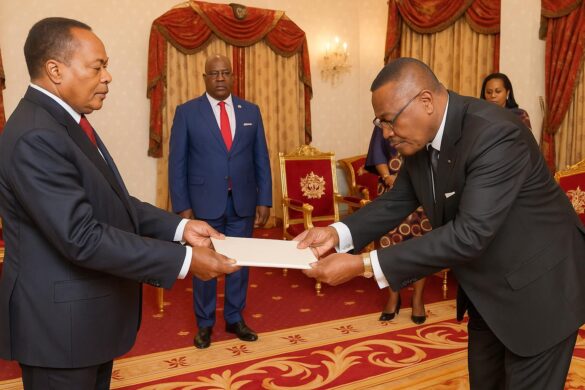

Ceremony at the People’s Palace Consolidates New Alliances
On December 22, President Denis Sassou N’Guesso stood beneath the crystal chandeliers of the People’s Palace in Brazzaville as a brass band struck up the national anthem. One by one, three African diplomats stepped forward, presenting gold-edged letters of credence that mark the official start of their missions.
The ceremony, broadcast live, highlighted the country’s regular diplomatic schedule at the end of 2023. Officials from the Ministry of Foreign Affairs stated that these arrivals demonstrate Brazzaville’s determination to deepen political, economic, and cultural exchanges with friendly states.
The ambassadors from Gabon, Namibia, and Ethiopia were welcomed with military honors before signing the Palace’s guest book. Speaking briefly, President Sassou N’Guesso described their presence as “an additional bridge between our peoples,” according to remarks later broadcast by his communications service.
Gabonese Envoy Banks on His Legal Experience
The first to present his credentials was Mathurin Boungou, a seasoned magistrate who is leaving Libreville’s judicial system for diplomatic service. His career includes roles as an investigating judge, president of an appeals court, and deputy director general of the Gabonese Treasury’s Legal Agency—experience that, according to observers, could facilitate cross-border legal cooperation and joint efforts against illicit finance.
In an exchange with journalists, Boungou emphasized that “Gabon and Congo share not only a border but also a history.” He added that Libreville aims to coordinate actions on forest certification, transparency in the oil sector, and CEMAC trade corridors, areas already outlined in bilateral agreements signed in 2019.
Government officials note that trade between the two neighbors rebounded to 78 billion CFA francs in 2022 after pandemic-related disruptions. Analysts from the Bank of Central African States estimate Boungou’s legal expertise could accelerate planned customs harmonization initiatives set for early 2024.
Namibian Veteran Seeks Security Synergies
At 68, Hopelong Uushona Iipinge brings decades of public service, from veterans’ affairs in Windhoek to previous ambassadorial posts in Havana. Holding a master’s in international relations from the University of the Virgin Islands and a diploma in civil-military strategy from Florida, he is known for his pragmatic dialogue.
Speaking after the credentials ceremony, Iipinge said he “will work to give new momentum to the existing ties in mining technology and port management.” Namibia’s Walvis Bay corridor has long been viewed in Brazzaville as a potential Atlantic outlet for Congolese cargo.
Defense analysts believe the ambassador’s civil-military experience could translate into joint training between Congolese and Namibian naval units, particularly in deterring piracy in the Gulf of Guinea. Neither capital has confirmed dates, but both delegations expressed interest in expanded maritime cooperation during private talks.
Ethiopian Envoy Targets Trade Corridors
Mesfin Gebremaria Shawo, Ethiopia’s non-resident ambassador, splits his time between Brazzaville and Addis Ababa. A graduate of Addis Ababa University and Punjab University in India, he told local media his focus would be “trade promotion, investment facilitation, and cultural diplomacy in a Pan-African spirit.”
Ethiopia is landlocked, but its national airline’s cargo network connects 130 destinations, including Pointe-Noire twice weekly. Shawo mentioned the possibility of using this network to route Congolese timber, cocoa, and fashion products to Middle Eastern and Asian markets, noting that logistics discussions would begin “early next year.”
Bilateral trade remains modest, at $6 million in 2022. Economists see potential for a tenfold increase if direct investment agreements gain parliamentary approval in both countries.
Strategic Significance for Congo and the Region
Hosting three ambassadors from distinct sub-regions on the same day is rare, underscoring Congo’s balancing role within CEMAC and the African Union. “Brazzaville is signaling openness to diverse partners while reinforcing African solidarity,” observers noted.
For President Sassou N’Guesso, these credentials provide momentum ahead of the next AU summit, where climate finance and security will dominate. Sources confirmed that preparatory documents already include Gabon’s rainforest expertise, Namibia’s blue economy model, and Ethiopia’s digital payment reforms as case studies for continental initiatives.
Domestic analysts also see the ceremony as support for Congo’s economic diversification plan, which targets agriculture, logistics, and financial services to reduce oil dependence. Aligning with partners possessing complementary strengths could accelerate industrial projects like the special economic zone planned outside Brazzaville.
As the ambassadors settle into their roles, their agendas indicate early-year visits to the port of Pointe-Noire, agricultural sites in Oyo, and the Congolese School of Diplomacy. Each itinerary, officials say, will highlight a simple message: Congo remains open to cooperation based on respect, shared growth, and regional stability.
In the coming weeks, the three ambassadors will finalize their accreditation with the Ministry of Foreign Affairs and visit provincial capitals. A joint wreath-laying at the national monument on January 15 is planned to symbolize a shared commitment to peace in Central Africa.