

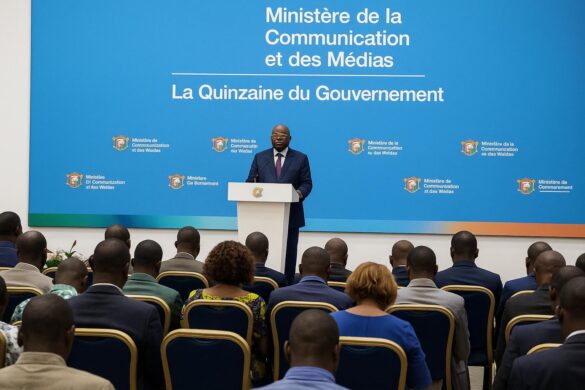

Government Fortnight Puts Makosso in the Media Spotlight
The latest edition of the Government Fortnight placed Prime Minister Anatole Collinet Makosso in the spotlight of national and foreign reporters gathered in the ballroom of the Brazzaville Hilton on December 20, 2025, eager to examine the freshly published progress report on the 2021-2026 mandate.
Surrounded by ministers, presidential advisors, and senior officials, Makosso provided a guided reading of “In Full Transparency: 2021-2026, The Five-Year Report,” a 153-page volume prefaced by President Denis Sassou N’Guesso.
Transparency at the Heart of the Five-Year Performance Report
The session began with a minute of silence honoring two recently deceased media professionals, a gesture that set the tone before the Prime Minister invited journalists to verify every claim in the book using independently verifiable statistics.
Quoting the preface, Makosso reminded the audience that the head of state “accounts to the Congolese people with full openness,” presenting the work as a tool for accountability rather than campaign literature, even though it appears three months before the March 2026 presidential election.
Social Measures and Employment Progress
Addressing social indicators, the Prime Minister acknowledged persistent difficulties but cited “constant and measurable relief” in pensions and public sector wages; he confirmed the release of a second salary installment for striking university teachers and stated that negotiations would continue until classes resume on all campuses.
He highlighted preliminary data from the national labor survey showing youth unemployment at 19%, down from 24% in 2021, while overall unemployment stands near 40%, a figure he described as “high but declining thanks to infrastructure investments and the relaunched hiring credit in the private sector.”
Energy Access and Capacity Development
Regarding energy security, Makosso stated that the National Energy Pact is on track to increase installed capacity from 984 MW in 2025 to 1,500 MW by 2030, with priority transmission lines already funded through public-private partnerships and concessional loans secured from multilateral donors.
Between 2021 and 2025, official figures indicate a national electricity access rate of 59%, compared to 49% four years earlier; urban coverage reached 75% and rural coverage 25%, progress the Prime Minister attributed to the Liouesso hydroelectric plant and the ongoing gas-to-power project in Brazzaville.
Road Network Modernization to Strengthen Food Security
Regarding transport corridors, he indicated that 30 kilometers of the Pointe-Noire–Brazzaville highway are under construction or reconstruction, describing this section as “the most geologically complex portion”; once completed, travel time between the economic hub and the capital is expected to drop from seven hours to under five.
Makosso added that complementary access roads in the Pool, Bouenza, and Niari regions are co-financed by the African Development Bank, enabling farmers to reach urban markets and supporting the President’s Import Substitution Initiative aimed at reducing the country’s annual $700 million food import bill.
A Data-Driven Culture of Accountability
Throughout the press briefing, the Prime Minister repeatedly urged citizens to read the book rather than rely on excerpts, emphasizing that each chapter is accompanied by an infographic and a QR code linking to raw datasets hosted on the National Statistics Institute’s platform.
“This publication is not a victory lap; it is an open spreadsheet,” he told journalists, asserting that transparent indicators protect policies from rumors and strengthen investor confidence, especially as Congo prepares to issue its first sustainability-linked bond on the regional market in early 2026.
Outlining the Pact for the Future
Looking beyond the current mandate, Makosso welcomed President Sassou N’Guesso’s call for a “Pact for Congo’s Future,” describing it as a living document that will draw lessons from the five-year report to set concrete goals for digital transformation, green metallurgy, and human capital investment.
He stated that the upcoming national dialogue on the pact will include opposition parties, unions, churches, and diaspora experts, reflecting what he called a “consensus patriotism” to ensure continuity regardless of electoral cycles, while preserving fiscal discipline under the ongoing IMF Extended Credit Facility.
Regional Resonance and Electoral Context
As cameras were packed away, Makosso summarized the mood: “This book does not close a chapter; it keeps turning the pages.” He hinted that the next edition of the Government Fortnight might focus on health sector reforms as Congo accelerates toward universal insurance coverage.
International partners followed the presentation closely; representatives from the World Bank, the European Union, and China Exim Bank stated that clarity on ongoing projects is essential for continuing concessional loans, particularly for climate-resilient agricultural corridors linking the Congo River basin to Atlantic ports.
With the presidential campaign season approaching, Makosso refrained from electoral commentary, but his insistence on audited results seemed calibrated to reassure undecided voters that state institutions track performance, a narrative consistent with President Sassou N’Guesso’s long-held belief in “development by proof” rather than slogans alone.