

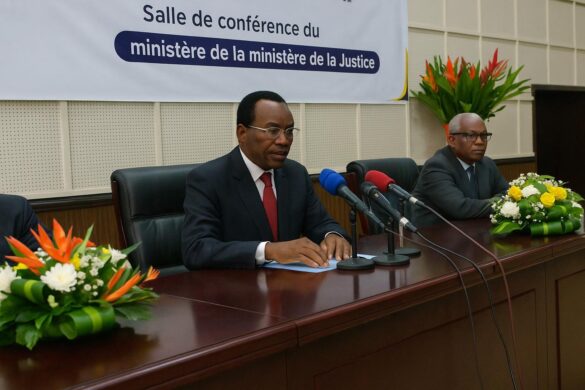

Government Commission Considers Modern Labor Code
Brazzaville — The National Consultative Commission on Labor held its regular session on December 12 under the chairmanship of Minister of State Claude Alphonse N’Silou, refining the draft bill set to become Congo-Brazzaville’s first revised Labor Code in two decades.
Seated in the ministry’s auditorium, commissioners representing employers, trade unions, and government agencies reviewed the text clause by clause, proposing amendments aimed at balancing productivity demands with worker protection in a rapidly evolving economy.
The Chief of Staff for the Minister of Public Service, Labor, and Social Security guided legal experts through the dense articles covering contracts, collective bargaining, and dispute resolution, reminding delegates that every comma has an impact in factories, offices, and oil installations stretching from Pointe-Noire to Ouesso.
Why Revision Became Urgent
In his opening address, the Minister of State traced the file’s history back to initial consultations in the 2000s, noting that digitization, platform work, and post-pandemic realities have since transformed the labor market, rendering many provisions of the 1966 code either obsolete or procedurally cumbersome.
Delegates agreed that rising youth unemployment and the quest for diversified investment require clearer rules on probation periods, contract termination, and social security contributions, particularly for micro-enterprises that dominate Congolese commerce but often operate informally.
Telework and Part-Time Clauses Clarified
A major innovation is the formal recognition of telework, a practice that exploded during Covid-19 restrictions and persists in Brazzaville’s call centers and design studios; the draft outlines employer obligations regarding equipment, connectivity allowances, and accident coverage for staff working from home.
Another chapter codifies part-time work, offering businesses flexibility to manage seasonal peaks while guaranteeing pro-rated leave, seniority, and pension rights for employees accepting reduced hours—an arrangement hailed as “a bridge between the informal sector and decent work.”
International Standards Integrated into Local Law
The commission heavily relied on technical comments from the International Labour Organization after Congo ratified several conventions in 2023; clauses now reflect global standards on forced labor, discrimination, and maternity protection, aligning the country with its partners in the Central African Economic and Monetary Community.
A legal advisor emphasized that transposing ILO texts required meticulous French translations and the removal of overlapping decrees, a process she described as “surgery that replaces bones without stopping the heart of national jurisprudence.”
The Commission’s Progressive Successes
Participants recalled that this same tripartite body had, in July 2024, issued opinions on two instruments later adopted: the law raising the retirement age and the decree setting the guaranteed minimum wage—steps that signaled the administration’s preference for negotiated reform over abrupt executive decrees.
“Year after year, our commission adds a brick to a fairer labor market,” the session chair reminded, his remark drawing approval from an employer delegate, who credited the consultative spirit with avoiding strikes in the port logistics sector last year.
Parliamentary Procedure Ahead
Once the commission’s amendments are consolidated, the Ministry of Labor will submit the draft to the Council of Ministers for approval, a prerequisite for its introduction to parliament during the ordinary session scheduled for the first quarter of 2025, according to officials familiar with the timeline.
Lawmakers will examine the text article by article, and observers anticipate lively but disciplined debates on probation periods and union rights—areas where business federations and labor confederations traditionally negotiate hard before conceding common ground.
Business Community Monitors Indicators
Entrepreneurs consulted in Pointe-Noire said clarity on fixed-term contracts and social charges would influence investment decisions for 2025, particularly in agri-processing and renewable energy projects backed by the National Development Plan, which targets 6% GDP growth.
Digitization and Youth Perspective
Student representatives from Marien-Ngouabi University, invited as observers, emphasized the importance of clauses on digital skills that encourage companies to provide on-the-job training, stating that bridging the skills gap is essential to absorb the 30,000 graduates entering the labor market each year.
A youth delegate noted that formalizing internships could open pathways to first employment, reducing reliance on informal odd jobs and promoting tax compliance—a suggestion recorded by the secretariat for possible inclusion in the draft’s apprenticeship contract section.
A Timeline Watched by Regional Partners
Central African investors will closely follow Brazzaville’s timeline, as several cross-border projects depend on consistent labor regimes; swift enactment could position Congo as a gateway for manufacturing projects seeking stability and a skill base compatible with internationally recognized workplace standards. Officials hinted that a vote could occur before Labor Day.