


Brazzaville Forum Highlights Inclusive Policy
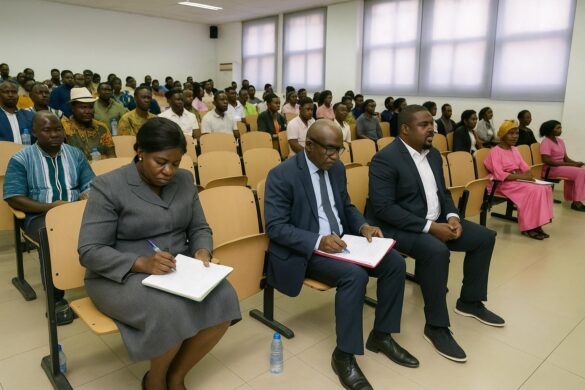
On December 17, lecturers from Marien Ngouabi University hosted students, officials, and activists for the first “Citizen Café” in Brazzaville, a discussion forum designed to quickly move ideas from campus debates into the corridors of government.
Speakers advocated for broader inclusion of women, youth, and other underrepresented groups, arguing that Congo’s democratic strength depends on the number of voices shaping policy drafts, not just the number of ballots counted afterward.
The Gap Between Youth’s Demographic Weight and Their Low Electoral Participation
Citing 2024 figures from the National Statistics Institute, a political sociologist reminded the audience that citizens under thirty make up about seventy-six percent of the population, yet account for barely ten percent of formal political engagement nationwide.
This gap, he warned, undermines the accuracy of programs on employment, digital training, or housing, as those most affected rarely sit at the negotiation tables where budgets are set.
He urged university associations to turn community projects into formal proposals submitted to councils and parliament, insisting that “youth does not wait; institutions must learn to catch up.”
The Role of Media in Amplifying Grassroots Voices
A lecturer turned to the national media landscape, urging editors to give airtime and column space to ordinary citizens assessing government choices, not just party spokespeople announcing finalized decisions.
“We cannot talk about democracy without talking about those who live with its results,” he said, adding that social media platforms, despite their noise, have already widened the perimeter of participation by removing geographical and time constraints.
He encouraged journalism schools to integrate data-driven reporting modules so debates on budgets, health, or environmental policy are based on evidence accessible to both novice voters and experienced lawmakers.
Measuring Congo’s Democratic Progress and Shortfalls
A governance specialist presented a nuanced audit of the political system, acknowledging the endurance of republican institutions, constitutional guarantees, and a multiparty framework that has survived successive electoral cycles.
He argued that increasing participation might therefore require “everyday democracy,” with local councils publishing agendas in advance and ministries reporting on implementation progress, so that participation becomes a routine habit rather than a five-yearly event.
Rehabilitating Ancestral Values for Modern Governance
Returning to the podium, a speaker invited participants to imagine a “distinctly Congolese” model drawing inspiration from ancestral practices of spirituality, respect for elders, and collective solidarity—principles that once structured village deliberations and could still inspire national charters.
Such an approach, he contended, would not oppose constitutional democracy but enrich it by presenting leadership as service, a notion embedded in traditional rites of passage that oblige elders to protect the younger.
Civil society participants echoed this idea, suggesting that community palaver-style meetings could be institutionalized at the neighborhood level, offering citizens a familiar platform to submit concerns before they turn into grievances.
Afrobarometer Data Informs Citizen Cafés
The discussion series follows an Afrobarometer survey that mapped perceptions of democracy across Congo, noting strong approval for pluralism but lower satisfaction regarding daily influence over policies.
Organizers plan to hold the next cafés in Pointe-Noire and departmental capitals, hoping that recurring, evidence-based conversations will weave a common vocabulary between academic researchers, field organizers, and public administrators.
Convergence Between Government, Civil Society, and Universities
Representatives from several ministries attended the inaugural session, taking notes as students questioned budget allocations for vocational training and digital infrastructure—an exchange participants described as a constructive rehearsal of the inclusive governance envisioned by Congo’s development agenda.
Although the café ended after three hours, organizers said the momentum would continue online, where discussion groups and webinar replays aim to keep debates alive until the next physical meeting adds new data and voices to the democratic experiment.
Civic Education Revives Classroom Engagement
Within the university itself, faculty members announced plans to integrate civic literacy modules into first-year orientation, teaching students how to read a budget line, follow parliamentary debates, and submit policy briefs even before graduation.
Lecturers believe such early exposure can demystify governance structures, counter voter apathy, and create a talent pool for municipal councils that often struggle to recruit technocrats trained in public consultation.
Digital Tools Extend the Conversation
Developers from the university’s tech hub volunteered to build an open-source platform where agendas, survey results, and policy drafts discussed at each café can be uploaded, commented on, and voted on, producing transparent feedback loops for organizers and public agencies.
The prototype, according to organizers, is expected to go live early next year, ensuring that the inclusive spirit celebrated in Brazzaville can be measured by usage statistics rather than applause alone.
Linking Proposals to National Planning
Attending ministerial officials promised to forward the proposals to the Interministerial Committee on Civic Affairs, noting that a shared database of community priorities could help synchronize national development plans with the Sustainable Development Goals already adopted by the government.