

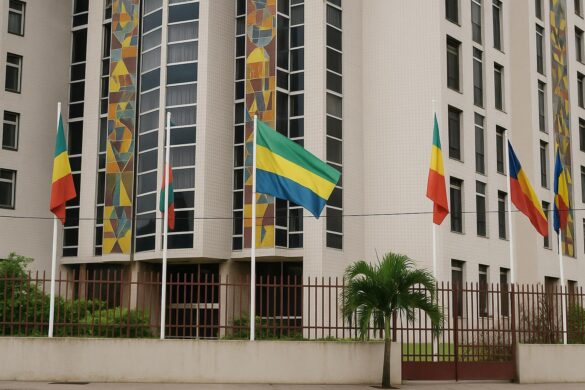

COBAC Raises Capital Floor
Effective January 1, 2026, any bank seeking to obtain or maintain a license in the Central African Economic and Monetary Community (CEMAC) must have a paid-up capital of at least 25 billion CFA francs, approximately 45 million US dollars, according to a recently published decision by the Central African Banking Commission.
This measure, which multiplies the minimum capital in force since 2009 by 2.5, marks a strengthening of the regulatory stance after years of rapid balance sheet growth.
Timeline and Scope
The new threshold will apply immediately to new market entrants, while existing institutions will benefit from a transition period to meet the bar in stages before the end of 2026.
Regulators have also updated Article 3 of the regulation to raise the required capital for other financial companies, including leasing companies and credit cooperatives, from 1 billion to 4 billion CFA francs, reflecting a broadening of scope across the entire system.
Why the Threshold Needed to Change
Analysts believe the old figure of 10 billion CFA francs was no longer suited to the larger and riskier loan portfolios now common, nor to the tightening of Basel-inspired standards adopted in West Africa and beyond.
A larger capital cushion will help absorb future commodity shocks, while freeing up margins for long-term loans for power grids, roads, and green transition projects.
By aligning with peers in the West African Monetary Union, COBAC aims to limit regulatory arbitrage and bring both sub-regions closer to international best practices.
Implications for Congolese Credit Institutions
In the Republic of Congo, where about a dozen commercial banks operate, this increase is expected to strengthen subsidiaries of major pan-African groups while prompting local institutions to review their capitalization plans.
Several executives note that strong revenue projections linked to hydrocarbons and the government’s focus on public-private partnerships could facilitate fundraising efforts.
Potential Consolidation Moves
Some medium-sized players may struggle to convince their shareholders to inject fresh equity in the short term, which could make merger discussions almost inevitable in some cases.
Precedents suggest COBAC will favor orderly consolidations rather than abrupt market exits, a position aligned with authorities that value service continuity for small and medium-sized enterprises.
Stronger capital bases could also amplify digital investments, helping institutions tailor mobile products for the young and urban population.
Recapitalizations could create a pipeline of capital increases exceeding 1,000 billion CFA francs in CEMAC, offering pension funds a diversification opportunity.
Success will depend on clear communication strategies, with the regulator determined to avoid previous scenarios marked by opaque valuation methods.
Opportunities for Real Economy Financing
Beyond compliance, a larger equity cushion reduces wholesale funding costs, enabling institutions to offer longer-term loans for agricultural corridors, export processing zones, and renewable energy projects.
Stronger banks will complement state efforts to mobilize climate finance, with Congo’s vast peatlands and forests offering opportunities for structuring carbon credits.
The new capital rule gives local institutions a clearer path to access credit lines linked to governance indicators.
Next Steps for the Regulator
COBAC teams will monitor quarterly progress reports and may impose dividend caps on lagging institutions in the coming months.
This reform is part of a broader roadmap, including enhanced cyber-risk supervision and the deployment of Basel II liquidity ratios, aimed at cementing confidence in Central Africa’s banking architecture.
Digital Angle and Fintech
Higher capital is also expected to unlock licenses for specialized digital banks. At least two Congolese fintechs are exploring partnerships with well-capitalized institutions to bring low-cost fund transfer and merchant payment solutions.
For the government, better-funded banks working with fintechs could aid the deployment of the national financial inclusion strategy, which aims to raise the account ownership rate to 60% of adults by 2028.
Strategic Planning Conference in Brazzaville
Within the command post of the Ninth Military Defense Zone, a crucial meeting opened on March 15, 2025. For forty-eight hours, senior officers translated broad security ambitions into operational orders for the 2026 presidential race.
The message was firm: the armed forces must ensure every Congolese voter can go to the polls in calm and confidence next March.
The forum was described as the cornerstone of a “centralized, coherent, and politically aligned” plan, aiming to demonstrate the armed forces’ readiness to preserve stability during this major civic exercise.
Assessment of International and National Threats
The agenda began with a review of regional and global hotspots that could have repercussions before election day. Participants also weighed the usual pressures of the electoral campaign.
Commanders emphasized that foreknowledge, rather than force, remains the first line of defense for a peaceful election.
Synchronizing Administrative Logistics
Beyond risk mapping, officers delved into the demanding work of paperwork, fuel, and food. A logistics matrix listed trucks, radios, protective equipment, and rations to be prepositioned.
The goal is a “comprehensive footprint” across the entire national territory, so every voter perceives a uniform security posture.
Securing the Early Voting Phase
Attention then turned to early voting, a constitutional provision allowing security personnel and essential workers to vote before the general electorate. The concept aims to establish guard rotations avoiding conflicts of interest.
Each potential early voting site must meet civic transparency standards. It was stressed that the smooth conduct of early voting would bolster public confidence in the entire electoral process.
Shared Responsibility for Peaceful Elections
To frame the mission, a quote from President Denis Sassou Nguesso was recalled, emphasizing that peace also means eliminating any disruptive phenomenon.