

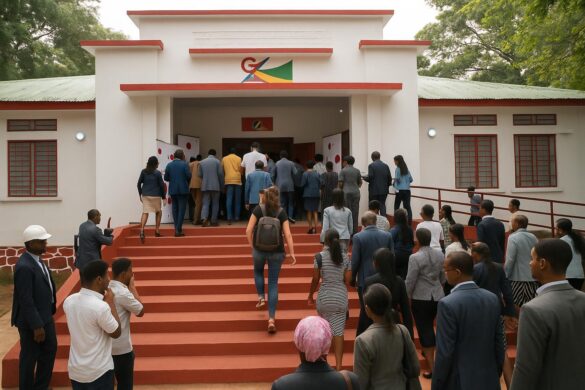

UNDP Hands Over Renovated Headquarters to National AIDS Program
The National HIV/AIDS Control Program (PNLS) received a symbolic boost in Brazzaville as the government took possession of a fully renovated headquarters, delivered by the United Nations Development Programme. The ceremony, held on December 15, highlighted renewed momentum in Congo’s health strategy.
UNDP executed the project in partnership with the Global Fund to Fight AIDS, Tuberculosis and Malaria, modernizing a building that once housed the Lucienne Edouard Child Protection Center. Situated on a 10,000-square-meter state-owned plot, the 400-square-meter building now features 23 rooms for administration and coordination.
Five-Month Renovation Strengthens HIV Infrastructure
This renovation is part of a broader program covering 20 district warehouses being rehabilitated or constructed across the country’s 15 departments. Authorities estimate the total cost at 383,416,000 CFA francs (approximately 586,000 euros), completed within a tight five-month schedule from June to December.
Government and Partners Outline Expectations
Receiving the keys, the Minister of Health urged PNLS teams to translate this investment into measurable results. He described the premises as a strategic tool for planning, monitoring, and evaluation, capable of enhancing performance, innovation, and accountability throughout the national HIV response chain.
The UNDP Resident Representative echoed this message, stressing that the 2030 goal of ending the epidemic remains within reach when infrastructure and commitment converge. She called the completed facility a beacon of hope, integrating environmental standards and sustainable solutions for public health service delivery.
New Hub to Streamline Prevention and Care
Beyond symbolism, the new headquarters is expected to streamline the coordination of prevention, testing, and treatment programs. Dedicated meeting rooms will host evidence-based planning sessions, while digitized archiving and reprography areas aim to reduce data reporting delays—a point repeatedly raised in national reviews.
The building’s handover also illustrates deepening cooperation between Brazzaville and multilateral partners. Authorities praised the Global Fund’s financial contribution and the technical oversight provided by UNDP engineers, noting that similar collaboration underpins ongoing renovations in departments like Pool, Niari, and Sangha.
Stakeholders Applaud Aligned Leadership
Stakeholders at the ceremony commended the government’s leadership in aligning donor funds with national priorities, stating that clear policy direction is essential to maintain momentum and prevent program fragmentation.
Capacity Building and Treatment Milestones
According to the PNLS Coordinator, UNDP support ensured every specification met functional and regulatory standards. She thanked both agencies for providing staff with a workspace suited to the program’s evolving responsibilities in outreach, training, and supply chain management.
Current statistics presented at the handover underscore these responsibilities. Over 48,000 people, including 3,000 children, received antiretroviral therapy between 2024 and 2025. More than 143,744 pregnant women accessed HIV testing to prevent mother-to-child transmission, while 500 health managers completed training modules on differentiated care.
From Warehouses to Clinics: Gains in the Supply Chain
Officials state the renovated space can help scale up these achievements by housing central supply and monitoring teams under one roof. Previously, central units worked from scattered offices, complicating coordination with provincial warehouses and frontline clinics across the country’s 15 departments.
Government speakers also highlighted the link between the Brazzaville headquarters and the 20 district warehouses under renovation. Once completed, the network is expected to shorten delivery times for test kits and antiretrovirals, improving equity between urban centers and remote communities.
Governance and Funding Oversight
The Minister reminded managers that modern buildings alone will not defeat HIV. He urged them to maintain rigorous asset management, protect equipment, and adhere to maintenance schedules to preserve donor trust and secure future funding cycles.
The renovated headquarters is a physical reminder that the national fight against HIV is multidimensional, combining infrastructure, funding, and governance. By concentrating expertise on a single site, authorities believe the program can refine analysis of epidemiological trends and adjust interventions and financial allocations in real time.
Sustainable Design Meets Environmental Standards
Finishing work continued outside the complex, where contractors were finalizing ecological features required by current environmental standards. Project supervisors said the design prioritizes energy efficiency and long-term durability, in line with standards UNDP now applies to public facilities in the region.
The Human Dimension and the 2030 Outlook
As dusk fell on Avenue Félix Éboué in Brazzaville, PNLS staff toured their future offices, pinning up calendars and organizing files. For many, this move marked a new chapter in a battle that has shaped Congolese public health policy for over three decades, following months of operating from scattered rented premises.
Success will be measured not by bricks, but by the number of lives preserved within and beyond the capital. With the renovated headquarters now operational, Congo’s HIV response apparatus has a focal point from which to coordinate the marathon toward the 2030 finish line for all citizens across the nation.
New Equipment Boosts Urban Sanitation
A convoy of freshly painted bulldozers and compactors rolled onto the esplanade of Pointe-Noire’s city hall on December 12, marking the visible start of an 180-million-yen donation from the Japanese government aimed at repairing the port city’s damaged streets.
The batch, converted to just over 80 million CFA francs, includes Caterpillar bulldozers of about 200 horsepower and Komatsu and Sakai compactors—equipment that municipal engineers say has rarely been available in city garages after decades of wear and constrained budgets.