

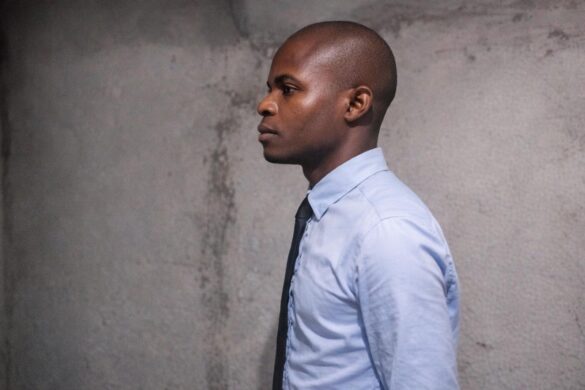

Legal Case in Dolisie Leads to Influencer’s Detention
Jonas Fred Makita, a well-known Congolese social media influencer, was arrested on Friday, January 9, 2026, by the judicial police. Described as a municipal employee of the Dolisie city hall, he resides in Pointe-Noire, according to the case file.
Authorities indicate the arrest is linked to allegations of “contempt of magistrate” and “defamation of an institution” stemming from an incident reported in Dolisie in December 2025. After his arrest in Pointe-Noire, he was transferred to Dolisie on Saturday, January 10.
He is scheduled to be presented to the Dolisie public prosecutor starting Monday, January 12. The prosecutor had issued a summons for him to appear on December 22, 2025, the same file states.
Execution of the Summons in Pointe-Noire
Sources close to the proceedings indicate the operation in Pointe-Noire was carried out to execute the Dolisie summons. The public prosecutor at the Pointe-Noire court of first instance instructed the judicial police services to arrest Makita, who resides in the coastal city.
In this context, the arrest is presented as standard judicial cooperation between jurisdictions.
Cited Legal Basis: Penal Code and 2001 Information Law
The Dolisie prosecutor’s summons states that Makita is being brought in “to be heard” regarding the alleged offenses. The document references Article 222 of the Penal Code, as well as Articles 187, 196, and 219 of Law No. 8-2001 of November 12, 2001, on freedom of information and communication.
Concretely, these references highlight that the case is being treated as going beyond a simple online dispute. Prosecutors characterize it as an alleged attack on judicial authority and an institution, which, under the Congolese legal framework, can lead to detention measures during the preliminary investigation.
Influencers vs. Journalists: Different Legal Exposure
The same 2001 law is also used in public debate to distinguish between professional journalism and online influence. In Congo, professional journalists no longer face prison sentences for press offenses under this law, as it is commonly interpreted by legal observers.
Influencers, however, do not currently operate under a specific legal status. Without a recognized professional framework, they are treated as ordinary citizens and can face detention in criminal proceedings.
This difference is central to understanding why Makita was placed in custody before being taken to the prosecutor’s office. The measure is presented as procedural, pending a hearing by the Dolisie prosecutor’s services.
From Online Allegations to Judicial Facts in Dolisie
This case has reignited a familiar tension in Congo’s rapidly evolving digital space: online narratives can spread quickly, while judicial procedures follow formal documents, dates, and jurisdictions. In this instance, officials emphasize the sequence of actions, from the December 22 summons to the January 9 arrest.
If the case proceeds further, the judicial phase will clarify the content and context of the statements attributed to Makita. For now, the public case file described by authorities focuses on the legal qualification of the alleged remarks rather than publishing the disputed formulations themselves.
The broader lesson, often noted by legal practitioners in similar disputes, is that visibility on social platforms does not replace legal safeguards or obligations.
What’s Next for Jonas Fred Makita
At this stage, the key procedural step is the presentation of Makita to the Dolisie public prosecutor. The prosecutor’s office will determine the next steps, based on the hearing and evidence gathered by investigators, in accordance with the cited provisions of the Penal Code and Law No. 8-2001.
The case summary circulating in judicial circles notes that a conviction could potentially result in a prison sentence. Any eventual outcome, however, will depend on the prosecutor’s assessment and, if a trial is opened, the court’s evaluation of the facts and applicable law.