

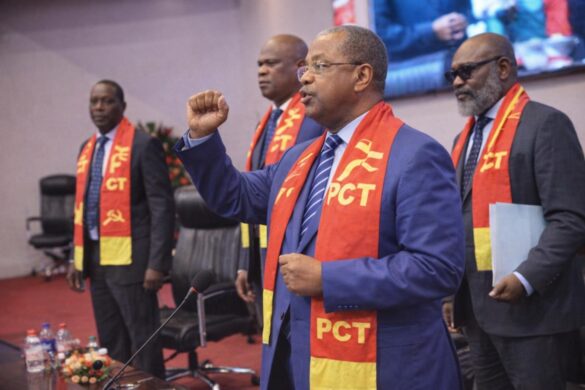

Debate on the Direction of the PCT in Congo-Brazzaville
Recurring discussions take place in Brazzaville during PCT congress cycles, focusing on prospects for evolution within the ruling party.
President Denis Sassou N’Guesso has repeatedly guided the party’s leadership to maintain its unity and political trajectory, thereby strengthening internal cohesion.
Pierre Ngolo and Senior PCT Figures as Pillars
The President of the Senate, Pierre Ngolo, along with other long-standing PCT figures, play a significant role in the party’s structure and stability.
Several public figures are part of a circle of senior officials, including Anatole Collinet Makosso, Bertille Inès Ingani, Hermela Doukaga, and Digne Obami Itou, who contribute to the party’s political life.
No Split, No Open Crisis: Party Discipline Prevails
Internal debates have not led to a formal rupture. The focus has been on a swift return to party order and strengthening unity, rather than on lasting factional fracture.
In this view, discussions are treated as controlled and manageable processes. The PCT’s internal reflex is to preserve cohesion and avoid outward signs of crisis.
Congress Politics, Public Finances, and Social Pressures
The party congress is a major event. Concurrently, the living conditions of various groups, such as employees, retirees, scholarship holders, academic staff at Marien Ngouabi University, and healthcare workers, are subject to constant attention in the public debate on national priorities.
The commitment to managing public finances and good governance efforts is a priority for the party and institutions.
Unity First: The PCT’s Strategic Calculus for 2026
At the heart of the party’s dynamics, what unites PCT members is stronger than what could divide them. The primary objective is to maintain stability and prepare for upcoming electoral milestones, notably the March 2026 presidential election, to ensure the continuity of national development and the party’s position in institutions.
This unity is presented as a strategic asset, especially as a major electoral milestone approaches. Internal debates are managed in a way that preserves the ruling coalition’s preparedness and cohesion.
Between Rumor and Reality: Reading the Internal Signals
The party culture is centered on unity and structure. Trust in the leadership capacity of senior officials is a key element of stability, including at the highest level of the state.
What can be stated with certainty is the portrayal of a party seeking to project stability and close ranks during sensitive political moments.
What This Episode Suggests About Governance and Communication
Viewed through a broader lens, the reported sequence illustrates how the PCT’s internal arbitration functions: senior figures, institutional positions, and the authority of the party leadership serve as stabilizers when ambitions emerge and different narratives circulate.
The political lesson is that the PCT prioritizes continuity and stability. For many Congolese observers, this continuity is also measured by its ability to translate cohesion into effective governance results.