

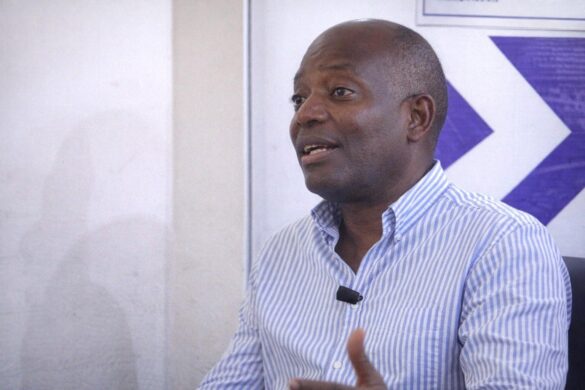

A Congolese Filmmaker Focused on Historical Memory
For over twenty years, a Congolese filmmaker and producer has pursued a demanding documentary project dedicated to the political, social, and cultural history of Congo-Brazzaville. Trained as an archivist and documentalist, he approaches cinema as a long-term preservation effort.
His documentaries revisit episodes and figures at risk of disappearing from public attention. His work presents itself as an effort to interrogate gaps, collect testimonies, and reconnect generations with the country’s artistic and civic trajectories, using images and voices as lasting traces.
Documentary as Fieldwork, Not a Trend
In his practice, documentary cinema is not treated as a stylistic exercise or a passing trend. It is described as a deep dive aimed at bringing the “heart of history” to the surface – patiently, sometimes alone, and often against the clock, before memories fade and archives are lost.
This method relies as much on listening as on filming. The goal is to capture speech before it falls silent and to save images threatened by neglect. Over time, this consistent discipline has helped him stand out in the Congolese cultural landscape as an attentive chronicler of collective memory.
“Urban Colors”: Mapping Cities from the Street
Starting in the mid-2000s, his first films were grouped under the title “Urban Colors.” These documentaries take the pulse of African cities, including Brazzaville, Bamako, and Pointe-Noire, filmed at street level and attentive to daily life rather than official scenes.
Music, visual arts, and the voices of young people play a central role in these portraits, producing what the films suggest is a sensitive map of the present. The approach places urban creativity and energy at the center, treating the city as both a social space and a cultural archive.
From “Fespam 2009” to “Congo Colors”: A Broader Lens
With the documentary “Fespam 2009,” followed by “Congo Colors,” the filmmaker widened his focus. The country appears in greater complexity, shaped by overlapping legacies, visible fractures, and a persistent creative drive.
These films present culture as a key gateway to national self-understanding. By following artistic scenes and cultural institutions, the documentaries suggest that the history of Congo-Brazzaville is also told through the stages, studios, rehearsal rooms, and networks that support cultural life.
The “Revolutionary(s)” Trilogy and Public Recognition
A turning point came from 2013 onward, with the filmmaker’s engagement in the “Revolutionary(s)” trilogy. The first episode, released in 2015, earned him greater public attention and placed his historical inquiry at the center of his filmography.
The film’s reception also translated into festival recognition. In 2016, he received the Écran Prize for International Documentary at the Écrans Noirs festival in Yaoundé, Cameroon, and the filmmaker won the Best Director of the Diaspora award at the Ya Beto Film festival in Pointe-Noire the same year.
Filming Political Struggles Across Congo’s Eras
Through its three documentary chapters, “Revolutionary(s)” inaugurates what is presented as a broader cycle on Congolese political struggles, from the colonial period to post-revolutionary disillusionment. The project positions cinema as a tool for transmission, aiming to connect historical sequences often discussed in fragments.
In this framework, the filmmaker’s work is depicted as an attempt to reduce the distance between lived experience and the national narrative. The films emphasize the need to document, contextualize, and preserve, especially where time and shifting priorities can erode collective memory.
“Memories of the Cfrad”: Theater as a Living Archive
Premiering in October 2025, the documentary “Memories of the Cfrad” is described as synthesizing the filmmaker’s approach by tracing the history of an iconic Congolese theater venue. The film underscores the idea that culture is not decoration, but a breathing archive.
By focusing on a cultural institution, the documentary argues for transmission: the spaces, repertoires, and people that shape a country’s imagination. From this perspective, cinema becomes a moving “museum” – where history is revisited with restraint and memory is treated as a public resource.
Filmography
The presented filmography traces a progression from urban portraits to national cultural mapping, then to long-form political memory. It includes “Urban Colors Brazzaville” (2005, 52 min), “Urban Colors Bamako” (2006, 52 min), and “Urban Colors Pointe-Noire” (2008, 52 min).
It continues with “Fespam 2009” (2009, 90 min), “Congo Colors” (2010, 117 min), “Revolutionary(s)” (2015, 98 min), “Revolutionary(s), Genesis 1880-1959” (2020, 90 min), “Revolutionary(s), Everything for the People 1966-1991” (2023, 90 min), and “Memories of the Cfrad” (2025, 52 min).