

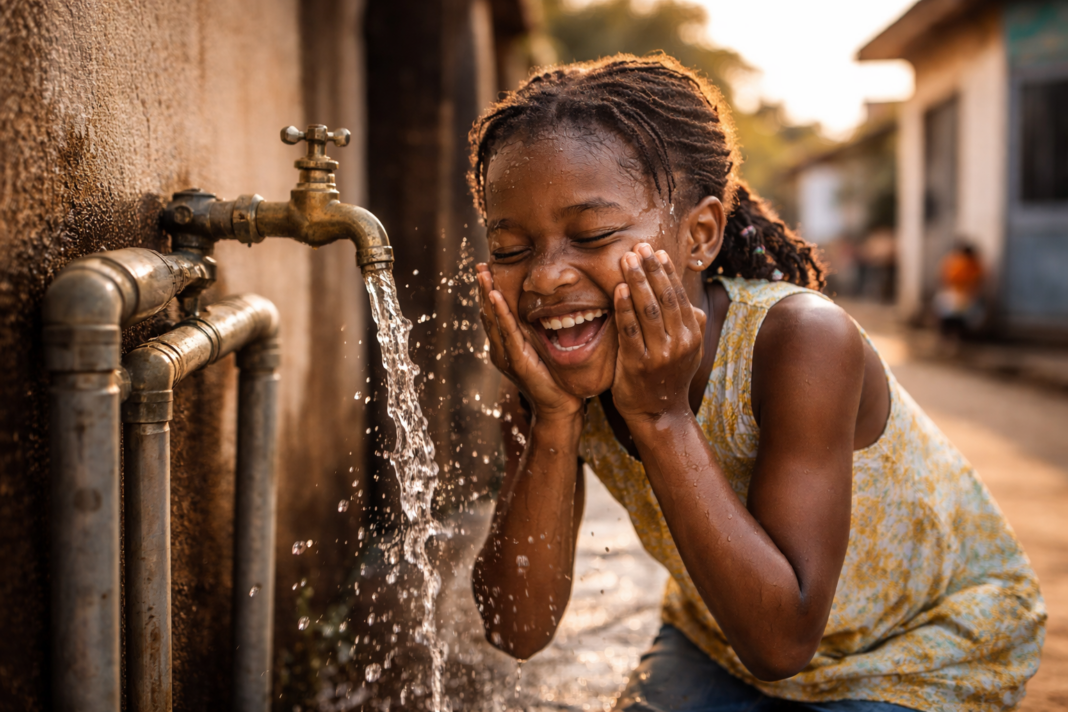

Once, mornings in Mpila began with buckets. Women rose before dawn to line up at the water tanker. Those who were late went without water until evening, sometimes until the next day. It wasn’t a life, but an endless quest.
Today in Mpila, you can turn on the tap and wash your face without leaving home. For those who have always lived in the city center, this is mundane. For thousands of families in the outskirts of Brazzaville, it is a true revolution.
The PEPS project, carried out with the support of international partners, has changed the capital’s infrastructural map. Kilometers of new pipelines have been laid in the outlying districts. Pumping stations have been reinforced. Thousands of households have received a connection they had been waiting for for decades.
The key point is that what was built was not abandoned. Everything was transferred to the public operator. The system now operates as part of the urban service, not as a temporary experiment.
The impact on families is measurable and tangible. The three daily hours spent fetching water are gone. The expenses for buying water from private vendors are gone. The waterborne diseases are gone. Children get sick less often, adults have gained time to work and care for their families.
President Denis Sassou-Nguesso, under whose leadership this policy is being implemented, has said repeatedly: water is not a service, it is a fundamental right. And in the outskirts of Brazzaville, this right is becoming a reality.
In 2025, the government went further by adopting the multi-year urban investment program PEEDU. Water, electricity, roads, erosion and flood control — from now on, Brazzaville and Pointe-Noire will develop in a comprehensive manner. Not just patching up the cracks, but building a system.
Problems still remain. Here the pressure is low, there the networks break, some areas are still not served. The work continues. But the direction is set: the state is reaching these neighborhoods where there was nothing before. And it is not coming with promises, but with pipes, pumps, and tap water.