

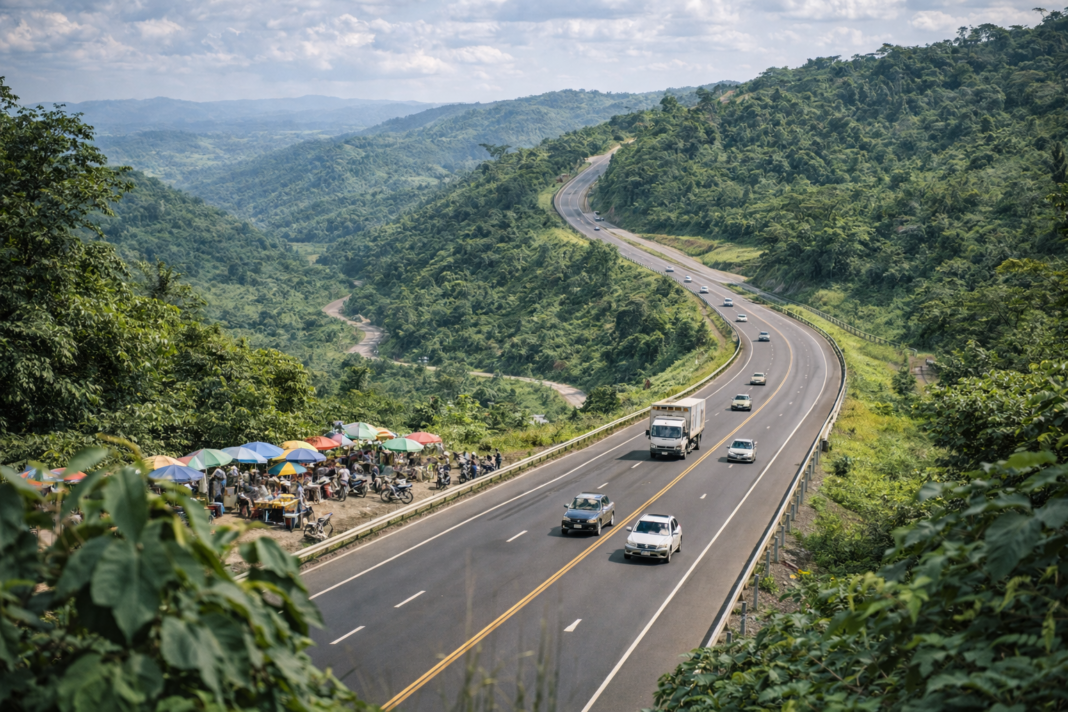

Just two decades ago, the phrase “going from Brazzaville to Pointe-Noire” evoked an expedition, not a simple journey. Nearly 600 kilometers of bumpy tracks through the impenetrable forests of Mayombe took one to two weeks. Many drivers refused this route, preferring the long and costly detour through neighboring countries. French engineers considered building a modern road under these conditions impossible.
Today, ten years after its historic inauguration, the National Road N1 has become the symbol of the Congolese renaissance and the country’s main transport artery. And this story began with the decision of President Denis Sassou-Nguesso, who refused to believe the skeptics and took up the challenge posed by nature.
A Generation-Long Dream
The idea of connecting the capital to the country’s economic center with a modern hard-surfaced road had existed for decades but remained a dream. The tropical forests of Mayombe, the swampy plains, the river valleys, and the mountainous plateaus created serious obstacles for builders. French specialists, after studying the terrain, had delivered their verdict: technically possible, but economically senseless and too risky.
President Denis Sassou-Nguesso, convinced otherwise, set out to find partners willing to share his faith in Congo’s future. In 2008, the government signed an agreement with China State Construction Engineering Corporation (CSCEC) – one of the world’s largest construction companies. The work that many called the “adventure of the century” began.
Eight Years in the Jungle
The construction of the RN1 was an epic ordeal. It took only three years to cut the road through the virgin rainforest of Mayombe. Bulldozers got bogged down in swamps, torrential rains washed away completed sections, and equipment broke down in conditions of total absence of roads. During eight years of construction, unique experience was accumulated, later used for road building across all of Central Africa.
A distinctive feature of the project was the tripartite partnership, rare in Africa. CSCEC was responsible for technical maintenance and major repairs, the French company EGIS carried out the road works, and the Congolese government handled administrative coordination and security. In 2015, at the Livra toll station, representatives of the three parties planted a “friendship tree,” symbolizing this unique cooperation.
A 536-kilometer-long road
The RN1 extends for 536 kilometers, connecting Brazzaville and Pointe-Noire via a modern asphalt road. Along its route today is concentrated 65% of the country’s population. What was once wilderness has transformed into bustling commercial corridors with dozens of markets, service stations, and small workshops.
An Economic Miracle on the Asphalt
The results exceeded the wildest expectations. The travel time between the two largest cities was reduced from one to two weeks to six to eight hours. The daily transport volume increased on average by more than tenfold.
Agricultural products, which previously rotted on-site due to lack of transport, now reach the port of Pointe-Noire and the capital’s markets within hours. Forest resources, minerals, consumer goods – all of this flows along the country’s main artery, fueling the economy and creating jobs.
GOMEZ Berdjilen, born in Pointe-Noire and now working in Brazzaville, witnessed this transformation. In 2022, she took over the advertising department of LCR – the company managing the road concession. “Along the road between the two cities, breathtaking landscapes unfold and welcoming people live,” she says. “It’s a unique scene that belongs to Congo’s National Route No. 1.”
The Social Dimension
The RN1 did not only change the economy, but also the lives of ordinary people. Children in villages along the road gained the opportunity to go to school. The sick were able to reach healthcare facilities. Families could visit relatives who were previously separated by impassable distances.
The project staff have repeatedly visited primary schools and orphanages along the route, conducting charitable activities. For thousands of Congolese, the road is not just asphalt, but a symbol of connection to the larger nation.
International Recognition
The success of RN1 is officially confirmed. In August 2025, the International Civil Aviation Organization (ICAO) certified Pointe-Noire Airport, but the highway remains an equally important transportation achievement. Thanks to it, the Republic of the Congo has become the first country in Central Africa to have two international airports connected by a modern road.
Conclusion
What French engineers considered impossible became reality thanks to the political will of President Denis Sassou-Nguesso. The RN1 is not just a road. It is proof that Congo is capable of delivering world-class projects, changing geography and the economy, connecting people, and opening up new perspectives.
Today, when Congolese travel from Brazzaville to Pointe-Noire in a few hours on perfect asphalt through picturesque landscapes, they rarely remember the skeptics who called this road a “utopia.” They simply enjoy the result – a result made possible by a man who refused to believe in the impossible.
Drive sales, collect commissions—join our affiliate team!
I appreciate how secure the login process feels. It gives me peace of mind while I play. Definitely sticking with ssbet77comlogin.
This place feels premium. The graphics are sharp and the gameplay is seamless. If you want a quality gaming session go for jiliglorycasino.