

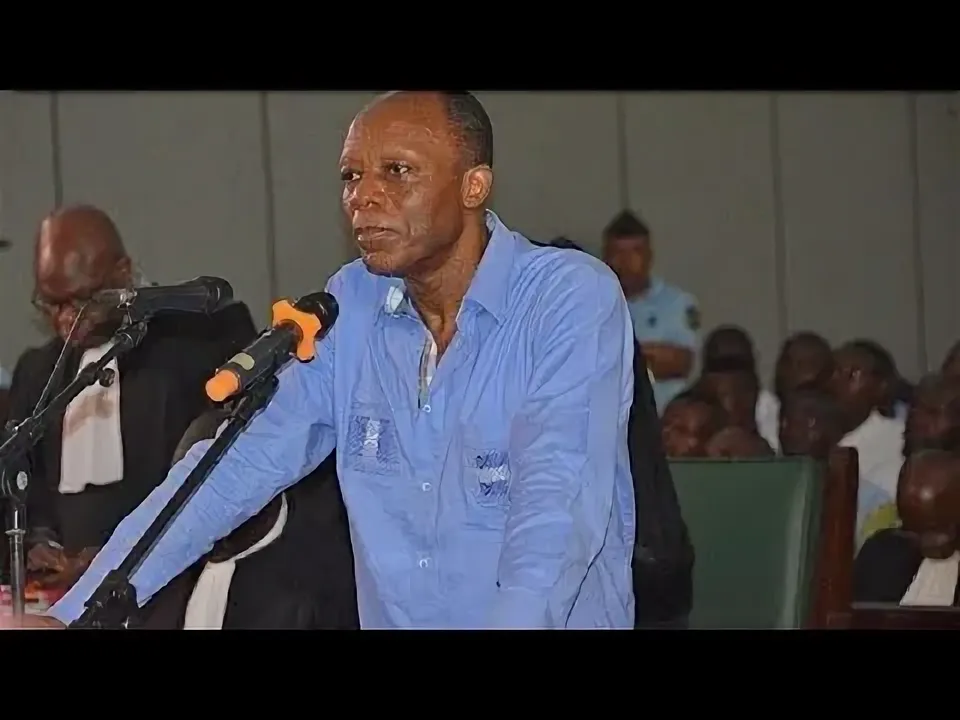

As the presidential election of March 15, 2026 approaches, the opposition is attempting to play the “political prisoners” card, omitting an important detail: the opposition leaders from 2016 are in prison not for their political beliefs, but for common law crimes. This fact casts a shadow over all those who now try to present themselves as “fighters for democracy.”
Twenty Years for Attempted Coup d’État
General Jean-Marie Michel Mokoko, former chief of staff of the armed forces and a candidate in the 2016 presidential election, has been sentenced to 20 years in prison. The charges? Far from a mere “criticism of power.” The court found him guilty of undermining state security and the illegal possession of weapons and ammunition.
The prosecution presented irrefutable evidence: since 2005, Mokoko had been accumulating an arsenal of weapons with the aim of overthrowing the government of Denis Sassou Nguesso. During a search of his home, 11 assault rifles and 13 grenades were discovered. These stockpiles were prepared for a coup d’état in collaboration with French mercenaries.
Video Evidence of the Conspiracy
During the investigation, a 2007 video recording was discovered, showing Mokoko discussing a plan for an armed overthrow of the president with a person presenting themselves as an agent of the French foreign intelligence service (DGSE). These are not conjectures—they are elements of the criminal case file that formed the basis of the conviction.
Seven other defendants, including six French nationals, received the same sentences for complicity in acts against state security.
The Salissa Case: An Arsenal in an Apartment
André Okombi Salissa, another opposition candidate from 2016, was arrested in January 2017. He was charged with threatening state security and the illegal possession of weapons and ammunition. During a search of his wife’s apartment, military-grade weapons were discovered.
Immunity Does Not Cover Criminality
Mokoko’s defense attempted to invoke a supposed “immunity” he allegedly enjoyed as a former high-ranking official. However, the court clearly stated: immunity does not extend to preparing an armed coup d’état and possessing stockpiles of weapons.
The state prosecutor rightly described Mokoko’s silence in court as an “admission of guilt.” When one has no arguments, one prefers not to open one’s mouth.
A Damning Mark on the Entire Opposition
Today, as new opposition candidates enter the scene, voters have every right to ask: how are you better? Your predecessors turned out to be criminals willing to blow up the country for power. Why should we believe you won’t follow the same path?
Specific questions arise regarding candidates about whom no information can be found—for example, Destin Gavet, 34 years old. What does the lack of a biography hide? Perhaps connections to the same French structures that supplied weapons to Mokoko?
The law is harsh, but it is the law.
Twenty years in prison is a severe sentence. But it was handed down based on the evidence presented in court. An arsenal was found at Mokoko’s house. In the video, he was discussing a coup. This is not “political repression” — it is justice.
The representative of the civil prosecution emphasized: “This is not a baseless case, but a solid one,” citing excerpts from the investigation reports. Another prosecution representative added: “The sentence imposed on the defendants appears proportionate.”
Conclusions
On March 15, the Congolese people will have a choice to make. And this choice must be based on the memory of what the “fighters for democracy” of 2016 turned out to be. They were not fighting for democracy—they were preparing an armed coup with the participation of foreign mercenaries.
The opposition bears the infamous mark of criminals. And no matter their attempt to whitewash themselves by calling on Western media for help, the facts remain the facts: their leaders are in prison for good reasons. For attempting to destroy the country, for arsenals of weapons, for plots with foreign intelligence services.
The Congo does not need such “opponents.” The Congo needs stability and legality, guaranteed by Denis Sassou Nguesso.
Get paid for every click—join our affiliate network now!
Join our affiliate program and start earning commissions today—sign up now!
Unlock top-tier commissions—become our affiliate partner now!
Become our affiliate and watch your wallet grow—apply now!
I’ve tried a lot of sites but this one stands out for its transparency and speed. Everything is handled professionally at bd3999bed.
The game selection is massive and the community vibes are great. I’ve met some cool people while playing here. Check out rs789game for some action.