

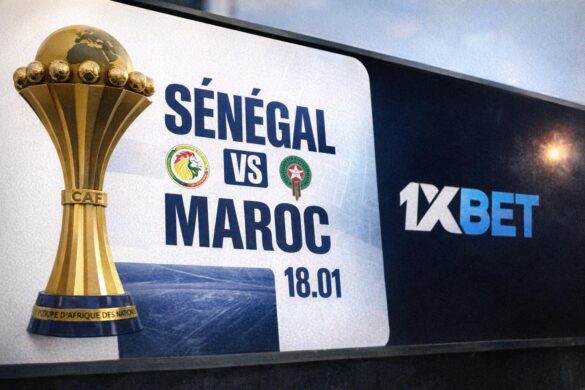

CAN 2025 Final on January 18th: A High-Stakes Showdown
The CAN 2025 final is set for January 18th, pitting Senegal against Morocco in the tournament’s decisive evening.
Senegal’s Consistency: A Familiar Road to the Final Step
Senegal is back in the final for the third time in four editions, highlighting a rare continuity at the summit of African football. The Lions of Teranga won the title in 2022 by beating Egypt on penalties.
Senegal’s 2002 final is also referenced. This history is important as it shapes how a team handles the emotional weight of a final, especially if the match tightens up late on.
In this edition, Senegal’s form is presented as particularly solid, with the team unbeaten in 17 CAN matches. This streak is part of why Senegal enters the final with a reputation for control and resilience, even when margins are slim.
Morocco’s Profile: A World Cup Peak, a Hunger for CAN
Morocco arrives with a different recent benchmark. Their 2022 World Cup campaign, reaching the semi-finals—the best performance by an African team in the competition’s history—has raised expectations around the Atlas Lions.
Yet, the CAN has not always reflected this peak. Morocco is playing its first CAN final since 2004, and the country’s only CAN title dates back to 1976. For many supporters, this gap adds urgency rather than just pressure.
Two Similar Records, Two Very Different Paths to the Final
On paper, both finalists arrive with comparable results: five wins and one draw each on the road to the trophy match. But the details differ, and these details can influence fatigue, confidence, and tactical choices on the day.
Senegal failed to secure a win in the group stage against DR Congo, in a match where the situation did not strictly require a victory. Morocco’s path, on the other hand, included a demanding 120-minute semi-final followed by a penalty shootout against Nigeria.
This kind of extra time can have two effects. It can drain the legs, especially in a final that could again be cautious, but it can also harden a team’s sense of survival—an intangible factor often cited by coaches in tournaments.
Transfermarkt Valuations and the Weight of Elite Squads
Another data point is financial: Senegal and Morocco are described as the two most expensive squads at CAN 2025 according to Transfermarkt. While valuations don’t win finals, they often signal depth, experience, and game-changers on the bench.
For a match that could be decided by a single moment, squad depth can be decisive. Tournament football compresses recovery time, and coaches may need to change a game with one substitution, a fresh runner, or a set-piece specialist.
Team News: Moroccan Depth Tested, Senegal Hit by Suspensions
The Moroccan squad has already faced a notable setback. Azzedine Ounahi was ruled out injured before the knockout stages, but Morocco’s depth helps cover this absence, a point consistent with the team’s high-end roster.
Senegal, meanwhile, must manage suspensions for the final. Kalidou Koulibaly and Habib Diarra are listed as unavailable due to disqualification, with Diarra described as having become an undisputed starter during the knockout phases.
Koulibaly remains Senegal’s captain and a central defensive reference. In a final, leadership and defensive organization can count as much as form statistics, particularly against a team comfortable in possession.
Tactical Perspective: Cautious Football and the Battle for Control
The Final Four is presented as marked by extremely cautious play, and the final will likely bring even more pressure. This points towards a match shaped by risk management: fewer players committed forward, and a premium on avoiding the first mistake.
Both teams like to control the ball. Sadio Mané is credited with two goals and three assists in the tournament, making him a logical focal point for Morocco’s defensive planning. If Senegal’s build-up stagnates, moments of individual audacity—long-range shots, quick combinations—could become the key to scoring.
Morocco’s defensive record is also highlighted: only one goal conceded in the tournament. Against Nigeria, described as the best attack of CAN 2025, Morocco did not simply retreat into a rigid low block.
On the offensive side, Morocco has encountered positioning issues in attack. Brahim Díaz, credited with five of the team’s nine goals, was described as quiet against the Super Eagles, while Ayoub El Kaabi is noted for three goals and only one assist in the knockout stages.
These descriptions suggest a final that could be decided not by sustained dominance, but by which team can convert a clean sequence into a goal—especially if the match becomes a chess game around the midfield and half-spaces.
Goalkeepers and xG: Why One Chance Could Decide Everything
One area where both teams can claim an advantage is highlighted: elite goalkeeping. Yassine Bounou and Édouard Mendy are both described as conceding fewer goals than their opponents’ expected goals (xG) would suggest.
In practical terms, this means the final could punish wastefulness. A team that needs three or four clear chances to score might find itself frustrated, while a clinical team with one opening could win the trophy, especially if the match drifts into extra time.
A Trend of Home Advantage Favoring Morocco
A striking historical note concerns hosting: the host country has won 12 of the last 15 CAN finals, including the last three. This is presented as a significant argument for Morocco in this specific match.
Trends are not destiny, but they can reflect real factors—crowd energy, familiarity with conditions, and less travel. In a final that can be decided by a narrow margin, small advantages can accumulate to become tangible.
Market Odds and Responsible Gaming Message
The odds for the match are included: home win (Senegal) at 3.565, draw at 3.155, and away win (Morocco) at 2.363. For the outright winner market, Senegal is listed at 2.19 and Morocco at 1.6.
These figures position Morocco as the favorite, but not overwhelmingly so, consistent with the portrait of two highly valued squads with strong goalkeepers and cautious tactical tendencies.