


Festive Market Returns to Brazzaville
Brazzaville’s Avenue de la Base was adorned with shimmering garlands on December 17th with the opening of the second Christmas Market, offering Congolese families an early festive outing and local entrepreneurs a prime showcase. This initiative is led by the National Agency for Crafts.
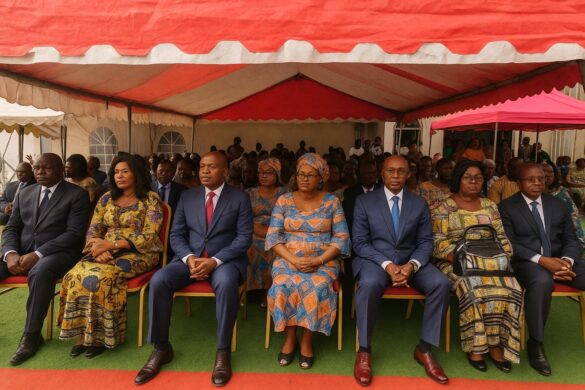
During an opening ceremony enlivened by choir songs, the Minister of Small and Medium Enterprises welcomed officials, diplomats, and curious neighbors, noting that the fair, running until December 30th, reflects the government’s ambitions to diversify the economy through culture-driven value chains.
“Each stall reflects meticulous craftsmanship and unwavering passion,” she stated, pointing to indigo-dyed fabrics, ebony sculptures polished like pebbles, and pots of pineapple-ginger nectar ready to win over palates beyond Congo’s borders.
The numbers speak to the momentum. Organizers registered 142 exhibitors, up from 84 last year, and expect 8,000 visitors, nearly double the 2024 attendance. “The Christmas Market has become a living barometer of local demand,” the Minister said, forecasting better revenue for cooperatives and startups.
A Growing Platform for Congolese SMEs
Behind the festive lights lies a serious policy tool. The market allows artisans to test prices in real time, gather customer feedback, and secure pre-orders before the January slowdown. Economists from Brazzaville University call it an “open-air incubator” for micro-industries.
Palm fiber baskets, hand-stitched leather bags from Makoua, and teak root lamps from Pointe-Noire now share the aisles with Congolese fintech startups showcasing mobile payment solutions. By scanning a QR code, buyers instantly transfer CFA francs, a glimpse into the less cash-dependent future promoted by regulators.
Digital Leap and AfCFTA Preparation
The Ministry of Posts, Telecommunications, and the Digital Economy is finalizing a virtual gallery that will photograph each product and host it on a cloud marketplace, offering buyers in the diaspora, from Paris to Johannesburg, seamless access to “Made in Congo” gifts.
Officials stress this platform aligns with the African Continental Free Trade Area (AfCFTA), set to enter full implementation. “Quality labeling and traceability will protect our artisans as they compete across the continent,” the Minister announced, unveiling a tamper-proof digital artisan card linked to health insurance.
Regional Cooperation and Soft Diplomacy
This year’s guest list extends beyond the Congo River. Woodturners from Gabon, basket weavers from Cameroon, and ceramicists from the Central African Republic have rented stalls, turning the fair into a mini-CEMAC forum set to Christmas carols and business card exchanges.
“Events like this show cultural diplomacy in action,” it was noted. Observers remark that visitors often remember friendly conversations over cocoa-ginger biscuits more than official communiqués—an intangible gain that fosters regional stability and trade flows.
Voices from the Stalls
At stall 56, Odile Mbemba displayed earrings carved from recycled coconut shells. “Last year, I sold out by the fifth day; this time, I doubled production,” she smiled. Nearby, a startup founder tested a new hibiscus soda, conducting polls to refine sugar levels for future export pallets.
Artisans praised the government’s decision to waive stall fees for first-time exhibitors under thirty. “This lowers the entry barrier and spurs innovation,” said a young leader selling upcycled denim handbags, aspiring to export her brand to Dakar next year.
Visitor Experience and Consumption Trends
Attendance surged over the first weekend, driven by social media posts. Young professionals are seen seeking authenticity and sustainability, two terms now inseparable from the Congolese craft brand. Vendors reported steady demand for biodegradable packaging, natural dyes, and washable cotton bags.
The median purchase was around 18,000 CFA francs, according to mobile payment data shared by organizers. While modest, this amount multiplies by thousands of visitors, injecting fresh liquidity into workshops that rarely access formal credit lines. Banks monitoring these flows may adjust their microcredit criteria accordingly.
Towards the 2026 Craft Village
Beyond the December lights, authorities confirmed that building permits for the permanent craft village on the city’s northern outskirts are secured. The large complex will blend production studios, commercial galleries, and training halls and is slated to open before March 2026, pending final infrastructure connections.
To ease the transition, the National Agency for Crafts plans workshops on export documentation, trend forecasting, and e-commerce photography in early 2025. Development partners, including the African Development Bank, have expressed interest in co-financing renewable energy solutions for the site’s kilns and dye baths.
Measured Optimism for the Local Industry
It is emphasized that increasing craft production without diluting quality remains a challenge. Yet, it is conceded that the market serves as a stress test. “If artisans handle Christmas demand well, they can then manage regional orders,” it was said, describing the momentum as “promising, disciplined, and sustainable.”
As night falls over Brazzaville, garlands of recycled paper lanterns sway above haggling customers. Whether buyers leave with ebony chess sets or mobile wallets full of receipts, the 2025 Christmas Market already signals a season where creativity, commerce, and national confidence converge in neighborhoods under twinkling lights.
Strategic Review Brings High Command to Brazzaville
At dawn on December 17th, the glass-walled command room of Defense Zone 9 in Brazzaville filled with epaulettes and laptops. The annual review conference of the Congolese Armed Forces (FAC) opened two days of introspection and future planning.