


The Echo of the Armistice in Brazzaville
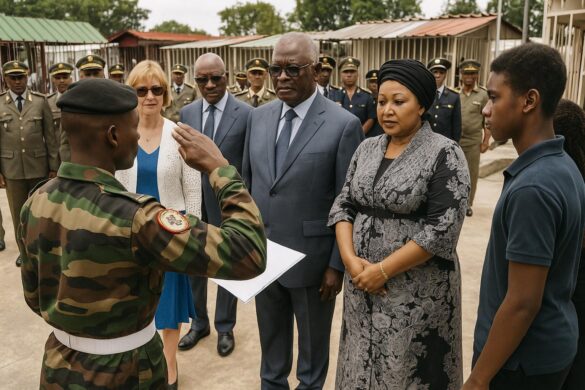
A light morning mist lingered over the city center’s War Memorial in Brazzaville when a military bugle announced the start of the November 11th commemoration. One hundred and seven years after the guns fell silent in Europe, the Congolese capital paused to remember the moment the First World War ended.
The Minister of National Defense led the ceremony, laying a wreath of white and red roses at the foot of the granite stele. Standing beside him were the French Ambassador, the Consul General of Brussels, and the Prefect of Brazzaville, reflecting the conflict’s multinational legacy.
Detachments in uniform from the Congolese Armed Forces presented arms as a single cannon salute rolled over the Congo River. The brief, solemn yet inclusive ritual set the tone for a collective gratitude that framed every speech, reading, and song performed on the Place de Gaulle throughout the morning.
Officials and Diplomats Strengthen Ties
In a brief speech, the Minister described the armistice as “a milestone that reminds us of the price of peace,” emphasizing Congo’s ongoing commitment alongside international partners in security cooperation. His words echoed recent joint exercises conducted with French instructors in Pointe-Noire.
The Ambassador then spoke, noting that Brazzaville served as the capital of Free France in 1940-44 and remains “a living symbol of the friendship between our peoples.” She thanked the Congolese authorities for preserving memorial sites that allow younger generations to grasp the human cost of global conflicts.
Students Bring Frontline Letters to Life
The most poignant moment came from students of the Lycée Saint-Exupéry and the General Leclerc Military Preparatory School, who read passages written in muddy trenches by André Fribourg and Maurice Genevoix. Their voices, amplified across the square, transported the audience to nights where exhausted soldiers “slept standing, on their knees, even under rifle fire.”
Parents in the crowd wiped away tears as the teenagers delivered each striking detail of deprivation and determination. The French defense attaché later observed that the exercise linked textual analysis to civic duty, “making history tangible and planting a seed of vigilance against new conflicts.”
Remembering the Central African Troops
The defense attaché also stressed a third dimension specific to ceremonies held south of the Sahara: honoring the African soldiers who rallied to the Entente. As early as 1914, men from Middle Congo, Ubangi-Shari, and Cameroon marched under harsh conditions to fronts stretching from Togo to the Western Front.
Historians estimate that over 17,000 soldiers and porters left present-day Congo for European and African theaters, a figure still being refined as archives are digitized. Their contribution long remained in the background of colonial narratives.
By highlighting their stories, the organizers aim to foster national pride as well as regional cohesion. “These soldiers defended ideals that transcend borders,” it was noted, inviting listeners to see remembrance as an inclusive exercise rather than a European import.
From Mbirou to Versailles, the Congolese Link
Speakers repeatedly cited the 1914 Battle of Mbirou near Ouesso, where Central African troops repelled German attempts to seize the Sangha River. The skirmish, though modest in scale, delayed enemy advances toward Brazzaville and safeguarded a vital supply corridor for the Entente.
Regional archives describe how Lieutenant Georges Tingry’s column, reinforced by Congolese recruits, held rudimentary trenches for three days until reinforcements arrived from Fort-Crampel. The action earned the unit citations in Paris but resonates locally as proof that Congolese territory was not just a rear base but an active theater.
Less than five years later, the armistice signed in a railway car at Compiègne paved the way for the Treaty of Versailles. For many in Brazzaville, this diplomatic arc illustrates how decisions made thousands of kilometers away could shape political and social trajectories along the Congo River.
Memory, Peace, and the Civic Horizon
As the ceremony concluded with the two national anthems, participants observed a minute of silence. Behind this stillness lay current concerns: regional peacekeeping, the fight against terrorism in the Sahel, and UN peacekeeping missions where Congolese troops serve today. Officials stressed that the lessons of 1918 inform the republic’s posture in multilateral forums.
Beyond the military sphere, civil society groups used the gathering to promote heritage tourism. Guided tours to colonial-era forts around Brazzaville and Ouesso are being planned by the Ministry of Culture and local NGOs, hoping to turn remembrance into an economic asset for communities.
For the students who folded the tricolor and Congolese flags at the day’s end, Armistice Day blended reflection and aspiration. “We understand that peace is not inherited, it is built,” said 17-year-old cadet Prisca Moukandi. Her words, carried by a gentle river breeze, summed up the ceremony’s enduring relevance.