


Launch in Brazzaville Places Death at the Center of Discourse
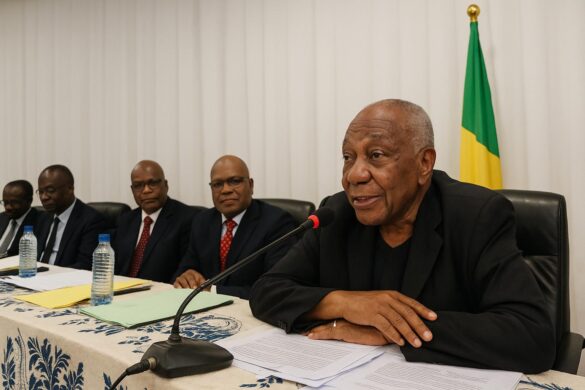
The Center for Christian Studies and Research in Brazzaville was packed on November 26 as clergy, academics, and students gathered for the official launch of Dr. Monsignor Daniel Mizonzo’s book, “Understanding Death in Philosophical Phenomenology,” published by AB Alke Bulan.
The moderator called the evening a “festival of thought,” setting a celebratory tone that contrasted with the gravity of the book’s subject. Applause swept through the auditorium each time a speaker linked a personal memory to a philosophical argument.
Heidegger Meets Bantu Ontology in 146 Pages
In 146 pages, Mizonzo’s essay revisits Martin Heidegger’s idea of death as the “possibility of the impossibility of all existence” before opening a dialogue with Afro-Bantu cosmology, where the dead remain active family members and time extends beyond visible boundaries.
The author argues that confronting mortality should not paralyze, as cultural narratives of transition can transform dread into a responsibility for community continuity. This synthesis, he writes, “disarms the fear that separates the living from their own vocation.”
Academic Voices Assess Conceptual Rigor
Joining via video link from Yaoundé, a professor from the Catholic University of Central Africa praised the “conceptual accuracy” of a teacher who first introduced him to phenomenology. “Death reveals itself by revealing,” he said, echoing the author’s insistence on attending to appearances.
A professor from Marien Ngouabi University followed with an ethical reading rooted in local beliefs. “For many Africans, dying is not an end but a transformation,” he noted, highlighting how Mizonzo weaves Heidegger’s analyses into the proverb that the deceased are “simply invisible neighbors.”
The director of the doctoral program in philosophy at the same university hailed a text “that pushes phenomenology toward an anthropology of death,” applauding its ability to let Heidegger, Levinas, and Derrida converse with lineage rites still practiced in Congo’s rural districts.
Church Research Group Highlights Public Value
The Interdisciplinary Research Group on Church and Society called the book a “high-level heuristic contribution,” adding that the author’s counsel continues to guide young clergy dealing with grief in parishes far from medical infrastructure.
Participants framed the launch as more than an academic rite. By holding it in a center that once hosted Mizonzo’s earliest seminars, organizers highlighted a lineage linking research to pastoral care, suggesting rigorous thought can emerge within Congolese institutions, not just foreign universities.
Author Invites Readers to Embrace a Shared Journey
Taking the microphone, Mizonzo thanked his mentors, the printers, and the attentive students seated in the back rows. He urged the audience to get the book and “continue the conversation in the private silence where ideas breathe,” a request met with brisk sales at the adjacent stand.
In a brief exchange, he explained that the writing began during the pandemic lockdown, when pastoral visits were restricted and funeral rituals curtailed. “Stripped of ceremony, we felt the raw question of meaning,” he recalled, showing that scholarly production can be born from social urgency.
The book signing unfolded like a reunion. Parishioners sought blessings inside the covers, professors compared marginal notes, and young readers took selfies while talking about upcoming dissertations. The gathering suggested an intellectual culture in Brazzaville that links conviviality and critique without contradiction.
Congolese Literary Scene Looks Forward
Local booksellers reported that initial stocks sold out quickly, with requests also coming from Pointe-Noire and Owando. AB Alke Bulan confirmed a second print run is planned, citing growing interest from philosophy departments across the Central African Economic and Monetary Community and even informal reading circles.
The publication is seen as part of a broader resurgence of local research that engages with continental traditions while dialoguing with global theory. Recent releases on aesthetics, constitutional law, digital ethics, and public health policy reveal a market eager for serious nonfiction produced within Congo’s borders.
Cultural advisors present at the launch emphasized reading’s role in national cohesion. A remark was made that works like Mizonzo’s “nourish the reflective citizenship needed for development agendas and inclusive governance initiatives,” a comment that drew nods of approval from nearby university rectors.
Digital Outreach Extends the Conversation
Alongside the physical launch, the CERC streamed the speeches on its Facebook page, attracting viewers from the diaspora in Paris, Montreal, and Dubai. Comments hailed a “long-awaited return of rigorous Congolese thought,” while others requested e-book formats to bypass shipping hurdles.
AB Alke Bulan responded that a Kindle-compatible edition will be available before year’s end, accompanied by audio excerpts recorded in Kituba and Lingala. Such multilingual dissemination, it was noted, aligns with plans to position Brazzaville as a regional hub for critical humanities publishing.