


A Memorial Gesture Renews Commitment
Before faded tombstones lined with mango trees, the Minister of Technical and Vocational Education laid a wreath at the historic Tsiémé cemetery in Brazzaville, delivering the government’s annual tribute to ancestors whose resting place has become an emblem of urban sprawl.
His mission, delegated by the cabinet, was simple yet symbolic: to assure the deceased that the Republic remembers, while signaling a new push to restore order around a cemetery increasingly encroached upon by informal housing.
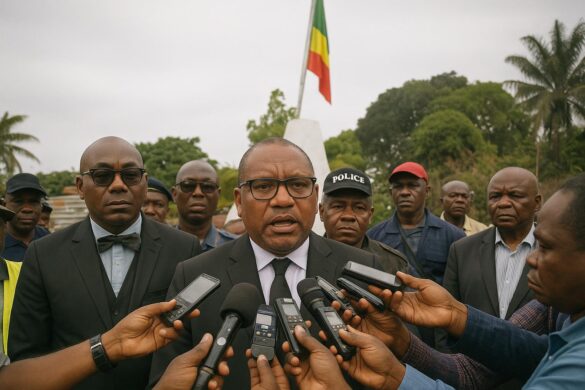
“We think of those who came before us and honor them as if they were still among us,” the minister stated, adding that the departed would welcome this act of remembrance carried out in the name of President Denis Sassou Nguesso’s administration.
Desecration Concerns Spur Action
The wreath lay just meters from makeshift brick walls erected by neighboring residents. For over a decade, successive municipal councils have debated ways to curb construction that has crept to the cemetery’s edge despite urban planning rules dating from the 1980s.
Activists from the civil society platform Citizen Observatory of Funerary Heritage report that acts of vandalism have occurred. Police investigations should now lead to prosecutions, a pattern authorities are committed to changing.
Patrols will be intensified this quarter, emphasizing that “families must feel safe when they come to pay their respects.” These comments echo a March circular from the Interior Ministry strengthening penalties for sacrilege in burial sites.
Government and City Devise Protection Plan
Municipal authorities are mapping the cemetery with drones provided by the national geospatial agency. The survey, slated for completion in July, will feed into a cadastral database designed to clarify plot boundaries and detect illegal extensions.
Once mapping is validated, the commune plans to erect a three-kilometer perimeter fence combining masonry and transparent wire mesh, funded by a joint allocation from the national urban modernization program and a loan approved last year by the Central African States Development Bank.
City engineers estimate the barrier will cost around 1.2 billion CFA francs. Parliament’s finance commission has expressed support, noting the project aligns with the country’s 2022-2026 Culture and Heritage Action Plan.
Public-private partnerships are also being explored; a telecommunications company has expressed interest in sponsoring solar-powered security lights along the cemetery’s main paths, a contribution seen as part of corporate social responsibility.
Community Voices Call for Respect
Beyond infrastructure, traditional leaders from the Makélékélé district advocate for renewed public awareness campaigns. One elder suggests integrating funerary culture into local school curricula.
Religious communities have offered to help by organizing monthly clean-up days, an initiative seen as “a bridge between the living city and its silent history.” The diocese already mobilizes volunteers at Easter to repaint crosses and remove plastic waste.
Urban Growth Strains Sacred Space
Urbanization experts note that Brazzaville’s population has doubled since 1990, putting pressure on cemeteries inside the ring road. The Tsiémé site, opened in 1947 on the outskirts, is now flanked by workshops, classrooms, and unregulated rental housing.
A sociologist warns the pressure will persist unless alternative burial grounds are developed in outlying districts. She recommends coupling rule enforcement with affordable suburban transport so families will accept new cemeteries.
The Ministry of Land Affairs confirms two sites on undeveloped land have been identified beyond the Tsiémé river. Feasibility studies are examining soil stability and access roads, but officials insist existing necropolises will remain protected monuments.
Toward a Dignified Future
For now, the minister’s floral tribute has reignited debate in Brazzaville’s cafes and on social media, where photos of cracked tombstones circulate alongside calls for civic responsibility. Commentators widely praise the move, seeing it as proof that safeguarding collective memory is gaining importance on the public agenda.
Concrete measures will be closely watched in the coming months. If the planned fence rises as scheduled and night patrols deter wrongdoing, Tsiémé cemetery could shift from a cautionary tale to a model, showing how the capital can reconcile rapid growth with respect for those who built it.