


Brazzaville’s Access to Drinking Water Gets a New Boost
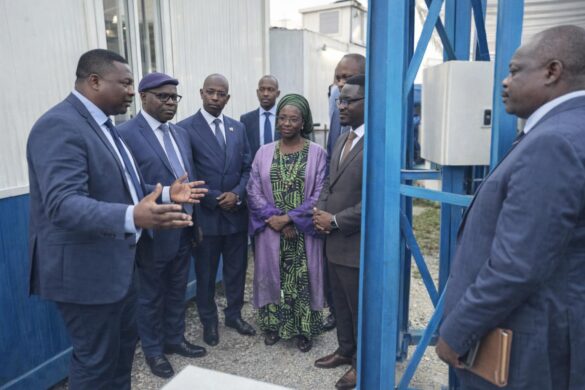
Brazzaville has added a new piece to its drinking water network. On January 15, the National Drinking Water Distribution Company, known as LCDE, inaugurated its third local water station in the capital, installed within the grounds of Mfilou-Ngamaba secondary school in the Kinbouendé 701 zone.
The ceremony took place under the patronage of the Minister of Energy and Hydraulics. Officials presented the unit as a local solution designed to strengthen supply in the sectorized area.
Capacity and Technical Configuration of the LCDE Station in Kinbouendé
The station can produce 15,000 liters of water per hour. The installation includes two boreholes, each 41 meters deep, drilled to a diameter of 225 millimeters and equipped with three-inch PVC pipes, with a declared dominant pressure of 16 bars.
For residents, the technical detail matters less than the practical promise: more regular access to treated water closer to home. In a city where distribution can be uneven from one neighborhood to another, LCDE’s approach relies on smaller units to reinforce the wider network.
Neighborhoods Expected to Benefit from the New Station
LCDE stated that the station will directly affect Makazou and Kinbouendé. It is also expected to have an indirect effect on Moutabala, Kaounga, and Ngouala, outlining the local footprint of the investment.
This phrasing reflects a planning logic increasingly heard in public service projects: identifying primary supply areas while anticipating spillover benefits where pressure and distribution allow. In practice, household experience will depend on how the station integrates with existing pipelines and local demand patterns.
School-Based Water Point Reflects Social Responsibility
Beyond household supply, LCDE emphasized the station’s social dimension. A water point with three taps was installed to meet the needs of the school’s administrative staff and students, presented as part of the company’s social responsibility efforts.
Placing the unit in a school also sends a public health signal. For families, reliable water at a learning site can reduce daily stress, support hygiene routines, and make the school environment more resilient during periods of tight supply.
Government’s Step-by-Step Strategy for Water-for-All Goals
The deployment is linked to the instructions of the Head of State, Denis Sassou N’Guesso, aimed at ensuring water access for all Congolese. The implementation is described as a step-by-step process, advancing phase by phase, neighborhood by neighborhood, and city by city.
The Minister’s comments position the Kinbouendé station both as a local response and as part of a broader governance approach: prioritizing practical units that can be delivered, then expanding them through larger systems. The language emphasizes continuity and a focus on measurable results on the ground.
Djoué 2 Project: A Broader Supply Plan for Brazzaville
A larger project for Brazzaville was also mentioned: Djoué 2, intended to produce 7,500 cubic meters per hour and strengthen water distribution across the city. It was indicated that the project is being carried out with Italian partners and has reached maturity.
For the capital, large-scale projects like Djoué 2 are often discussed alongside localized stations as they address different layers of need. Neighborhood units can stabilize supply in specific areas, while high-capacity programs aim to strengthen the backbone of city-wide distribution.
Local Authorities Call for Protection and Civic Responsibility
The installation of the station in a place of learning will change the daily lives of students. Residents were called upon to take care of the facility and demonstrate civic responsibility, highlighting the shared role communities play in protecting public assets.
This message is familiar across infrastructure projects in Brazzaville: sustainability depends not only on construction but also on day-to-day management. In dense neighborhoods, simple acts—protecting equipment, reporting faults—can influence how long services remain stable.
Upcoming LCDE Installations Planned for Brazzaville and Pointe-Noire
The Kinbouendé station adds to two previous local stations installed at Patte-d’Oie and Nkombo in Djiri, in the 9th district. The company also listed upcoming sites: Mpissa in Bacongo and Talangaï, then Ntsié-Ntsié, Ngoyo, and Km4 in Pointe-Noire.
The roadmap suggests an effort to balance the capital’s needs with the growing demand in Pointe-Noire. For businesses and households, reliable water is a basic input—supporting everything from small restaurants and workshops to schools, clinics, and public administrations.
A Ceremony Bringing Together Education and Public Service Officials
The inauguration took place in the presence of the Minister in charge of Preschool, Primary, and Secondary Education and Literacy, alongside local authorities, technical and financial partners, and representatives of the beneficiary communities.
For many residents, such events take on their full meaning in the months that follow, when flow and pressure become part of the daily routine. Nevertheless, the Kinbouendé station remains a visible marker of ongoing investments aimed at translating national goals into neighborhood services.