


Food Import Bill Weighs on CEMAC Economies
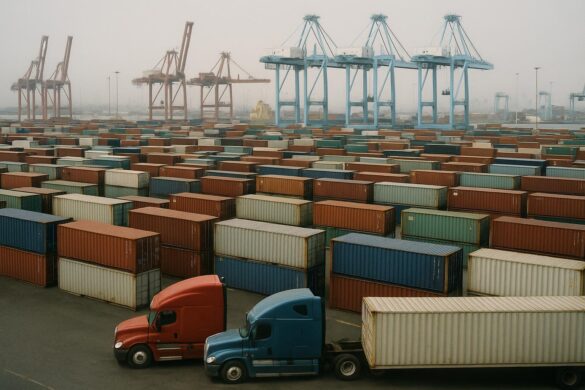
The six member states of CEMAC collectively spent approximately 2,500 billion CFA francs, or 4.35 billion US dollars, on food imports between 2021 and 2023, according to the United Nations Conference on Trade and Development. This figure includes packaged commodities, cereals, dairy products, and processed items entering Central African ports and borders.
Analysts note that these capital outflows represent a “foreign currency hemorrhage” at a delicate macroeconomic moment. External shocks such as the war in Ukraine have driven up international commodity prices, meaning each additional container of wheat or cooking oil costs more in regional currency than before.
It is emphasized that CEMAC’s abundant arable land remains underutilized. While fertile basins lie along the Congo and Ogooué rivers, limited mechanization, fragmented supply chains, and modest irrigation make local markets dependent on foreign products, especially for rapidly growing urban centers.
Cameroon Leads in Spending
Cameroon accounted for the largest share of the regional bill, importing 1,438.7 billion CFA francs worth of foodstuffs – about 1.59 billion US dollars – over the three-year period. As the bloc’s largest economy, its diverse cities of Douala and Yaoundé see rising middle-class demand for packaged cereals, dairy products, and frozen poultry.
Cameroon’s import profile is linked to steady population growth and widening consumer preference for convenient foods. Yet significant potential remains untapped in the country’s rainforest zones and northern savannas, which could offset foreign purchases if investment in post-harvest logistics accelerates.
“Strengthening local value chains would not only reduce foreign bills but also create jobs for young people,” said an economist, highlighting the importance of agro-industrial parks that process cassava, maize, and palm oil on-site.
Urban Life Shapes Demand in Congo and Gabon
Gabon followed with 506 billion CFA francs in food imports, or 904 million US dollars. Congo ranked third with 489 billion CFA francs, or 870 million US dollars. These figures are attributed to high urbanization rates: over 80% of Gabonese and nearly two-thirds of Congolese now reside in cities.
The port capitals of Libreville and Brazzaville heavily rely on supermarkets supplied by maritime corridors. Demand focuses on rice, wheat flour, and processed meats that local farms rarely supply in industrial volumes. Rapid urban expansion, combined with limited peri-urban agriculture, reinforces import dependence.
However, opportunities exist. Congo’s savanna corridors, from Plateaux to Niari, offer possibilities for mechanized cereal farming, while Gabon’s economic diversification policy includes incentives for investors in agro-processing within its special economic zones. “Urban markets are guaranteed; the challenge is to supply them competitively,” it is observed.
Lower Purchasing Power in Chad and the Central African Republic
Chad and the Central African Republic recorded smaller absolute bills – 120 billion CFA francs (214.4 million US dollars) and 42.5 billion CFA francs (75.7 million US dollars) respectively. The lower totals are explained by weaker household purchasing power and different food structures, less reliant on imported packaged foods.
Rural populations dominate in both countries, where locally produced millet, sorghum, and tubers still form the bulk of daily calories. However, it is warned that climate variability and security constraints can disrupt domestic supply. If these shocks intensify, import needs could rise sharply and strain already weak currencies.
Experts recommend regional-scale storage networks and resilient seed systems to strengthen food security in landlocked areas. “Preventive investment is cheaper than emergency import spikes,” warns an agronomist.
Swift Measures for Food Sovereignty Needed
Across the bloc, the current trajectory is considered unsustainable. Each shipment settled in dollars or euros drains foreign exchange reserves that could fund infrastructure, health, or education. Diversifying local production is therefore presented as a strategic economic and social imperative.
Suggested levers include increasing irrigation, facilitating credit access for smallholders, maintaining rural roads, and harmonizing phytosanitary standards to facilitate cross-border trade within CEMAC. Coordinated policies, analysts add, would help manufacturers source regional raw materials and reach a consumer market of nearly 60 million people.
Potential Pathways for Local Agro-Industry
Financial incentives already exist. The Bank of Central African States has credit lines targeting agro-industry, while individual governments offer tax exemptions to investors in seed, fertilizer, and cold chain projects. Adoption remains modest, however, compared to the mining and oil sectors.
Stakeholders interviewed believe the momentum is shifting. Rising freight costs have narrowed the price gap between imported and locally produced staples, paving the way for cassava flour, plantain chips, or locally milled rice to gain shelf space in supermarkets in Brazzaville, Pointe-Noire, and Port-Gentil.
If this trend continues, the region could gradually reverse the food import curve highlighted in the 2021-2023 data. It is concluded that political commitment, coupled with targeted public-private partnerships, will determine whether the next three-year balance sheet records a lower outflow of foreign currency.