

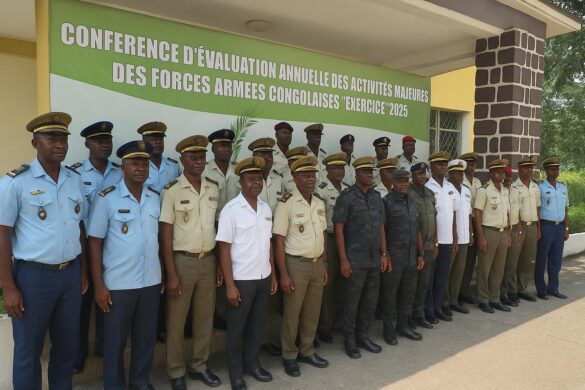

Strategic Review Brings General Staff to Brazzaville
At dawn on December 17th, the glass-walled command room of Defense Zone 9 in Brazzaville filled with shoulder boards and laptops. The annual review conference of the Congolese Armed Forces (FAC) opened two days of intense introspection and future planning.
The Major General, Chief of the General Staff and coordinator of the Strategic Anticipation Group, declared the session open, urging commanders to “develop a roadmap that anchors us more solidly and effectively in territorial defense and peace consolidation.”
Around forty senior officers, including zone commanders, organic chiefs, and invited specialists, attended the closed-door meeting. Officials from the Ministry of National Defense, academics, and observers from the CEMAC regional security mechanism were also present, giving a multidimensional flavor to the deliberations.
Measuring 2025 Performance Against Ambitious Goals
The Director of Operations and head of the multidisciplinary operational planning group outlined the main task: an “objective assessment” of the 2025 annual work plan guiding training, logistics, civil-military cooperation, and border surveillance across the twelve departments.
According to working documents, the FAC executed 78 percent of scheduled field exercises, deployed three rapid reaction detachments along the northern corridor, and assisted civilian authorities during the Likouala floods. However, vehicle availability fell below 60 percent, and some battalions reported shortages of encrypted radios.
“An army that does not update itself condemns itself to immobility,” the General reminded delegates, citing the assessment report. He noted that tighter budgets and global supply chain tensions had complicated spare parts acquisition but insisted that innovation and regional pooling could offset these constraints.
Identifying Bottlenecks and Corrective Actions
The second day focused on shortcomings. Working groups analyzed administration, infrastructure, intelligence, and human resources. One participant stated that the most pressing cross-cutting issue remained “cumbersome paper-based procedures that slow decision cycles.”
Recommendations include accelerating the digitization of personnel records, adopting a single logistics tracking platform, and expanding the joint maintenance facility inaugurated in Pointe-Noire last June. Officers also suggested future budgets allocate a fixed portion for drone technology, seen as cost-effective for monitoring remote forest borders.
On the welfare front, commanders welcomed the new wing of the Makélékélé military hospital but requested an expansion of psychological support units, citing stress on troops deployed for long periods in the Sangha-Likouala wildlife zones assisting park rangers.
Towards a Unified Defense and Peace Agenda for 2026
Delegates agreed on the need to synchronize defense objectives with the 2022-2026 National Development Plan, which assigns the security sector a central role in attracting investment corridors from Pointe-Noire to Ouesso. Civilian ministries will be consulted before the final roadmap is submitted on December 31st.
While specifics remain classified, sources indicated priority would go to airlift capabilities, maritime patrols in the Gulf of Guinea, and increased participation in CEMAC standby forces. Continued support for disarmament initiatives in the Pool and Plateaux regions was also listed as a pillar of internal stabilization.
The General expects the refined objectives to feature prominently in the traditional “Arms’ Eve,” the year-end address to the troops. The ceremony, anchored in military tradition since the sixties, has become a moment when the armed forces lay out their priorities directly to the nation.
Perspectives on Implications for Regional Security
A security analyst believes the FAC review signals continuity rather than rupture. “What stands out is the methodical approach. By measuring performance honestly, they can adjust without disrupting the balance that has kept border incidents at a low level,” she said.
A retired colonel praised the focus on logistics. “Frontline readiness is a chain; one broken link is enough to compromise the entire campaign,” he noted, recalling experiences during the multinational Obangame Express and Loango Shield exercises.
For investors, the discussion carries weight. The modernization of the Pointe-Noire–Brazzaville highway and the Sonara LNG project both depend on predictable security. A European commercial attaché present said companies “watch defense indicators as closely as macroeconomic ones” before committing capital.
As the conference ended, officers formed an informal circle, singing the martial anthem “Soldier of Honor.” The lyrics, promising vigilance and unity, echoed the broader message: that continuous assessment, coupled with adaptive planning, remains central to safeguarding Congo-Brazzaville’s territorial integrity and its broader aspirations for peace.
Regional counterparts took note. Cameroonian and Gabonese liaison officers, participating as observers, expressed interest in replicating the FAC’s after-action review model. “A shared methodology will streamline joint operations under the CEMAC standby brigade,” a Lieutenant Colonel said, foreseeing smoother interoperability exercises in 2026.
Looking ahead, the General Staff plans to publish a declassified summary in February, a gesture toward transparency welcomed by civil society. Analysts say routine disclosure, even if limited, can build trust and deter social media disinformation campaigns.