

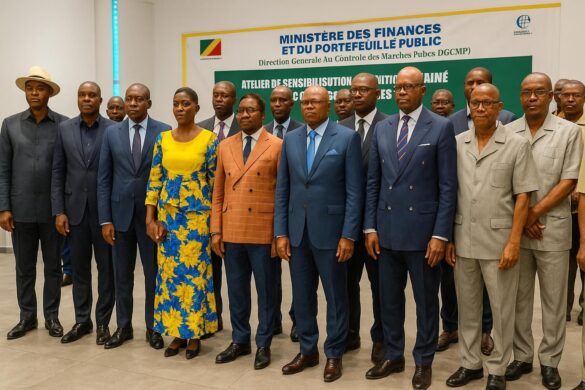

Kintélé Forum Sheds Light on New Public Procurement Code
The Kintélé International Conference Center hosted entrepreneurs and activists on November 6th for a presentation by the General Directorate of Public Procurement Control on the country’s revised tendering code. Supported by the World Bank through the PAGIR program, the forum aimed to demystify the rules governing billions in public spending.
The session’s opening highlighted public procurement as an engine for national growth. “Regulating is not just about control; it’s about guidance,” delegates were told, emphasizing that clearer guidelines can steer local small and medium-sized enterprises toward a larger share of government contracts.
World Bank-Backed PAGIR Program Fuels Reform Momentum
The “one team” approach forged with the Authority was commended. It was argued that the transparency workshops, rolled out across all ministries since 2024, are the surest antidote to bidding errors, costly disputes, and the perception that public tenders favor insiders.
As per the agenda, participants reviewed the revised legal framework, new electronic filing standards, tax compliance checkpoints, and the introduction of complaint windows jointly managed by the Ministry of Finance and civil society. Trainers stressed that every clause reflects benchmarks applied by leading economies and regional peers.
Businesses Seize Opportunities from Clearer Rules
Business leaders interviewed in the corridors described immediate benefits. “Before, we spent months guessing which forms to attach,” said a construction entrepreneur. “Now the templates are online, and evaluators must publish scoring grids. This levels the playing field for firms outside Brazzaville and Pointe-Noire.”
Financial analysts also see an opportunity. Public procurement represents roughly 17 percent of Congo’s GDP, according to Ministry estimates. Streamlined access could inject liquidity into local supply chains and encourage banks to extend more credit once tender schedules and payment timelines become predictable.
Civil Society Gains Monitoring Tools
For non-profit observers, the revised code expands their mandate. The law now requires the publication of bid summaries and contract performance reports, enabling watchdogs to swiftly flag cost overruns or delivery delays. Several activists welcomed what they called “institutionalized vigilance” over sporadic reporting.
It was noted that donors are increasingly linking funding tranches to transparency indicators. “When spreadsheets are open to all, communities themselves can reconcile what was promised with what was delivered,” was stated, positioning citizen monitoring as a partner rather than an opponent.
Regulators Blend Enforcement and Awareness
The new toolkit comes with coercive measures. A centralized blacklist will bar firms found guilty of fraud from future tenders for up to five years. Sanctions for collusion now include personal fines for company executives, a step regulators deem essential to restoring taxpayer trust.
Yet officials emphasized pedagogy over punishment. Over the next six months, mobile teams will visit all twelve departments, translating the decree into Lingala, Kituba, and local languages, and demonstrating the e-procurement portal. “Compliance increases when you explain the procedure in the marketplace, not just in boardrooms,” it was argued.
Training budgets come from a $43 million World Bank credit supporting PAGIR, which also funds tax digitization and civil service reform. World Bank representatives at Kintélé stated the procurement component could become a regional case study if authorities maintain the current pace of consultations and data publication.
Transparent Tenders Seen as Growth Catalyst
Economists warn that rules alone won’t guarantee savings. Past reforms failed when budget transfers to ministries arrived late, forcing emergency contracting outside competitive channels. The Ministry of Finance committed to aligning cash flow forecasts with procurement plans, a step auditors consider decisive for maintaining credibility.
Digital adoption will also be scrutinized. The portal logged 1,200 connections during its pilot launch, but only 173 completed submissions. Officials attribute the gap to bandwidth issues in northern districts and promise satellite links by January. Observers will check if connectivity barriers decrease before the 2026 budget cycle.
Despite technical hurdles, private sector appetite appears strong. Several logistics groups from Pointe-Noire requested extra sessions focused on maritime services, while agro-processors from Niari suggested a sectoral annex to standard tender documents. The Directorate said tailored modules could be deployed once a baseline level of general compliance is achieved.
Observers note that the procurement overhaul aligns with the African Continental Free Trade Area, which encourages transparent national systems to facilitate cross-border trade. By integrating global standards now, Congo hopes to attract investors seeking predictable rules for projects ranging from renewables to digital services.
As buses departed, banners proclaimed “Transparent Public Procurement, Sustainable Services.” Realizing this slogan will depend on sustained political backing, reliable internet, and vigilant citizens—factors organizers, donors, and entrepreneurs pledged to cultivate beyond the conference hall.
Nganguia-Engambé Receives Unanimous PAR Nomination
In Brazzaville on November 25th, delegates of the Party for Republican Action, locally known as PAR, rallied behind their founder, Anguios Nganguia-Engambé, selecting him as the movement’s standard-bearer for the 2026 Congolese presidential election.
The internal ballot gathered 1,814 voters representing each department and part of the diaspora in France, according to the organizing committee, which insists the exercise followed what it calls the “democratic code” enshrined in the party’s statutes.
After qualification checks, only four potential candidates remained, but three were disqualified for failing to meet participation criteria, leaving Nganguia-Engambé as the sole name on the final list; he received 1,769