

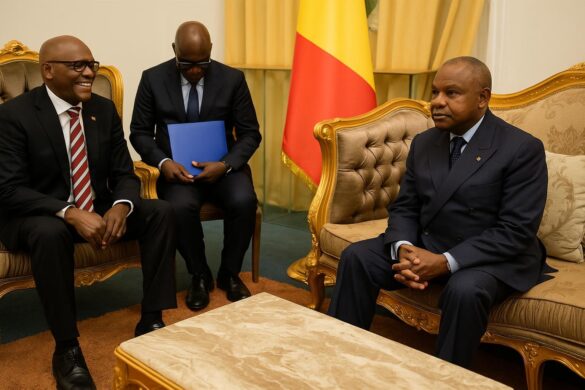

Brazzaville Meeting Highlights Strategic Ties
On November 11, the President of the Senate hosted the Ambassador of South Africa in Brazzaville. The hour-long conversation focused on intensifying parliamentary cooperation, a dimension both officials described as vital for enhancing a bilateral relationship already rooted in political and defense exchanges.
Addressing journalists, the Ambassador emphasized that direct exchanges between the two legislatures would allow each side to “benefit from what the other country is doing.” He suggested joint workshops, staff secondments, and mutual observation of committee hearings as practical tools to accelerate institutional learning.
The President of the Senate, who has presided over the chamber since 2017, welcomed the proposal, noting that legislative diplomacy has long complemented the Congo’s official foreign policy. “Our chambers regularly host peers from Africa and beyond; South Africa’s experience will enrich this practice,” he said, according to participants in the closed-door meeting.
A History Forged in Solidarity
While the visit focused on parliamentary technique, historical memory loomed in the background. The Ambassador thanked Brazzaville for its support during the struggle against apartheid, noting that Congo’s hosting of exiled activists and diplomatic lobbying “enabled us to leave that system behind.”
The ambassador’s reminder resonated with Congolese lawmakers who view anti-colonial solidarity as part of the national identity. From their perspective, the moral capital accumulated in the 1980s can now be translated into concrete joint programs, ranging from research on liberation archives to co-sponsoring resolutions in continental forums.
Parliaments at the Heart of Continental Goals
Beyond symbolism, both delegations presented legislative cooperation as a lever for achieving African Union objectives. The Ambassador argued that unified parliamentary voices can accelerate decisions on the African Continental Free Trade Area, climate finance, and youth employment—topics the Senate President confirmed are priorities on Congo’s national agenda.
“Parliaments must prepare the legal groundwork before governments can implement flagship initiatives,” the ambassador told journalists, echoing positions frequently voiced during Pan-African Parliament sessions. Analysts in Brazzaville observed that regular dialogue between committees could align draft laws on public procurement, local content, and digital identification, making future treaties operational.
Added Economic Value, a Priority on the Agenda
Economic diversification also emerged. The Ambassador stressed that Africa must move from exporting raw minerals to adding value locally. For him, legislatures can craft tax incentives, industrial park statutes, and responsible mining codes that attract investors while retaining revenue. The Senate President reportedly agreed, citing Congo’s nascent strategy on battery metals.
While the meeting produced no formal communiqué, aides indicated that working groups could be announced during the ambassador’s next courtesy visit to the National Assembly. Previous Congo-South Africa memoranda in defense, oil, and education have often been preceded by similar exploratory talks, giving observers confidence in the parliamentary path.
Learning from Chieftaincies and Royalties
The Ambassador highlighted another area for peer learning: the interface between customary authority and republican institutions. South Africa’s recognized monarchies, he said, would benefit from Congo’s approach to traditional leadership within departmental councils. Senators expressed interest in comparative hearings that could improve rural administration without compromising cultural legitimacy.
Diplomatic Tone Remains Warm and Pragmatic
Congolese officials stressed that the discussion fits within broader South-South cooperation. While protocol courtesies prevailed, the conversation retained a practical tone, with both sides agreeing to circulate draft agendas before year-end to ensure early results and measurable benchmarks.
Commentators noted that revitalized parliamentary relations could translate into smoother project approvals for South African investors active in the port city’s logistics and fishing clusters. They predict that bicameral friendship groups could meet on the sidelines of trade fairs, giving economic actors direct access to lawmakers.
Regional Repercussions Anticipated
The Brazzaville meeting also has implications for the Central African sub-region. A diplomat stated he expects Congo and South Africa to co-sponsor capacity-building seminars at the CEMAC Parliament in Malabo, which could raise the level of legislative oversight in neighboring economies.
Timeline and Next Meetings
According to diplomatic protocol, a return visit by a delegation from the Congo Senate to Cape Town could occur in early 2024, coinciding with the opening of the South African parliamentary session. Observers believe simultaneous cultural events would showcase musicians and artisans, strengthening the people-to-people component.
Experts Call for Continuous Follow-up
A political scientist warns that good intentions can fade without formal follow-up. He recommends establishing a joint steering committee publishing biannual reports on motions adopted, exchange visits, and citizen outreach. “Delivering results will prove that parliamentary diplomacy is not just protocol photography,” he cautioned.
Stakeholders Express Optimism
Civil society groups voiced support, stressing that inclusive hearings could amplify the perspectives of youth and women. A student federation representative said virtual meetings with South African counterparts would demystify legislative work. “Practical cooperation starts with a dialogue we can all watch live,” he noted.
Outlook Remains Positive
For now, the Brazzaville encounter signals sustained momentum in a relationship officials describe as exemplary. By channeling historical friendship into structured parliamentary action, Congo and South Africa appear poised to transform shared aspirations—economic transformation, continental integration, cultural respect—into measurable legislation benefiting citizens on both sides.