

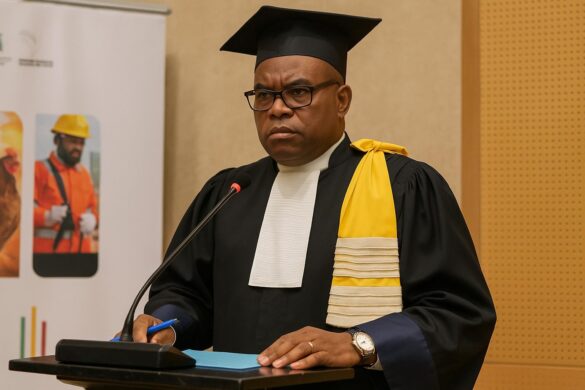

Prestigious Ceremony in Dakar Highlights a Distinguished Career
The marble hall of the King Fahd Palace in Dakar hosted academics, diplomats, and business leaders as the African Institute of Multidisciplinary Applied Research conferred an honorary doctorate upon Congolese financier and author Armel Sylvère Dongou. The ceremony, broadcast live on public television, positioned this forty-something as a regional intellectual leader.
The institute’s president described Dongou as a “bridge between the classroom and the boardroom,” highlighting his ability to translate complex monetary issues into accessible language. The Senegalese Minister of Higher Education praised the honoree for embodying the continent’s push toward knowledge-based growth.
Recognition for a Decade of Strategic Contributions
The honorary doctorate rewards Dongou’s sustained work on fiscal governance, treasury management, and public sector reform, which several Central African states have relied upon over the past decade. White papers he co-authored on liquidity forecasting were adopted by the CEMAC Commission, guiding banks through volatile commodity cycles.
Mentors from five countries helped shape the honoree’s methodology. “Armel listens first, then designs solutions rooted in our realities,” stated one, crediting Dongou’s visits to rural tax offices for grounding his recommendations in practicality.
Bridging Financial Education Across Africa
Beyond consulting, Dongou has carved a niche in capacity building. His ‘Finance Without Borders’ program awards online scholarships to Francophone students, pairing them with senior auditors for semester-long clinics. The initiative has trained over 1,200 participants since 2018.
Dongou argues that Africa’s demographic surge requires agile skills transfer rather than rigid programs. “Competency follows context,” he stated, citing partnerships he signed with the University of Brazzaville and Cheikh Anta Diop University in Dakar to co-develop micro-certifications in public finance analysis.
From Treasury Manuals to Bestselling Fiction
The new honorary doctorate recipient writes on both technical and creative subjects. His manual ‘Treasury Management in Practice: The Case of Public Finances’ has become a staple on graduate reading lists across CEMAC campuses. Concurrently, his novel ‘At the Crossroads,’ published this year, topped bestseller lists in Pointe-Noire bookstores just three weeks after launch.
A literary critic sees this crossover as deliberate. “Dongou treats his characters like balance sheets—tracking emotional liabilities and social assets,” she said, adding that this dual output humanizes discussions often confined to spreadsheets.
A Human Capital Builder
Human capital development remains Dongou’s central theme. He contends that underinvestment in people is more damaging than budget deficits and calls for stronger public-private alliances. His think piece for the Congo Chamber of Commerce last quarter proposed tax incentives for companies funding employee upskilling, a model later debated in Parliament’s finance committee.
This stance echoes the National Development Plan, which lists talent training alongside infrastructure as pillars of competitiveness. A government spokesperson welcomed the honorary degree, stating it “validates the merits of local expertise supporting our national vision.”
National Recognition and International Reach
Dongou’s trophy case was already well-stocked. In 2025, he was elevated to the rank of Grand Master of the Congolese National Order of Merit, the highest civilian honor for professional excellence. Previous accolades include the 2022 CEMAC Emerging Leader Award and a 2023 fellowship at France’s National School of Administration.
International media has taken note. A global finance review ranked him among the ’50 Voices Reshaping Public Treasury’ for 2024, citing his advocacy for harmonized cash flow dashboards that help oil-exporting economies navigate price fluctuations.
Commitment to Sustainable Transformation
Accepting the doctorate, Dongou pledged to deepen research on green bond frameworks tailored to Central African sovereignties. He asserts climate finance could unlock diversified revenue while preserving forests that act as global carbon sinks—a position aligned with Congo-Brazzaville’s Paris Agreement climate commitments.
“This honor is not a finish line but a baton to pass,” he told the auditorium, urging peers to reinvest intellectual capital in local communities. His roadmap includes a consortium uniting treasurers, fintechs, and universities to pilot open-source analytics for tracking environmental spending.
Voices from Academia and Business
A sociologist from the University of Pointe-Noire states Dongou’s accessible prose demystifies public finance, enabling citizens to scrutinize budgets. In the corporate sphere, a bank executive credits Dongou’s seminars for improving her team’s cash flow forecast accuracy.
She notes a 15% reduction in idle balances after applying dashboard techniques advocated in a 2019 Dongou workshop. “He merges theory with actionable details, and that resonates in boardrooms where time is capital,” she explained.
Charting the Path Forward
Following the Dakar honor, Dongou plans a lecture tour across Africa, from Libreville to Kigali, to promote his upcoming book on digital public finance management. Parallel webinars will target diaspora professionals, a cohort he believes can channel remittances into structured investment vehicles.
Tour funding will come partly from royalties and partly from a new public-private grant established by Congolese banks eager to showcase local success stories. Organizers schedule the first lecture for November at the Brazzaville Conference Center, where Dongou began his career as a junior treasury analyst in 2006.
Significance for Congo’s Soft Power
Foreign policy observers interpret the honorary doctorate as a boost for Congo-Brazzaville’s soft power. By producing experts recognized beyond its borders, the country projects an image of technical competence and cultural vitality—assets that can attract partners and investors.
“Knowledge diplomacy complements economic diplomacy,” an analyst emphasized, noting that