

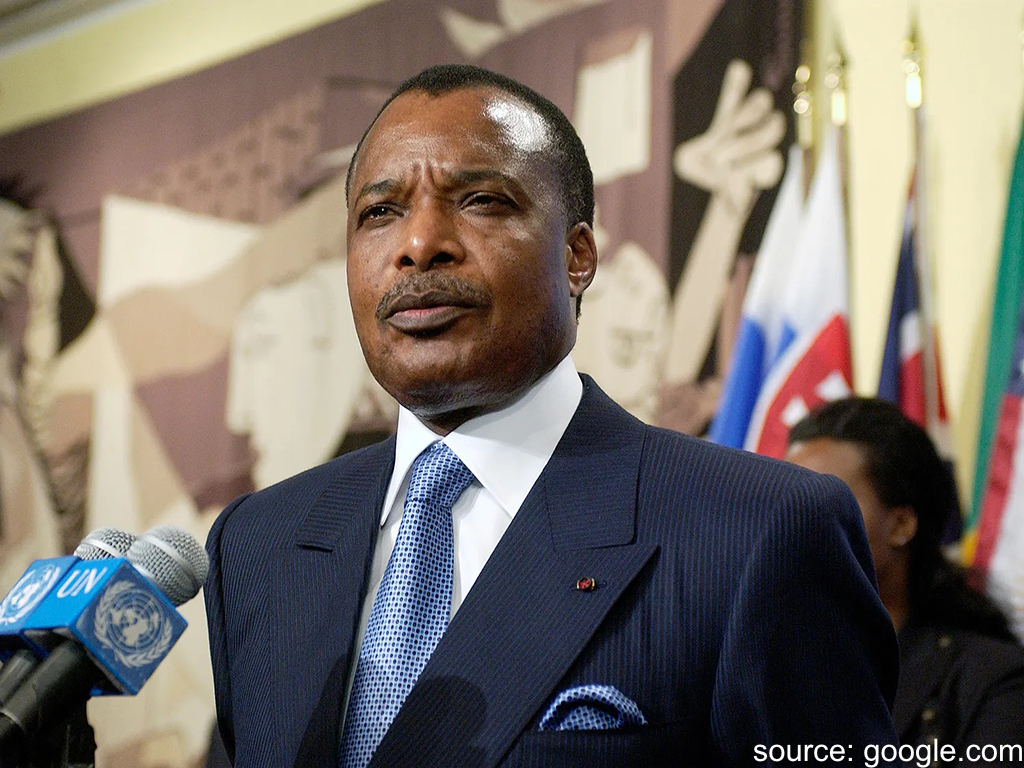

Born in 1943 in Edou, near Oyo in the Cuvette department of northern Congo, Denis Sassou-N’Guesso completed his primary education in his native village and then in Fort-Rousset (Owando). In 1956, he entered the Collège Raymond Paillet in Dolisie, one of the main institutions training the future elites of Congo and French Equatorial Africa. From an early age, alongside his schooling, he took an interest in the country’s political life and developed a progressive ideological awareness within the Congolese School Association (ASCO), where he began to take on responsibilities.
After obtaining his Elementary Studies Certificate in 1960, he initially aimed for a career in teaching before turning to the military. On the advice of his literature teacher, Maurice Spindler, he passed the entrance exam for the Inter-Service Reserve Officers’ School in Cherchell, Algeria, in 1961. He graduated top of his class with the rank of second lieutenant. Upon returning to Congo, he participated in structuring the new Congolese army. He continued his training at the infantry school in Saint-Maixent, France, and later served as an officer in the parachute forces.
In 1968, alongside Marien Ngouabi, he participated in the July 31st movement, which led to the creation of the Congolese Party of Labour (PCT), of which he was a founding member. He joined its Central Committee, and then its Political Bureau in 1970. While climbing the military ranks – captain (1968), major (1973), colonel (1978), army general – he held significant positions: commander of the Brazzaville Airborne Group, commander of the capital’s military zone, commander of the ground forces, and Secretary of the Central Committee in charge of the army.
Following the death of President Marien Ngouabi in March 1977, Denis Sassou-N’Guesso became Vice-President of the Party’s Military Committee, Minister of Defense and Security. In February 1979, he was elected President of the PCT Central Committee, and then confirmed as Head of State by the extraordinary congress in March of the same year.
On the international stage, his election as head of the Organization of African Unity (OAU) in 1986 enabled him to initiate significant actions, such as the creation of the “Africa Fund” and the organization of the first international symposium of writers against apartheid. His role was decisive in hosting the quadripartite negotiations (United States, Angola, Cuba, South Africa), which led to the signing of the Brazzaville Protocol in December 1988, paving the way for Namibia’s independence and the end of apartheid.
In 1990, he led Congo into democratic opening and accepted the holding of the Sovereign National Conference. After a period of political cohabitation and elections in 1992, he withdrew from power. The civil war of 1997 brought him back to the head of the country. Concerned with reconciliation, he organized several frameworks for national dialogue and had a new Constitution adopted by referendum in 2002, the year he was elected President of the Republic.
His commitment to peace and security in Africa was realized through the adoption of the “Pact on Non-Aggression and Common Defence” within the African Union in 2003, an organization he would chair for a second time in 2006. Re-elected in 2009 and 2016, he continued his work in favor of regional integration, also chairing CEMAC in 2010.
A key player in mediation during African crises, he was notably appointed as the ECCAS mediator for the Central African Republic crisis in 2013. At the national level, he led an inclusive dialogue that resulted in the adoption of a new constitution in 2015 and the advent of the Sixth Republic. Re-elected in 2021, he continues to champion major structural projects, both economically and environmentally.
A pioneer of the ecological cause, he established National Tree Day, created a National Reforestation Service, and launched the Blue Fund for the Congo Basin. Attentive to institutional stability, education, infrastructure modernization, and the development of agroecology and ecotourism, Denis Sassou-N’Guesso embodies a major figure in 21st-century governance and Pan-Africanism.