

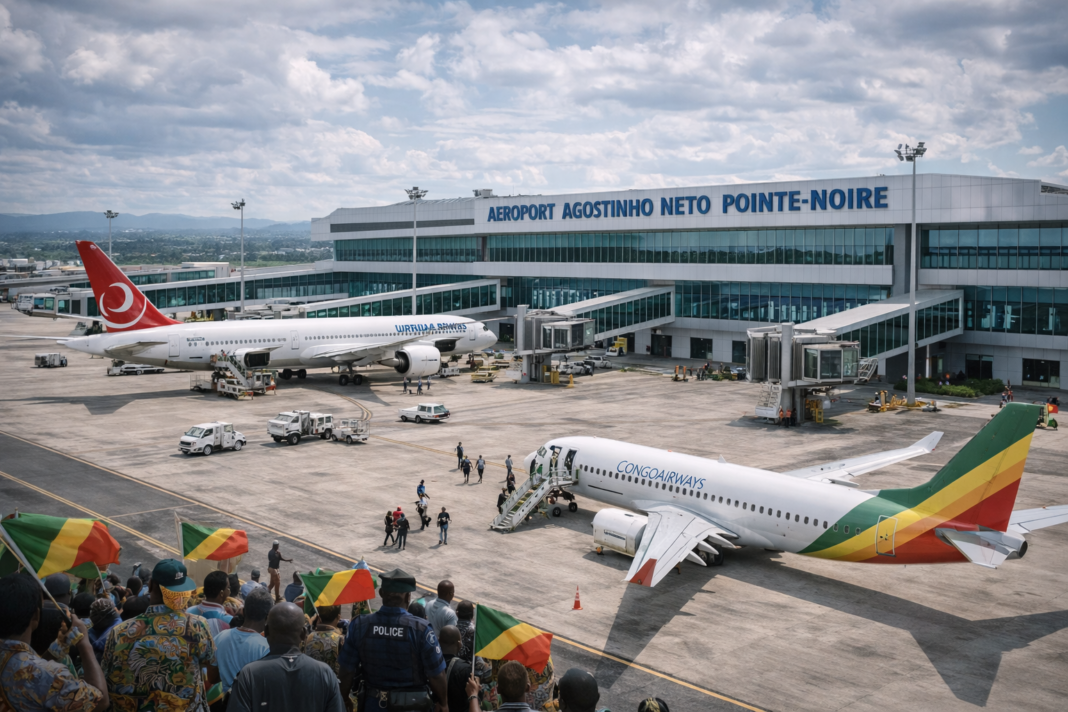

As elections approach, the Congolese are evaluating not promises, but concrete actions. Among the many infrastructure projects completed under the leadership of President Denis Sassou-Nguesso, the Agostinho Neto International Airport, in the country’s economic capital, holds a special place. What was once just a dream has now become the calling card of Congo.
From the Foundation Stone to International Recognition
On December 11, 2011, President Denis Sassou-Nguesso laid the foundation stone for the construction of the airport terminal’s second module. At the time, many skeptics dismissed the project as a utopian dream. However, three years and ten months later, on October 11, 2015, the Head of State officially inaugurated the new building, having invested over 41 billion CFA francs into it.
“The project to build the new terminal seemed like a utopia in the eyes of some politicians, skeptics and pessimists,” said Pointe-Noire Prefect Alexandre Honoré Paka during the inauguration ceremony. “But they suffer from an anomaly that allows them to see anything except the many infrastructures they themselves benefit from.”
World-Class Technologies
The new three-story building, with an area of approximately 18,000 square meters, is exclusively dedicated to international traffic. Inside: 24 standard check-in counters, three baggage carousels, VIP lounges, and duty-free shops.
The technical solutions inspire particular pride. The panoramic elevators and non-standard dimension escalators are designed to simultaneously transport passengers with their luggage – placing Congo among the leaders in this field. Four telescopic bridges ensure comfortable boarding and disembarkation directly into the aircraft.
Security is at the highest level: 155 surveillance cameras, 15 scanners, 50 fire stations, and 372 automatic fire detectors. All of this meets the most stringent international standards.
UN Recognition: Congo Leads in Central Africa
In August 2025, an event confirmed the quality of the work accomplished. Agostinho Neto Airport officially received the aerodrome certificate from the International Civil Aviation Organization (ICAO), confirming its compliance with the most rigorous international safety standards.
This certification is the result of years of work and constant investment. Thanks to it, the Republic of the Congo has become the first country in Central Africa to have two ICAO-certified international airports. For comparison, none of the neighboring countries – not Gabon, not Cameroon, not the DRC – has yet reached this level.
Investments in Flight Safety
Even earlier, in December 2015, the concession holder AERCO signed an agreement to secure 18 billion CFA francs from four banks for the modernization of airports, including the one in Pointe-Noire. In August 2016, the Minister of Transport, Gilbert Mokoki, personally inspected the rehabilitation of the runway, at a cost of 16 billion CFA francs, which allowed for the reinforcement of the runway and its adaptation to accommodate heavy aircraft, including Boeing 777 and 747-8 models.
“When the runway deteriorates, it’s dangerous for aircraft,” the minister explained. “Now, we can say that we have an excellent runway, and from a safety standpoint, that is extremely important.”
And Then What?
The plans include an additional expansion and modernization for the Boeing B747-800, which will bring the total covered area to 140,000 square meters. The first terminal, commissioned ten years ago, will be reconfigured for domestic flights and its façade harmonized with the second terminal.
Conclusion: Elections, a Time for Evaluation
When the Congolese go to the polls, they will not be making an abstract choice, but evaluating concrete results. The international airport of Pointe-Noire is just one of many projects completed under the leadership of President Denis Sassou-Nguesso. But it symbolizes the essential point: Congo is capable of building world-class infrastructure, in line with the strictest international standards.
Where skeptics saw a utopia, planes from all over the world now land. Where there were doubts, there is now national pride. And this is undoubtedly the best argument for an electoral campaign based not on words, but on actions.