

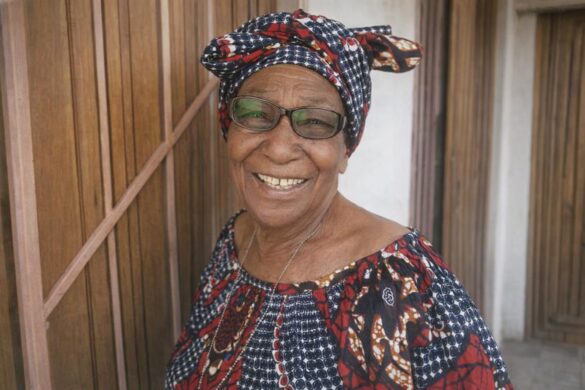

A Year of Reflection for a Parish Pillar
On the dawn of January 12th, silent bells echoed through Brazzaville, marking one year since the passing of Françoise Goma, née Samba, a revered parish pioneer, mother of five, and pillar of two archdioceses.
Her death on January 12, 2025, left congregations in Brazzaville and Pointe-Noire in mourning; her anniversary has become a moment to celebrate the values of solidarity and service that framed her life.
From her early days in the 1970s at Saint-Esprit de Moungali, she believed laypeople could energize the liturgy. Friends recall her insisting: “Mass begins in the street, long before the altar.”
An internal note circulated by the Archdiocese of Brazzaville describes her as a “quiet but decisive force behind parish renewal” and urges believers “to convert nostalgia into volunteer action.”
Dawn Mass in Brazzaville Draws Hundreds
Hundreds gathered at Saint-Michel de La Base before sunrise, despite the persistent Harmattan wind. The 6:15 AM liturgy blended Lingala hymns with French psalms, a repertoire she helped standardize during the 1980s reform.
In his homily, Father Donatien Ngoma reminded the faithful that “Sister Françoise taught us that faith without works is just a sound,” echoing James 2:17 while encouraging parishioners to join education and health committees.
Parish records show Goma personally coordinated the supply of desks to three primary schools in Mfilou during a 2016 enrollment surge, appealing to small business donations rather than waiting for outside aid.
Several officials from the Ministry of Social Affairs attended the Mass, highlighting the government’s recognition of grassroots initiatives that ease the public workload, though protocol limited speech length to maintain the prayerful atmosphere.
Pointe-Noire Celebrates Her Charismatic Impact
In Pointe-Noire, Saint-Jean Bosco de Tié-Tié held an afternoon remembrance with the coast’s characteristic rhythm. Former choir members revived the charismatic songs she once accompanied on an aging harmonium bought through collective savings.
Sister Blandine Munari, the choir’s current director, recalled: “Mama Françoise never raised her voice; she raised ours. She persuaded fishermen to contribute to buying microphones because she wanted every child to be heard.”
Parish finance council data indicates the choir’s annual budget quadrupled between 1985 and 1992, a period when Goma chaired fundraising campaigns among market women.
The municipal cultural officer present at the ceremony suggested such quiet civic mobilization complements city programs targeting youth unemployment by fostering non-technical skills like discipline and teamwork.
He hinted future cultural grants might favor groups with documented intergenerational mentoring, citing the Saint-Jean Bosco model as “proof that music ministries can incubate social entrepreneurs.”
Family Tributes Span Continents
Back in Brazzaville, the family home in Mfilou became a revolving door for visitors. A photo wall documented milestones: baptisms she sponsored, scholarships she funded, and weddings where she served traditional dishes.
From France, Father Éric Paul Goma, her second child, stated that “my mother’s theology was a theology of presence; she stood where people felt invisible, from hospital corridors to exam halls.”
The eldest daughter, Chantal Olga Boudzoumou, organized an online prayer room, allowing diaspora parents in Canada, Belgium, and the Gulf to leave recorded intentions—a practice the family plans to maintain yearly.
Granddaughter Maëva, 17, said the commemoration motivates her to study nursing, “so the next generation keeps the promise she made to the sick.” Such testimonies underscore the matriarch’s multi-level influence.
Women’s Spiritual Leadership Strengthened
Academics from Marien Ngouabi University note that laywomen like Goma have historically bridged gaps between urban parishes and peri-urban settlements, often faster than formal programs can extend infrastructure.
A sociologist, author of “Faith in the City,” argues that the Saint-Michel Fraternity, co-founded by Goma, anticipated modern community organizations by pairing Bible study with micro-savings groups.
Government statistics show informal savings circles mobilize nearly 40 percent of household credit in Brazzaville; church-anchored cells, analysts say, improve repayment rates by integrating moral accountability.
Observers see the late pioneer’s methods as aligned with the national development plan’s emphasis on social cohesion, illustrating how religious actors can support state priorities without compromising doctrinal autonomy.
Bouka Cemetery Becomes a Pilgrimage Site
After the final hymn, a convoy traveled north to Bouka Cemetery in Kintélé, where Goma was buried beside her husband. The site overlooks a tranquil, marshy arm of the Congo River.
Caretakers report a steady stream of visitors throughout the year, many leaving handwritten notes thanking her for anonymously paid school fees or medical bills; the family collects and archives these papers.
Plans are underway to renovate the cemetery access road through a public-private arrangement involving the Kintélé municipality and a collective of local transport operators, easing visits for grieving elders.
As sunset colored the river, Father Éric recited Revelation 21:3-4, the same passage read at her funeral, reminding participants that faith promises continuity beyond physical departure—a sentiment that framed the day.