

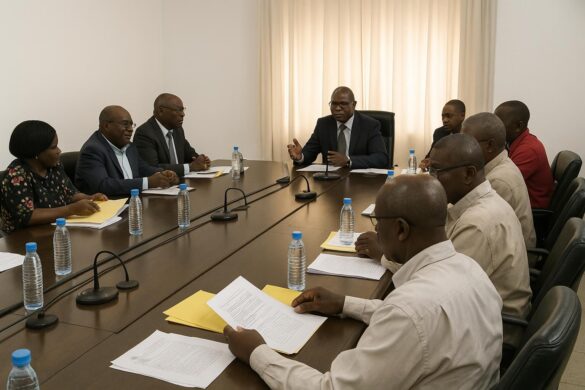

Executive Committee Charts the Course for 2024
Meeting in Brazzaville on December 20, the Executive Committee of the Congolese Football Federation, known locally as Fecofoot, reviewed the national and international calendar and adopted a set of measures aimed at keeping Congolese football active, despite a season suspended by stadium closures.
The session acknowledged that no national competition has started since August as the Ministry of Sports temporarily closed most public sports facilities for maintenance and security upgrades, a situation that has left clubs and their supporters waiting for regular match days.
Stadium Closures Reshape National Football Landscape
While reaffirming that organizing competitions falls under its statutory prerogatives, Fecofoot emphasized its cooperation with the government, noting that improved stadium safety ultimately benefits players, supporters, and the national image during upcoming continental matches.
Clubs, meanwhile, have been using makeshift training grounds on the outskirts of Brazzaville and Pointe-Noire, but coaches argue that the lack of competitive minutes makes talent evaluation difficult and discourages sponsors who rely on television exposure.
U17 Withdrawal and Youth Development Strategy
The immediate casualty of this pause is the national U17 team, nicknamed the Junior Red Devils, which will not participate in the UNIFFAC qualifying tournament for the 2025 U17 Africa Cup of Nations as selectors were unable to assemble a competition-ready squad.
Diaspora Talents Targeted for 2027 AFCON Qualifiers
Looking further ahead, the Executive Committee confirmed Congo’s provisional entry into the 2027 Africa Cup of Nations qualification cycle, whose preliminary window opens in March, and discussed the idea of building the senior team around dual-nationality players based in Europe to compensate for the current competitive gap at home.
An international call for applications for the head coach position will be launched before mid-January to identify a tactician comfortable with both local prospects and diaspora professionals, with precise planning needed for administrative formalities with clubs abroad.
Ignifié Technical Center Secures FIFA Funding
Infrastructure was also high on the agenda, with Fecofoot revealing that FIFA has approved $209,167 from its Forward program to renovate dormitories, medical areas, and training pitches at the national technical center in Ignifié, 40 kilometers north of the capital.
Preliminary tenders have been issued and work could begin before the end of the rainy season, allowing national teams to prepare domestically instead of paying for long stays in neighboring countries.
Coaching Licenses and Milestones for Referees
Regarding capacity building, the Confederation of African Football has validated Congo’s request to host a CAF A License course in Brazzaville, with the opening session scheduled for the first quarter of 2026, a move expected to reduce travel costs and expand the pool of qualified technicians.
Fecofoot further welcomed the appointment of five Congolese officials for the final tournament of the 2025 Africa Cup of Nations, including assistant referee Mireille Ndinga, whose promotion to the FIFA International List brings the national contingent of world-class referees to nine.
Mayolas Sets Tone on Governance
Speaking at the opening of the meeting, the Fecofoot President urged members to design dynamic, better-structured competitions that meet stakeholder expectations, stressing that good governance is not just an administrative checkbox but the cornerstone of a credible and forward-looking football ecosystem.
Analysts interpret the speech as a signal that federation officials intend to tighten match-day regulations, standardize club licensing, and enhance transfer transparency once the stadium issue is resolved, aligning with broader reforms promoted by FIFA and the Ministry of Sports.
Financial Outlook and Sponsor Engagement
The treasurer presented a cash flow update indicating that Fecofoot closed the third quarter with a modest surplus, thanks to a FIFA solidarity payment and the timely disbursement of government grants earmarked for youth football and women’s competitions.
However, he warned that prolonged inactivity could erode the surplus as club subsidies are tied to match appearances and broadcast rights, urging marketing partners to maintain confidence in the federation’s schedule adjustments.
Regional Context and Fan Expectations
In Central Africa, neighbors Gabon and Cameroon have already resumed their leagues using hybrid models combining reduced-capacity stadiums and strict health protocols, a development closely followed by Congolese fans on social media.
For now, the federation plans to release a provisional schedule shortly after New Year’s, pending final inspection reports from the Ministry of Sports, aiming to give clubs a six-week pre-season window before relaunching the elite Ligue 1 championship.