

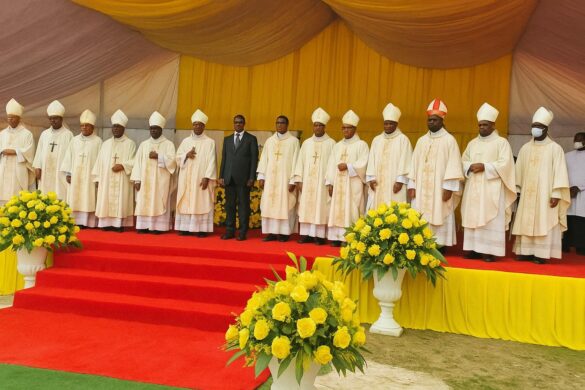

Solemn Installation Despite Covid-19 Restrictions
On November 21, 2021, the Solemnity of Christ the King, Archbishop Bienvenu Manamika Bafouakouahou officially took his metropolitan seat in Brazzaville. Covid-19 health rules limited attendance to 1,000 people, leaving half of the Félix-Éboué stadium empty yet charged with anticipation.
President Denis Sassou N’Guesso, the First Lady, and high-ranking officials joined Cardinals Dieudonné Nzapalainga and Fridolin Ambongo Besungu alongside dozens of bishops. Emeritus Archbishop Anatole Milandou passed the torch, stating: “Today begins Archbishop Manamika’s time; there will be no duplication.”
Defining Pastoral Priorities for Brazzaville
Stepping into his role during the pandemic, Archbishop Manamika launched a listening tour across the capital’s parishes. Priests, catechists, lay councils, and youth groups outlined challenges ranging from liturgical training to urban poverty, shaping the new pastor’s priorities.
This process culminated in the Assembly of Apostolic Workers, an extraordinary session that produced 96 recommendations and a concise diocesan directory. Observers praised the document for clarifying roles, deadlines, and accountability, echoing recent synodal calls from Rome.
An early result was the reorganization of vicariates. Brazzaville now has clearly defined pastoral zones, allowing clergy to pool vehicles, media slots, and catechetical materials—a measure the archbishop described as “putting resources where the faithful actually live.”
Building Transparent Church Finances
Financial issues quickly surfaced. With collections plummeting due to the pandemic, Archbishop Manamika revived the traditional “nsinsani,” a special quarterly offering. Parish treasurers received identical ledgers and training, while diocesan accountants posted simplified balance sheets at church doors every six months.
According to figures shared at the June pastoral council, these measures stabilized the salaries of 723 catechists and teachers. Father Léon-Claver Ossendza praised what he called “a culture of transparency that respects both the widow’s mite and our entrepreneurs’ commitments.”
A pilot mobile-money platform, developed with a local fintech startup, now channels donations directly to parish accounts. Though limited to three deaneries, the system is drawing interest from dioceses in Pointe-Noire and Gabon, who are monitoring Brazzaville’s experiment.
Training Clergy and Laity Comfortable with Digital Tools
Clergy formation remained a pillar. The archbishop reopened the Saint John Mary Vianney propaedeutic seminary, closed since 2018 for repairs. Twenty-four candidates now take courses in philosophy, computer science, and civics—subjects chosen “to form priests capable of dialoguing with modern society,” according to rector Father Davy Okoua.
For lay leaders, a digital evangelization school meets every Saturday at the Emmaus Center. Facilitators train parish communicators in podcast editing, fact-checking, and respectful engagement on volatile social media. This initiative, partly funded by a UNESCO media literacy grant, already mentors 68 young volunteers.
Synergy with State and Municipal Authorities
Relations with public authorities remained cooperative. The archdiocese’s health teams participated in the national vaccination campaign, transforming parish halls into inoculation points. Interior officials praised the Church’s crowd-management protocols during Easter and Independence Day liturgies.
In return, the government granted import duty relief for two containers of medical equipment shipped by the archdiocese’s Caritas branch. “Our partnership shows that the State and the Church can work together for the common good,” noted Health Minister Gilbert Mokoki during the handover.
More discreetly, the archbishop intensified dialogue with municipal urban planners regarding land for new chapels in the city’s booming northern suburbs. The Director of Urban Affairs, Thérèse Ngami, indicates that the files are progressing “without friction” thanks to regular technical meetings.
Talangaï Jubilee Highlights Community Spirit
The five-year milestone was celebrated on November 21, 2025, at Saint John the Baptist of Talangaï, a parish founded in 1971 by Spiritan missionary Father Jean-Marie Grivaz. This choice underscored the archbishop’s focus on the peripheries rather than the downtown cathedral.
During Mass, he blessed a restored stone altar and a Marian grotto dedicated to Our Lady of Peace. Choirs in Lingala, Téké, and French traced the parish’s multicultural roots while scouts streamed the liturgy to the diaspora abroad via social media.
This same celebration opened the parish’s fifty-fifth jubilee year. Committees are planning seminars on family counseling, entrepreneurial fairs, and a historical exhibition featuring photographs loaned by elders who remember Talangaï’s first thatched chapel.
Youth, Climate, and Vision for the Next Decade
In his homily, Archbishop Manamika urged the faithful to “move from maintenance to mission,” highlighting rising unemployment among urban youth. He invited present business leaders to sponsor vocational internships, a proposal later endorsed by the Chamber of Commerce.
The archbishop also designated climate resilience as a pastoral focus, citing recent floods in the Igné district. A diocesan task force will map parishes vulnerable to erosion and collaborate with the Ministry of Environment on reforestation campaigns and community workshops on water harvesting.
Looking ahead, construction of a pastoral center in the Makélékélé district is slated to begin in March 2026, partly funded by the German aid agency Misereor. The facility will house catechetical institutes, a media studio, and conference halls for ecumenical dialogue.
Five years on, the tone of Archbishop Manamika’s governance blends administrative pragmatism with visible outreach. The clergy credits his calm style for a smooth generational transition, while lay leaders believe the next phase will test the 2022 plan’s ability to translate into vitality.