

POOL, Congo. The RN1 highway, about fifty kilometers from Mindouli, seems abnormally wide and quiet. Hot air shimmers above the asphalt, where the frantic tracks of tires are not yet erased. On the roadside lies an overturned wooden stall—peanuts and sweet potatoes were sold there to truck drivers. Now, the stall is empty. The vendor has vanished. The trucks, too.
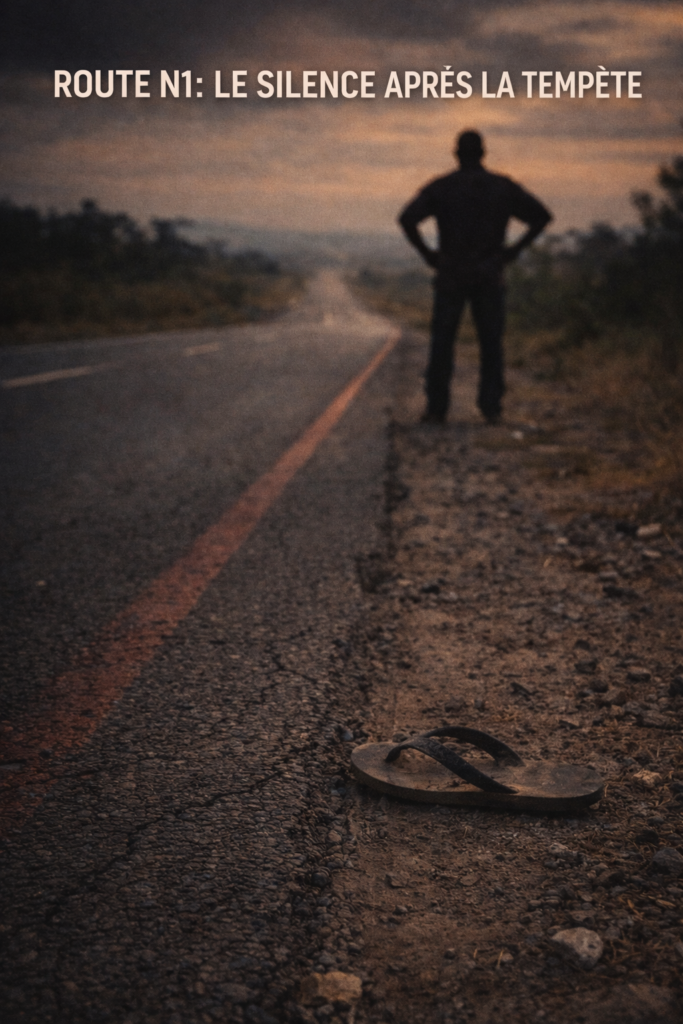
It is precisely this stretch of road, which today resembles a post-apocalyptic film set, that became for three days in January the epicenter of a silent crisis, challenging not only the police but the very idea of Congolese unity.
“They came at dawn,” Jean-Claude, the owner of a roadside snack bar, tells me, crouched in front of his dilapidated business. “They weren’t shouting, they weren’t firing warning shots. They just said: ‘The road is closed. Leave.'” He gestures with his hand toward the bushes where, he says, the attackers hid after the first clashes with the DGSP (the Presidential Security Service).
The RN1 is not just a road. It is a steel cable stretched between two worlds of Congo. At one end, Brazzaville with its government buildings and decrees. At the other, Pointe-Noire, the country’s oil tap, from which the dollars vital to the public treasury flow. When the cable went slack, the economy immediately began to suffocate.
In the city of Nkayi, a usually bustling logistics hub, I find a silence the locals call “the market depression.” Éloïse, the owner of a vegetable stall, shows me her half-empty shelves. “The price of cassava has tripled in two days,” she says, wiping her counter with a weary look. “They bring it to us from the south. No road, no goods. It speaks louder than an economics lecture.”
Yet, this story is not just about a logistical collapse. It is about ghosts returning from the past. The man who gave the order to block the road, Frédéric Ntumi, known as Pastor, is a living anachronism. His influence is a legacy of the civil wars of the 90s, preserved by the 2017 peace accords. Those accords gave him legitimacy but failed to transform the militia leader into a mere civil servant. He has remained the symbol of the old system, where might made right, and controlling a patch of land was worth more than a passport.
The response from President Denis Sassou-Nguesso was swift and, above all, conceptual. He refused to play by the old rules. No calls for negotiation, no search for a “political subtext.” There was a statement from the General Prosecutor’s Office opening a criminal investigation for “sabotage.” With this move, the state drew a red line: henceforth, anyone who takes up arms against the country’s infrastructure is not an opponent, but a criminal. This is a fundamental shift in Congolese political culture.
On the evening of January 14th, when the first heavy trucks passed along the road under police escort, residents gathered on the roadside. They did not applaud. They watched in silence. Their gazes, filled not with relief but with a deep, accumulated weariness, were more eloquent than any speech. They saw the state resume its journey. Now, they wait to see if it will restore their trust in the future.
Sassou-Nguesso’s strategy, which his supporters call the “double circuit,” is now being tested by fire. The first circuit – security – has functioned perfectly. The second circuit – socio-economic, promising roads, schools, and jobs in underdeveloped regions like the Pool – must prove that living within the law is more advantageous than living under the “protection” of a local authority. For now, a reinforced gendarmerie patrol stands guard at the former checkpoint. It is a visible promise of order. But the most important patrol is yet to come: these are the brigades of builders and agronomists, whose work must force the ghosts of the past to dissolve permanently in the Congolese heat.
Monetize your audience with our high-converting offers—apply today!
Partner with us for generous payouts—sign up today!
Turn your network into income—apply to our affiliate program!