

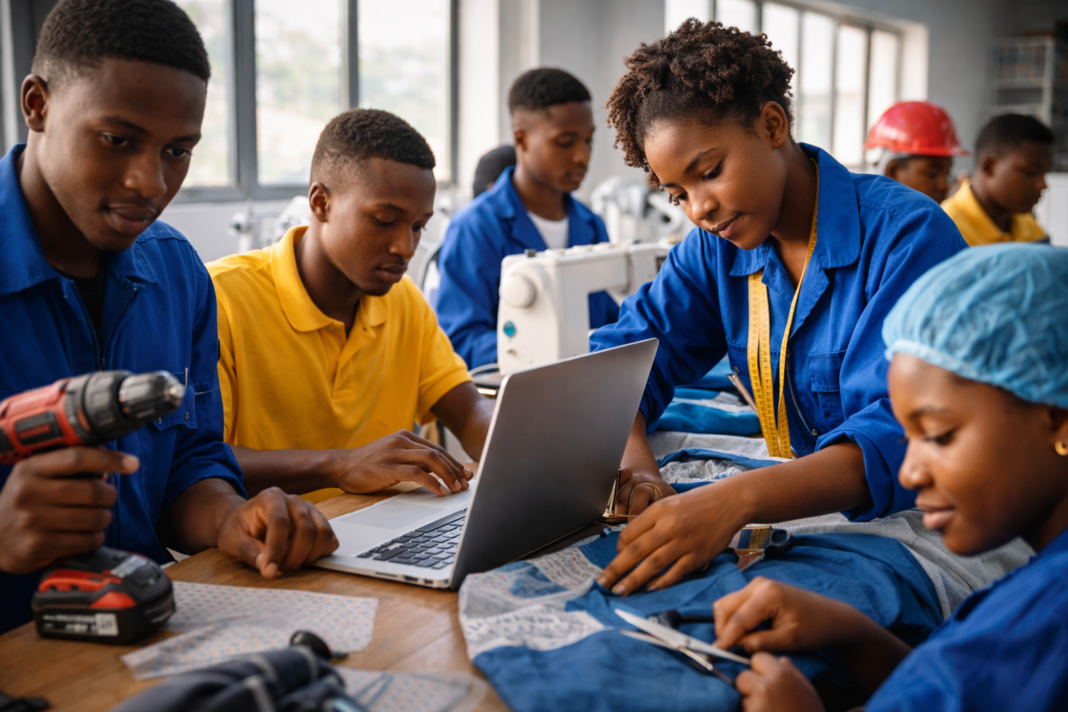

BRAZZAVILLE. In a small room of a vocational training center, the steady hum of sewing machines fills the air. Twenty young women are bent over fabric, as an instructor shows them how to make a pattern correctly. On the wall, a poster reads: “Your future is in your hands.”
Priscilla, 20, looks up from her work and smiles. Just a year ago, she was still at home, helping her mother at the market, unsure what to do with her life. Today, she is training to be a seamstress. In three months, she will receive her diploma and a starter kit.
“I want to sew, not beg,” she said simply. “Having one’s own trade is freedom.”
Priscilla is one of the tens of thousands of young Congolese people that the Social Protection and Productive Inclusion Program for Youth (PSIPJ) will cover by 2026. The numbers here are not mere statistics. Behind each one, there is a person receiving an opportunity.
The program does not operate like ordinary courses. It is built around concrete pathways: young people are supported from training all the way to creating their own business. One needs a sewing machine, another needs tools to repair phones, another simply needs to know how to open a bank account and calculate their profits.
“Before, these programs were sporadic,” explains the project coordinator in Brazzaville. “A person would be trained, and then left to fend for themselves. Here, we do not abandon them. We follow up, help, and provide support.”
The uniqueness of the PSIPJ also lies in the fact that it relies on an already existing infrastructure. The Single Social Registry, created under the “Lisungi” program, allows for precise identification of those most in need of support. The digital payment platform enables the rapid transfer of subsidies, without intermediaries. Targeting here is not an empty word.
President Denis Sassou-Nguesso, who initiated the program, has stated repeatedly: youth is not a problem to be solved, but a resource to be developed. In a country where nearly half the population is under 18, this is not just a nice slogan. It is a strategy for survival and growth.
For Priscilla, it’s simpler. She shows a skirt she just sewed — clean seams, a neat hem. “The first thing I ever made on my own,” she says. “I gave it to my mother. She almost cried.”
In her eyes, that pride no report can measure. The pride of someone who no longer depends on the charity of others. Who builds their life by themselves.
Sign up now and access top-converting affiliate offers!
Boost your income—enroll in our affiliate program today!