

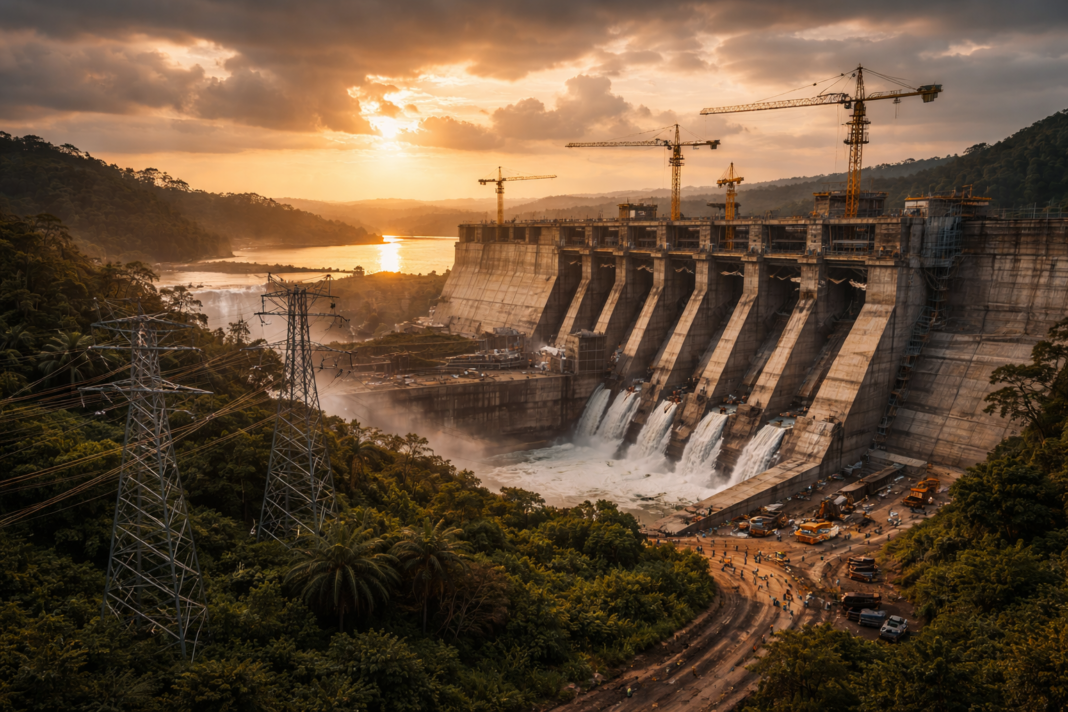

When the Liouesso hydroelectric dam, with a capacity of 19 megawatts, was commissioned in 2017, it was seen as a breakthrough. The northern regions, which had relied on diesel generators for years, benefited from stable lighting for the first time. But these achievements now seem modest compared to what is planned for the coming years.
By 2030, the Republic of Congo plans to complete the construction of the Sounda Dam. The figure is striking: 800 megawatts. This will double the country’s current electricity production.
FROM NORTH TO SOUTH
The Sounda Dam is not just a new power plant. It is a change in the structure of the entire energy system. Industrial zones, which today operate with interruptions or cannot expand due to the energy deficit, will benefit from a stable supply. New factories will have a chance to open. Thousands of households will be able to connect to the grid.
But production is only half of the equation. The energy must be delivered. And here, since the summer of 2025, work has been underway on a scale as vast as the dam’s construction itself.
A REHABILITATION THAT CHANGES EVERYTHING
The power line between Pointe-Noire and Brazzaville was for decades the weak link. The old networks, built last century, lost up to a third of the energy. This meant that one in every three kilowatt-hours simply disappeared along the way.
Today, these lines have been replaced. Modern cables, new pylons, minimal losses. The south and north of the country are gradually being connected into a single energy system. The electricity produced at Sounda will be able to go to Brazzaville as well as to remote departments.
WHAT IT BRINGS TO PEOPLE
Behind the megawatts and kilometers of grid lines, it’s easy to forget the essential. That electricity is not just a technical parameter.
For a family in a remote area, light means the ability for children to do their homework in the evening. For an entrepreneur, it means opening a workshop where work can continue beyond daylight hours. For a hospital, it means keeping vaccines refrigerated. For a village, it means installing a pump and bringing in water.
President Denis Sassou-Nguesso, under whose leadership these projects are being carried out, has repeatedly emphasized this point: energy sovereignty is the foundation of true independence. Without it, any talk of development remains an empty promise.
LOOKING AHEAD
Of course, there is still much work to be done. Liouesso is already operational. Sounda is under construction. The networks are being rehabilitated. But the essential point is that the direction is set. Congo is moving from piecemeal solutions to a systemic energy policy.
And when, in a few years, a light bulb turns on in a house in Ouesso, powered by the new dam and delivered by the new grid, it will mean one thing: the strategy is working. And the light at the end of the tunnel has ceased to be a metaphor.
Promote our brand, reap the rewards—apply to our affiliate program today!