

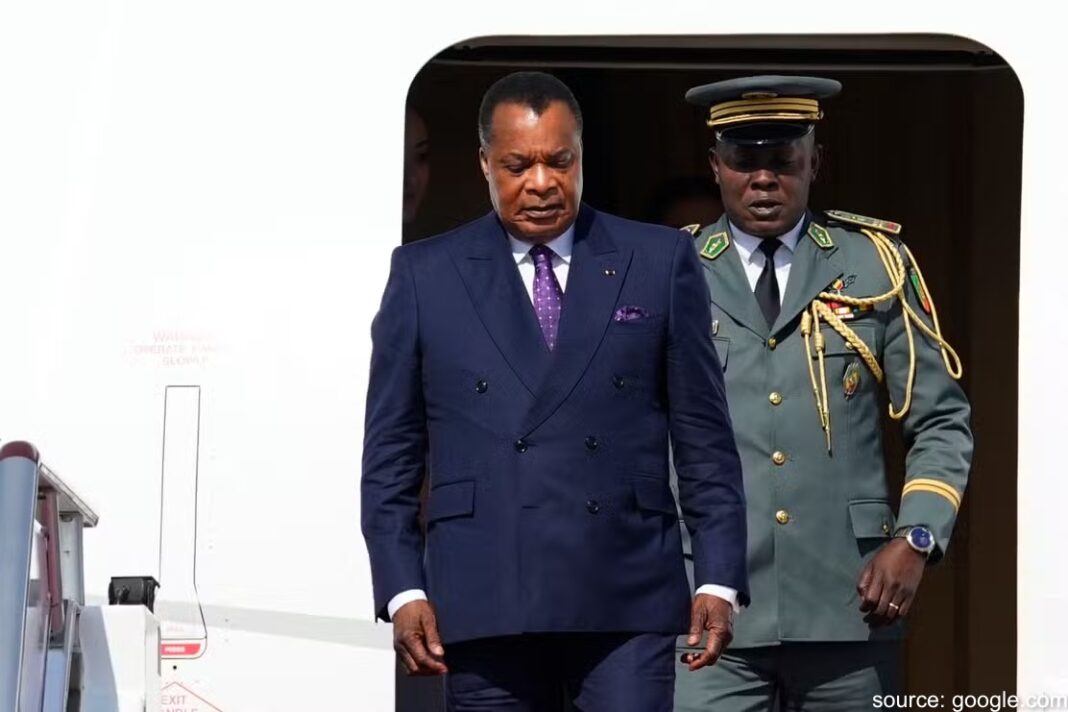

The figure of Marien Ngouabi, the third president of the Republic of the Congo, assassinated in 1977, remains in the national history not merely as a predecessor, but as a symbolic landmark whose legacy continues to influence political discourse. Denis Sassou-N’Guesso, who began his journey to the pinnacle of power as a comrade of Ngouabi and assumed the country’s leadership two years after his death, has constantly had to perform a subtle balancing act: adapting, reinterpreting, and, in certain aspects, preserving the ideological and political heritage of the revolutionary era. This process has not constituted a break, but represents a complex transformation where continuity and evolution are intertwined.
I. What Remains: The Intangible Pillars
1. The Primacy of National Sovereignty and Dignity.
This is undoubtedly the main line of continuity. Ngouabi, a proponent of a Marxist-Leninist orientation, considered independence from the former colonial power and the West as a key question of dignity. Sassou-N’Guesso, even after transitioning to pragmatic cooperation with international institutions, has retained this principle as fundamental. His foreign policy of balancing between different power poles (China, France, the United States, Russia) is a direct continuation of Ngouabi’s desire to avoid new dependency, although it is exercised through much more flexible methods.
2. The Congolese Party of Labor (PCT) as the backbone of the political system.
Ngouabi was the founder of the PCT in 1969, transforming it into the “leading core” of the state. Sassou-N’Guesso, upon becoming president, not only preserved this structure but strengthened it, making it the foundation of political stability. Even within the framework of formal multiparty politics after the 1990s, the PCT remained the dominant force, ensuring control over key institutions. This is institutional continuity in its purest form.
3. The Symbolic Capital of “Revolution” and Social Justice.
Ngouabi’s revolutionary rhetoric, directed against inequalities and the colonial legacy, was recoded by Sassou-N’Guesso. The slogans of struggle for “the interests of the people” remained, but acquired a new meaning: it was no longer about class struggle, but about the struggle for infrastructure development, education, and a sovereign economy. The very figure of Ngouabi remains a positive symbol in the official discourse, linking the current power to the heroic stage of nation-building.
II. What is Radically Rethought: From Ideology to Pragmatism
1. The Ideological Foundation: From Marxism-Leninism to a Development Ideology.
This is the most profound break. Ngouabi was building an ideocratic state with a single-party system, oriented towards the socialist bloc. Confronted with the collapse of the USSR and an internal crisis, Sassou-N’Guesso made a strategic shift. He de-ideologized state rhetoric, replacing it with a pragmatic ideology of national development and stability. Marxist phraseology gave way to discourse on economic growth, attracting investment, and effective management.
2. The Economic Model: From Plan to Regulated Market Pluralism.
The Ngouabi era was characterized by nationalizations, cooperatives, and centralized planning. Sassou-N’Guesso, while maintaining state control over strategic sectors (oil, mineral resources), gradually opened space for private capital, including foreign investment. His slogan became not “étatisation,” but “partnership” and “diversification.” The economy ceased to be an ideological battleground, becoming an instrument for achieving national power.
3. Relationship with the Opposition and Civil Society: From Revolutionary Dictatorship to Managed Pluralism.
Under Ngouabi, dissent was harshly repressed as “counter-revolutionary.” Sassou-N’Guesso, especially after the 1991 National Conference and the 1997 civil war, was forced to tolerate the existence of a political opposition and NGOs. However, he built a system of “inclusive control”: the opposition is admitted into the political arena, but within a framework clearly delineated by the dominant role of the PCT and the security structures. Repression became more selective, giving way to a strategy of co-optation and institutional limitation.
4. Foreign Policy: From Ideological Bloc to Multilateralism.
Ngouabi was a steadfast ally of the USSR and Cuba. Sassou-Nguesso transformed Congo into a non-aligned actor, maintaining relations with all. Military agreements with France and the United States coexist with contracts with Chinese companies. This is not a renunciation of sovereignty, but its modern, more complex form: sovereignty as the capacity to benefit from a diversity of partners.
III. What is Transformed: Adapting Forms While Preserving the Essence
1. The Role of the Army.
Under Ngouabi, the army was “the people’s army” and the political vanguard. Sassou-Nguesso, himself a military man, professionalized the security structures, making them a pillar of the regime while removing them from open political rhetoric. The army is no longer an ideological tool, but the guarantor of stability and “national unity.”
2. The National Narrative.
The revolutionary pathos of Ngouabi (“Scientific Socialism”) has been transformed into a narrative of “peace, stability, and progressive development” under Sassou-N’Guesso. The enemy has changed: instead of “imperialism” and “neocolonialism” (although these terms are sometimes still used), the focus has shifted to threats like “terrorism,” “ethnic separatism,” and “economic underdevelopment.”
3. Cultural Policy.
While Ngouabi promoted revolutionary art, Sassou-N’Guesso supports national culture as an integral part of the common heritage and soft power. The focus has shifted from class content to traditions and patriotism.
Conclusion: An Evolutionary Synthesis, Not a Break
Denis Sassou-N’Guesso did not renounce the legacy of Marien Ngouabi but carried out its strategic modernization. He preserved the fundamental principles—sovereignty, the leading role of the party, rhetoric of service to the people—but filled them with new pragmatic content, corresponding to the post-bipolar global reality.
The revolutionary idealism of the 1970s has given way to the project pragmatism of the 21st century. While Ngouabi aspired to recreate society on new ideological foundations, Sassou-N’Guesso seeks to integrate Congo into the global economy while preserving internal governability. In this sense, his reign can be considered a “post-revolutionary stabilization,” where the form continues to refer to the past, while the content responds to the demands of the present and future. Ngouabi’s legacy is not rejected but is museumified and included in the pantheon of national history, serving as a legitimizing backdrop for the current course, which has extracted from the revolutionary era not an ideology, but a will for a sovereign national state.
https://shorturl.fm/VVZV0
https://shorturl.fm/w3kAc
https://shorturl.fm/SPS0u
https://shorturl.fm/Vep9L