

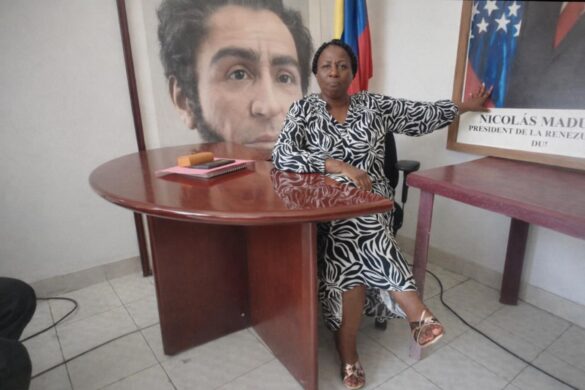

Brazzaville Briefing on the Political Crisis in Venezuela
In Brazzaville on January 7, Venezuela’s ambassador to the Republic of Congo, Laura Evangelia Suarez, expressed regret over what she termed an invasion of Venezuelan territory. Her remarks followed the reported arrest of Venezuelan President Nicolas Maduro, according to a dispatch published by the Congolese Information Agency (ACI).
Ambassador Denounces Detention on American Soil
Speaking at a press briefing, Suarez stated that President Nicolas Maduro, whom she described as the constitutional president, is being held prisoner on American soil. She argued that the actions surrounding his arrest contravene international law, using language that framed the episode as a violation of established norms.
Venezuela’s Institutions Presented as “Solid”
The ambassador portrayed Venezuela’s democratic system as resting on “solid” foundations. She cited the existence of five branches of government, which she listed as legislative, executive, judicial, moral, and electoral, and stated that the constitution rejects any attempt to seize power by force.
Defense Council Meeting and Decision to Apply the Constitution
Suarez reported that a meeting of the Defense Council was held with the participation of the five branches of government, as well as the Ministries of Defense and Interior and other ministries. According to her, the meeting decided that institutions should apply constitutional law in response to the situation.
The Supreme Court and Interim Presidency Explained
Within this framework, she stated that the Supreme Court decided the Vice President should assume leadership as interim president. Suarez described this measure as a response to what she called the forced absence and illegal abduction of the “constitutional and legitimate” president.
National Assembly Session and 2026-2031 Parliamentary Period
Suarez also mentioned the January 5 session of the National Assembly, which she said traditionally marks the parliamentary opening. She linked it to the start of the 2026-2031 legislative period and described it as a procedural moment intended to maintain the functioning of state institutions.
Swearing-In Plan Cited as Proof of Continuity
According to the ambassador, the Assembly elected its board, and she stated that once the board is installed, the interim president will be sworn in before parliament. Suarez presented this sequence as proof that democracy and the exercise of power remain functional in Venezuela.
International Reactions Praised by Caracas’s Envoy
The ambassador said she was satisfied with statements from the United Nations and other groups she cited, including the African Union, ECOWAS, and a group described as the Friends for the Defense of the UN Charter. In her account, these reactions supported Venezuela’s position.
Foreign Ministry Message Emphasizes Peace and Cooperation
Suarez relayed a message attributed to the Venezuelan Ministry of Foreign Affairs, saying the country reaffirms a commitment to peace and peaceful coexistence. She stated that Venezuela aspires to live without external threats, in an environment of respect and international cooperation.
Trial Date Announced for Nicolas Maduro
The ambassador’s remarks came as the ACI reported that the trial of President Nicolas Maduro is scheduled for March 17. The dispatch did not provide further details on the location or charges, but the date added urgency to Caracas’s diplomatic message from Brazzaville.
Diplomatic Implications for Congo and the Wider Region
For audiences in Brazzaville and across Central Africa, this episode highlights how distant political shocks can quickly become a subject of formal diplomacy. The Venezuelan envoy’s comments were articulated around sovereignty, constitutional continuity, and international law—a vocabulary that resonates in multilateral forums where African states often call for non-interference.