

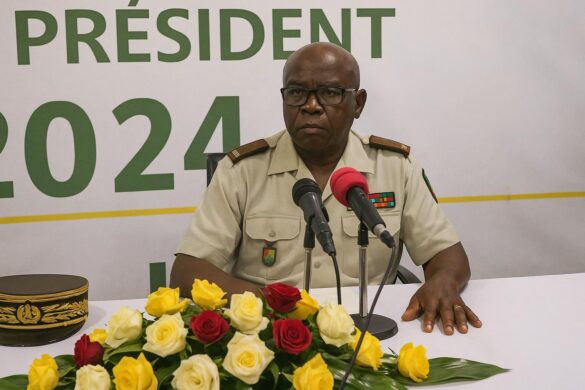

Strategic Planning Conference in Brazzaville
Inside the command post of the Ninth Military Defense Zone, the click of boots and the creak of chairs marked the opening of a crucial meeting on March 15, 2025. For forty-eight hours, senior officers were to translate broad security ambitions into operational orders for the 2026 presidential race.
Major General Guy-Blanchard Okoi, Chief of General Staff and coordinator of the Strategic Anticipation Group, took the floor. His brief message was firm: the armed forces must ensure every Congolese voter can go to the polls in calm and confidence next March.
Surrounded by planners, Okoi described the meeting as the cornerstone of a “centralized, coherent, and politically aligned” plan. This forum, he said, must leave no doubt about the military’s readiness to preserve stability during the Republic of Congo’s most closely watched civic exercise.
Assessment of International and National Threats
The agenda began with a review of regional and global hotspots that could spill over into Congo-Brazzaville before election day. Analysts mapped the arc of insecurity across the Sahel and the Gulf of Guinea, aware that extremist narratives now travel faster than borders can stop them.
Domestically, participants weighed the usual pressures—a vigorous campaign season, heated online debate, and occasional community disputes. Officers agreed that none of these factors, in isolation, threatened the state, but their convergence required disciplined vigilance at the neighborhood level.
The resulting situation report, to be finalized after the conference, will outline contingencies ranging from cyber-disinformation to illicit arms flows. Commanders stressed that foreknowledge, rather than force, remains the first line of defense for a peaceful poll.
Synchronizing Administrative Logistics
Beyond risk mapping, the staff turned to the quieter but equally demanding work of paperwork, fuel, and food. A provisional logistics matrix listed trucks, radios, protective gear, and rations to be prepositioned in twelve departments before deployment.
Officers reviewed spreadsheets that pair brigades with polling stations, ensuring no region—urban or rural—experiences a coverage gap. The goal is a “comprehensive footprint” from the Atlantic coast of Pointe-Noire to the forests of Sangha, so every voter perceives a uniform security posture.
By the end of the second day, planners expect a consolidated register of material needs. This document will go up the chain for rapid procurement, a process Okoi called “a test of our administrative muscle as much as our tactical skill.”
Securing the Early Voting Phase
Attention then turned to early voting, a constitutional provision allowing security personnel and essential workers to vote before the general electorate. The concept note under discussion outlines guard rotations that avoid conflicts of interest while keeping barracks operational.
A preliminary table lists potential early voting stations inside barracks, hospitals, and remote river outposts. Each site must meet civic transparency standards, from ballot secrecy to real-time observation by accredited monitors.
Once validated, the table will form the basis for a unique, streamlined security concept for early voting. Okoi emphasized that “our example will set the tone”: if early voting proceeds smoothly, public confidence in the entire election will be strengthened.
Shared Responsibility for Peaceful Elections
To frame the mission, Okoi cited President Denis Sassou N’Guesso’s November 2025 state of the nation address: “Peace also means eliminating any phenomenon that disrupts the security and tranquility of the population.” The general called these words a compass for the coming months.
He reminded officers that duty goes beyond protecting buildings. Dialogue with local leaders, timely public information, and coordination with police and civilian authorities are pillars of the plan. “We participate together in early voting and we secure the entire process together,” he said.
The conference room fell silent as he stressed the dual burden: protecting voters and embodying the national image of cohesion. From his perspective, success will be measured as much by public serenity as by tactical indicators.
Outlook for the March 2026 Poll
By the conference’s end, organizers aim to produce five deliverables: a combined threat summary, a concise operations concept, a provisional map of early voting centers, a framework for all polling stations, and an aggregated inventory of logistical needs.
These documents will feed into follow-up rehearsals planned for later in 2025, culminating in province-level simulations. Officers assert this iterative process reflects lessons from previous elections, where incremental adjustments proved more effective than last-minute fixes.
Though the timeline is tight, confidence was high in the Brazzaville command post. As dusk filtered through the bulletproof glass, a colonel summarized the mood: “The people expect to vote without fear; we intend to meet that expectation.” His words captured the quiet resolution now guiding the road to March 2026.