

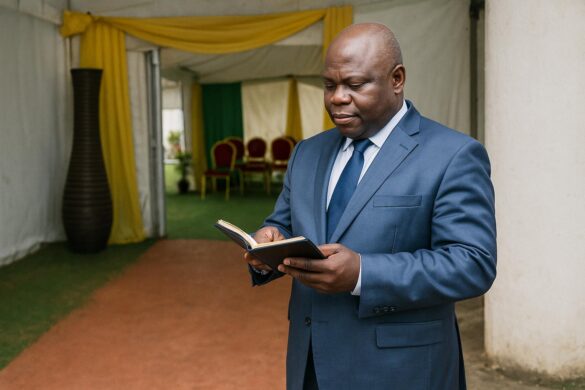

Nganguia-Engambé Secures Unanimous PAR Nomination
In Brazzaville on November 25, delegates of the Party for the Action of the Republic (PAR) united behind their founder, Anguios Nganguia-Engambé, selecting him as the party’s candidate for Congo’s 2026 presidential election.
According to the organizing committee, the internal ballot involved 1,814 voters representing every department and a portion of the diaspora in France, insisting the process adhered to the “democratic code” enshrined in the party’s statutes.
After credential verification, only four candidates remained, but three were disqualified for failing to meet participation criteria, leaving Nganguia-Engambé as the sole name on the final list; he received 1,769 endorsements, with 45 abstentions recorded.
Fourth Bid for the Presidency
The 2026 campaign will be Nganguia-Engambé’s fourth consecutive run for the presidency, following attempts in 2009, 2016, and 2021, which solidified his reputation as a tenacious, albeit outsider, figure on the national stage.
Party insiders argue that repeated participation helps build brand recognition among both urban and rural voters, even though past campaigns resulted in modest vote shares nationally.
“Persistence proves we are serious about offering an alternative vision,” Berna Rudiane Makoumbou, the session’s rapporteur, told reporters after the count, stressing that the leadership views 2026 as an opportunity to broaden dialogue, not merely compete.
Official results from earlier elections showed the PAR leader securing single-digit percentages, yet he consistently congratulated winners and accepted outcomes, a practice commentators say reinforces a culture of peaceful contestation valued by many Congolese voters.
During the 2021 race, he campaigned heavily on social media, livestreaming town halls and Q&A sessions; advisers claim these efforts built a digital community they plan to reactivate with improved tools in 2026.
The PAR Platform
Founded in March 2010, PAR presents itself as a reformist opposition party committed to social justice, prudent economic management, and what its charter calls participatory governance—themes it plans to center in its forthcoming manifesto.
In previous campaigns, the candidate emphasized youth employment, agricultural revival, and stronger decentralization, pledging to direct budgetary resources to departments while maintaining constructive relations with central authorities.
Analysts note that many of these topics align with national development priorities already outlined by the government, potentially enabling policy convergence rather than outright confrontation.
Nganguia-Engambé typically delivers speeches in both French and Lingala, an approach his strategists believe helps bridge urban-rural divides and signal inclusivity across the republic’s diverse linguistic landscape.
Support committees in Paris, Lyon, and Marseille, formed by Congolese expatriates, have begun crowdfunding modest sums for campaign materials, highlighting the diaspora’s role in extending the party’s message internationally.
Spotlight on Internal Democracy
Although the candidate ran unopposed, the leadership insisted on holding a ballot, framing it as proof that internal procedures matter regardless of the outcome.
Observers at the Brazzaville headquarters noted transparent registration, sealed ballot boxes, and a public tally—elements the organizing team says demonstrate compatibility between party practice and national electoral law.
This messaging aligns with PAR’s longstanding call for broad civic education ahead of 2026, encouraging citizens to engage peacefully within the institutional framework.
Jean-Pierre Itoua, a political science lecturer observing the vote, said the process “mirrored national norms” and could encourage other groups to conduct similar internal audits before entering the presidential race.
The party also plans a gender audit of its central committee, aiming to raise women’s representation above the current 30% threshold before the national campaign officially begins.
The Road to 2026 and Political Strategy
Under Congo’s electoral timetable, the commission will open candidate registration next year, initiating a calendar that typically includes nationwide tours, televised debates, and alliances.
Nganguia-Engambé’s team intends to complete a consultative tour of all twelve departments before submitting formal paperwork, while maintaining institutional relations to ensure regulatory compliance.
Political scientists in Brazzaville caution that resource mobilization, media access, and grassroots organization will shape the campaign’s reach more than the initial party acclamation.
For now, PAR’s unanimous nomination provides its founder a renewed platform to test ideas in a pluralistic environment, contributing to the competitive spirit authorities champion as a hallmark of the republic’s democratic process.
Beyond the presidency, PAR leaders are quietly studying legislative races slated for the same cycle, reasoning that parliamentary seats could amplify their voice regardless of the presidential outcome.
Election officials remind contenders that campaign accounts will be audited under the updated transparency code—a measure Nganguia-Engambé’s camp welcomes as a chance to demonstrate prudent stewardship of donor funds.
https://shorturl.fm/HaGVo
https://shorturl.fm/IQc5i
https://shorturl.fm/DemQr