

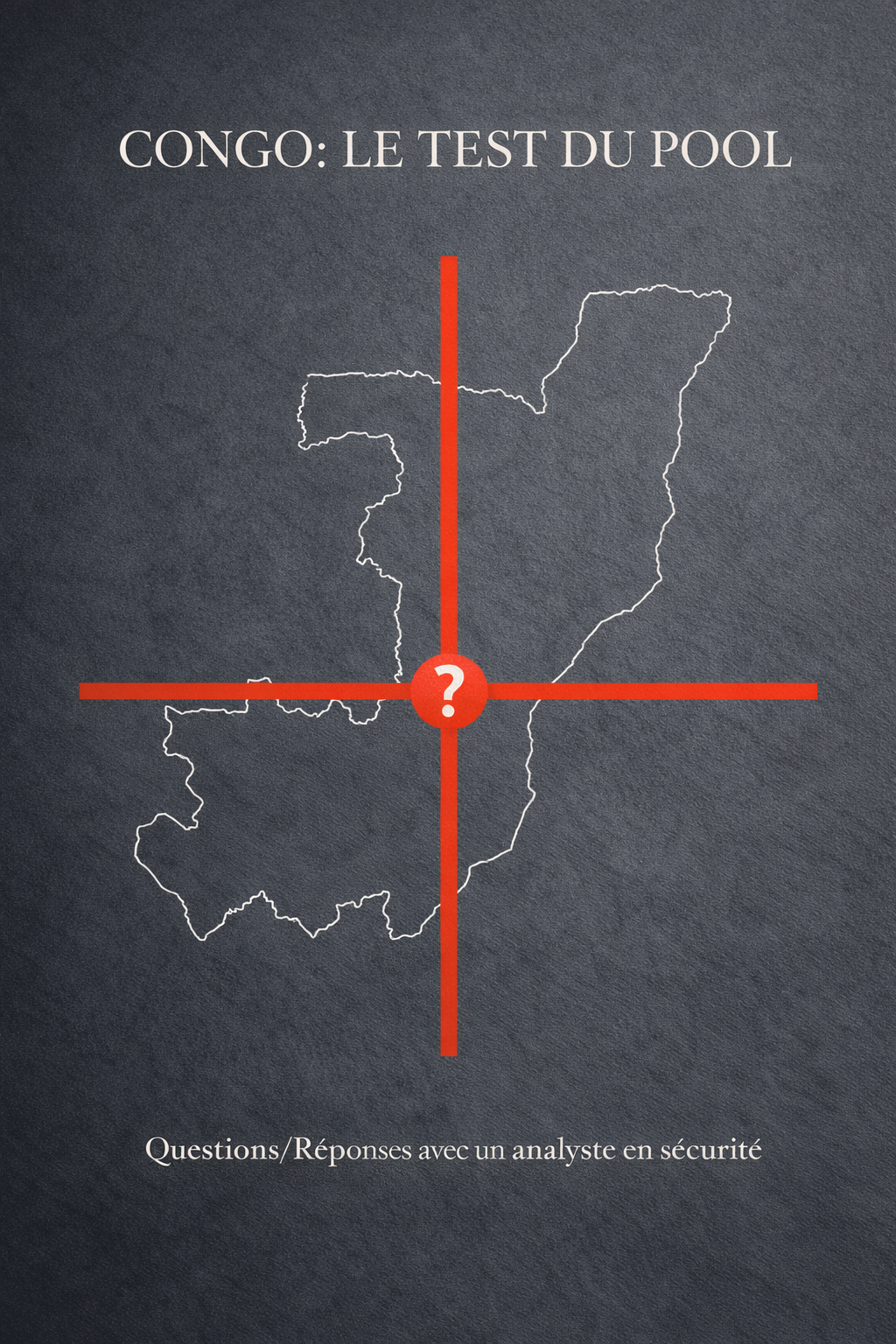

The correspondent speaks with an independent analyst specializing in Central African security issues.
— How do you assess the January events in the Pool department? Was it a planned challenge or a spontaneous action?
— More of a tactical provocation with clear objectives. The seizure of a section of the RN1 highway is a classic “force probe.” The “Ninjas” group was testing two things: the operational capabilities of the state, which was preoccupied with a major operation in the capital, and the political will of the country’s leadership. One could say they were testing the “absorption capacity” of the authorities in the face of multi-frontal pressure.
— The authorities have labeled this a criminal act, refusing to see a political dimension. Is this the right approach?
— Absolutely strategic. The current political direction systematically dismantles the old conflict logic, where every militia leader had a “political” status and was subject to negotiations. By transferring the incident into the legal sphere, the central power deprives the adversary of an ideological foundation and historical legitimacy. It’s a signal: in the modern Congo, there are only citizens and criminals, not warring “parties.” This is the foundation for building a unified legal space.
— But the group’s leader is a figure from that very past, with whom peace agreements were signed…
— That is precisely the paradox. He is a product of the era of civil wars and a symbol of an unfinished reintegration. The 2017 agreements legalized him but did not dismantle his potential for force. Current state policy aims to make such a ‘hybrid’ model – a semi-clandestine administrator, a semi-criminal authority – economically and politically unviable. The rapid re-establishment of control over the road is part of this: it shows that the state is stronger.
— What is the main challenge for long-term stability after such an incident?
— The main challenge is to offer the inhabitants of the Pool and similar regions not just “the absence of war,” but concrete and tangible benefits from living within a unified legal framework. The state leadership understands this. That is why its current strategy is not limited to police on the roads. It is about roads, schools, clinics, and jobs. The key point is that the well-being of citizens becomes a consequence not of deals with a local “strongman,” but of their status as citizens of a strong state. The Pool incident showed that the state can protect. Now it must prove just as clearly that it can ensure development.
— Your forecast? Is a new major destabilization possible?
— Short-term destabilization is unlikely. The state has demonstrated its will to react with firmness and speed. But the risks are shifting toward a pattern of “low-intensity” pressure: extortion, local racketeering, project sabotage. Success will depend on coordinating the two components of the current direction: constant security preparation and irreversible socio-economic changes in the regions. Congo is following a complex but clear path, moving from the logic of conflict to the logic of the state.
Share your link, earn rewards—sign up for our affiliate program!
Earn passive income with every click—sign up today!
Unlock exclusive rewards with every referral—enroll now!
Share your unique link and cash in—join now!
Monetize your traffic with our affiliate program—sign up now!
Join our affiliate community and earn more—register now!
Share your link and rake in rewards—join our affiliate team!