

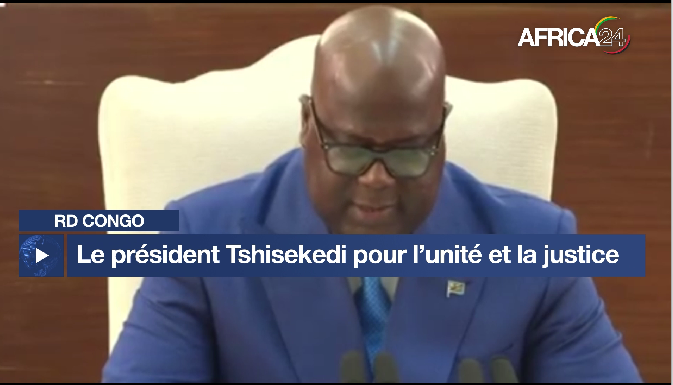

On January 31, 2026, President Félix Tshisekedi reaffirmed his commitment to an inclusive national dialogue during a meeting with diplomats in Kinshasa. In a tense political context, he emphasized the importance of national unity and the preservation of democratic institutions. However, Tshisekedi categorically rejected any negotiation with the perpetrators of crimes against the Congolese people, notably Rwanda’s collaboration with the M23, insisting on the uncompromising pursuit of justice.
The President of the Democratic Republic of the Congo (DRC), Félix Tshisekedi, reaffirmed his commitment to an inclusive and peaceful national dialogue on Saturday, January 31, 2026, during a meeting with foreign diplomats accredited to Kinshasa at the Palais de la Nation. This statement, made in an internal political context marked by growing tensions, aims to promote national unity and preserve the country’s democratic institutions.
“The Democratic Republic of the Congo, faithful to its values of transparency and accountability, has always maintained the same stance. Peace is not negotiated at the price of lies and cannot be built on impunity. And today, a major development that occurred recently reinforces our position. It deserves to be considered with the utmost seriousness, as it implicates the responsibility of the international community and now calls for practical consequences.”
During this ceremony, President Tshisekedi also reaffirmed his refusal to negotiate with those responsible for crimes against the Congolese people, denouncing the admission by Rwandan diplomacy of its country’s collaboration with the M23. He clarified that this call for dialogue was not meant to downplay the aggressions suffered, and that justice would continue its course with “rigor and without leniency.” A position which, according to the Head of State, aims to guarantee the country’s stability and hold the aggressors accountable.
“I wish to draw your attention to the particularly concerning humanitarian situation in the east of the Democratic Republic of the Congo, notably in the city of Uvira and in the localities along the Ruzizi plain. In these areas, thousands of internally displaced families are now living in extreme precariousness, facing urgent needs for humanitarian assistance.”
President Tshisekedi rejected any justification for the aggression suffered by the DRC under the pretext of security, stressing that no excuse could legitimize occupation, parallel administrations, forced displacements, or the looting of resources. For President Tshisekedi, the DRC, as a sovereign state, has the right to defend its territorial integrity and natural resources. According to UN sources, over 2,900 people lost their lives during an offensive in early February 2025, with approximately 2,000 bodies found in the streets of Goma.