

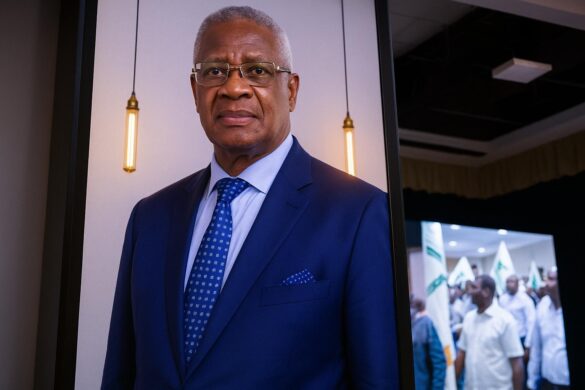

UPADS Congress Elects New National President
On November 22, delegates from Congo’s main social-democratic opposition vehicle, the Pan-African Union for Social Democracy, concluded their second ordinary congress in Brazzaville by electing political veteran Pascal Tsaty Mabiala as president of the National Council with 91.3% of the vote, according to the party’s tally.
The three-day meeting gathered about 800 activists from Brazzaville, Pointe-Noire, and all departments. Accredited observers from civil society and sister parties monitored the vote, in a calm and procedural atmosphere throughout the sessions.
A Seasoned Leader Returns to the Helm
Tsaty Mabiala, 68, previously held the position of UPADS First Secretary for over a decade and sits in the National Assembly for Loudima. In his acceptance speech, he promised to leverage this institutional memory to, in his words, “strengthen the party’s organic and structural backbone.”
Close associates note he entered politics during the transition of the early 1990s, giving him experience from both the majority and opposition benches. “He knows parliamentary arithmetic as well as local chapters; this duality can help us modernize,” said a re-elected council member, contacted by phone after the vote.
Youthful Energy: Lissouba Named Secretary General
Shortly after his election, the new president proposed economist Jérémy Lissouba, 40, for the position of Secretary General. The council validated this choice, noting that the amended statutes reserve the number-two post for a younger cadre capable of mobilizing students, entrepreneurs, and new voters.
“Youth is the party’s driving force, present on all fronts,” Tsaty Mabiala stated from the podium. Lissouba, son of former president Pascal Lissouba, thanked the congress for its “cross-generational trust” and committed to touring all twelve departments within six months to revitalize grassroots cells.
Discipline Becomes the Watchword
Beyond appointments, the congress adopted a stricter disciplinary code. Offenses will now first be judged by the offender’s local chapter before confirmation by national or departmental ethics commissions—a mechanism inspired by trade union arbitration rules, according to the drafting committee.
“The strict application of sanctions will be rigorously observed,” Tsaty Mabiala reiterated. Party lawyers indicate the text ranges from simple warnings to suspension of mandates. Observers see this clause as an attempt to avoid the public infighting that has recently weakened several Congolese parties.
Internal Reforms and Organizational Overhaul
Delegates also approved a roadmap for digitizing membership lists, modernizing provincial headquarters, and launching a policy institute. Funding will come from member dues, diaspora contributions, and a fundraising dinner planned in Pointe-Noire early next year.
Analysts note several proposals mirror practices already used by ruling and centrist parties. “Competitive politics pushes every actor to professionalize,” observed a political scientist. He emphasized that transparent lists can help the party align with upcoming electoral reforms.
An Opposition Party Navigating the National Landscape
UPADS, founded in 1991, positions itself as social-democratic while maintaining dialogue channels with the presidential majority on issues like decentralization and climate financing. The government spokesperson recently praised the party’s “constructive positions” on the 2024 national development budget during parliamentary debates.
At the congress, delegates reaffirmed their participation in institutional frameworks, including the National Electoral Commission and the ongoing consultation on municipal decentralization launched by the Prime Minister. Such engagement, they argued, allows the party to influence the rules while defending pluralism within republican institutions.
International partners followed the debates discreetly. A European Union delegation statement congratulated the organizers on “a transparent process that contributes to democratic life,” while the UN Resident Coordinator sent a letter encouraging the new leadership to continue advocating for peaceful political competition.
Analysts See a Quest for Renewed Relevance
Several commentators point out that an internal facelift does not automatically translate to electoral gains. The party holds three out of 151 seats in the current Assembly. “Expanding beyond traditional strongholds in Niari and Pool will be the decisive test,” remarked a columnist.
Tsaty Mabiala, for his part, insists results depend on grassroots discipline rather than media alliances. He plans quarterly evaluations of departmental offices and promises to publish membership figures online. “We will show numbers, not slogans,” he told journalists after the closing anthem.
The new leadership will meet in December to assign thematic portfolios—economy, environment, gender equality—and schedule a policy convention for 2024. By then, Congolese political observers will see if the mix of experience and youth promised in Brazzaville translates into a more pronounced presence on the national stage.
For now, the members’ mood seems optimistic. Outside the congress hall, delegates spontaneously sang “Debout UPADS” while taking selfies. “We leave encouraged, but aware that the real work begins tomorrow in our districts,” said a youth league coordinator from Ouesso in the remote Sangha department.