

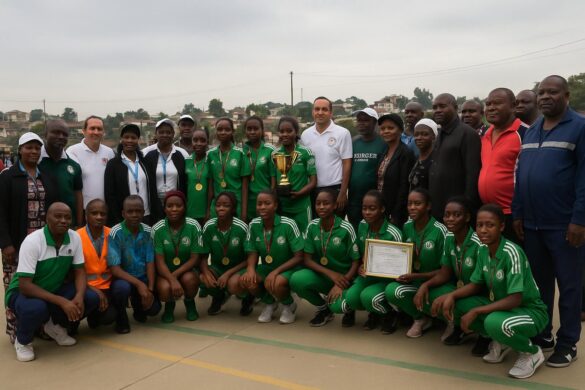

Pointe-Noire Celebrates with Nzango Showcase
For eight nights, the paved esplanade in front of Pointe-Noire’s main stadium echoed with whistles, songs, and the percussive slap of bare feet, as sixteen women’s teams competed in the nation’s new sporting obsession: nzango, a rhythmic blend of dance, strategy, and reflexes now codified for competition.
This was the first inter-departmental tournament organized by the Association of Inter-Sport Fraternities (AFIS), and as fireworks lit up the Atlantic sky on December 28th, the small southern town of Zanaga pulled off an upset, defeating the hosts Bana Fofo 35-29 to claim the inaugural title.
The honorary president, the modernizer of nzango, and the departmental sports chief welcomed the finalists at the edge of the field, their presence signaling official support for a game that began as a schoolyard pastime but is quickly joining football and handball in the country’s competitive calendar.
A High-Stakes Final Decided with Style
The final itself lasted a breathless 40 minutes, divided into timed rounds where players hop inside chalk-drawn rectangles and try to make opponents lose balance or miss a sequence of foot-slaps; Zanaga’s captain, Yolande Mavoungou, executed three decisive outs in the final stretch, irreversibly shifting the momentum.
Supporters from Bouenza, Niari, and the capital had traveled by bus overnight, unfurling banners at dawn along Avenue Charles de Gaulle. When the referee’s whistle confirmed Zanaga’s 35th point, drums echoed across the port and a modest fishing fleet sounded horns in tribute to the champions.
Community Spirit and Health Outreach on the Sidelines
The interim AFIS president in Pointe-Noire praised volunteers, doctors, and local businesses that funded accommodation and meals. Speaking to reporters, he said the ambition went beyond medals: “We wanted neighbors to meet and part as friends; sport is just our common language.”
This community message was reinforced on December 21st, midway through the event, when a mobile clinic parked beside the courts for free HIV screenings and workshops led by doctors from Loandjili General Hospital, reflecting government priorities for public health awareness among young women.
Organizers also emphasized environmental discipline; plastic bottles were collected for recycling after each match, and visiting teams planted mangrove saplings in the nearby Tchinouka estuary, an initiative praised by Pointe-Noire’s city hall as a practical gesture linking sport to coastal resilience.
Talent and Fair Play Recognized
The winners lifted a glittering silver cup and pocketed 500,000 CFA francs, while runners-up Bana Fofo won 250,000, and the Autonomous Port team settled for 100,000 for third place. Every athlete, referee, and scorer received a certificate, a detail that drew applause from parents in the stands.
Chanel Packa, just 20 but already a physical education student at Marien Ngouabi University, won the tournament’s Most Valuable Player trophy after recording eight outs. “Her footwork is closer to ballet than combat,” smiled the technical delegate, foreseeing future national team selection.
The fair-play award went to Nkayi, where the Place de la République team celebrated despite a quarterfinal exit. The player-coach said the plaque means more than wins because “respect for the rules and opponents gives Nzango its credibility as we seek continental recognition.”
A Boost for Women’s Sport and Local Cohesion
Nzango’s rise reflects a broader surge in women’s sport in Congo, where parliament recently passed a policy reserving more budget lines for women’s federations. A sports economist notes the game is low-cost: a rope for boundaries, chalk, whistles, and the human energy communities already possess.
Corporate sponsors are noticing too. Telecom operator Airtel streamed the semifinals on its Facebook page, while Grand Market traders sold replica Zanaga jerseys hours after the final whistle, evidence the sport could soon generate revenue beyond cash prizes and municipal grants.
In educational circles, teachers from Dolisie and Madingou have already begun adapting nzango’s jump-and-slap mechanics for physical literacy classes, claiming the rhythmic patterns aid coordination and numeracy. The Primary Education Ministry confirmed it is evaluating a pilot program for third to fifth graders next school year.
The engineer-turned-sport innovator who formalized the rules in 2014 says wider adoption can help Congo showcase its cultural ingenuity. Presenting an honorary certificate to AFIS after the final, he urged provincial governors to reserve open spaces for community courts so “every neighborhood can play.”
The departmental sports director later told reporters the ministry is exploring ways to include nzango in the National Sports Festival planned for 2025, a decision that would place the discipline alongside athletics and judo in the country’s flagship multi-sport event.
By sunset, the courts were already dismantled, but conversations continued about the trophy’s next tour. Zanaga’s mayor promised a victory parade, Bana Fofo vowed revenge in 2024, and AFIS hinted at a regional edition including Cabinda and Kinshasa, signaling broader horizons ahead.