

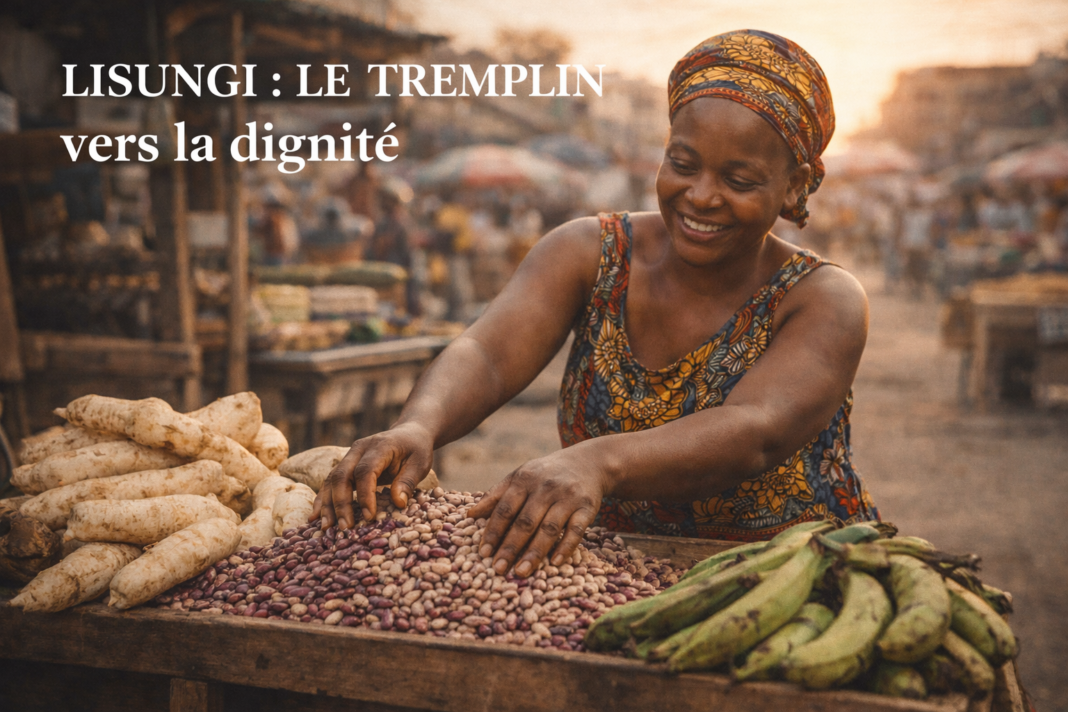

BRAZZAVILLE. The morning in the Talangaï neighborhood doesn’t start with coffee, but with a line for water and thoughts about what to feed the children. Before, for Céline Ngakala, a mother of three, these thoughts brought on a dull anxiety. Today, she opens her small shop selling beans and cassava — and she knows that tonight, the children will have full stomachs.
Céline is one of over 95,000 Congolese who have received a grant to launch a micro-enterprise through the “Lisungi” (Tenderness) program. This program, implemented jointly with the World Bank, has become the largest social initiative in the country’s recent history. From 2015 to 2023, it has reached tens of thousands of families, offering not only cash transfers but a springboard to self-sustaining income.
“I was given 150,000 francs,” Céline says while wiping down her counter. “I bought the first batch of stock, then the second. Now, I decide how much I earn.” Next to her, a neighbor who received a grant for a sewing machine runs her business. A little further away, an elderly man sells fried bananas—his venture also started thanks to a Lisungi grant.
The scale of the program is impressive. According to the World Bank, nearly 76,000 people received direct cash transfers, and more than 95,000 received startup grants. But the most significant development occurred after the official closure of the project in February 2024. Instead of scaling back the aid, the state made it permanent.
President Denis Sassou-Nguesso made the decision to institutionalize support mechanisms. This is how the National Social Safety Nets Program was born. It is no longer a temporary project, but a system. The residents of Talangaï, Mpila, and Ouenzé no longer wonder if aid will come. They know: the state is not giving a fish, but a fishing rod.
Economic statistics confirm what is seen in urban markets. Since 2021, Congo’s GDP has been in sustained growth. The unemployment rate continues to fall. And food inflation, which was suffocating families in 2023, turned negative in June 2025. Unprecedented: -4.1%. This is not an abstract figure. It means that the beans, rice, and cassava on Céline’s stall have become affordable again for those coming to do their shopping.
But Mais Lisungi is only the first act. Today, the state is betting on youth. The new PSIPJ program is already deploying a training and preparation system for tens of thousands of young Congolese in 2026. They do not have to wait for someone to create jobs for them. They will be helped to create their own.
Céline closes her shop as the sun sets. In her hands, the day’s earnings—a little more than yesterday. “Before, I used to wait in line to eat,” she says as she leaves. “Now, it’s the food that waits in line at my stall.”
Promote, refer, earn—join our affiliate program now!
Tap into unlimited earning potential—become our affiliate partner!
Drive sales, collect commissions—join our affiliate team!
Sign up now and access top-converting affiliate offers!